
The Stone Burner in Dune Messiah: The Weapon That Blinded Paul Atreides
The Stone Burner attack is more than an assassination attempt. It is a political trap, a theological crisis and a brutal demonstration of Frank Herbert's central warning: a ruler who can see the future may be less free than everyone around him.
Frank Herbert builds the Stone Burner sequence in Dune Messiah as the moment when Paul Atreides' imperial power, religious authority and prescient vision are forced into the same point of collapse. The blast destroys his physical sight, yet it initially appears to make him even more godlike. He walks through devastation without stumbling. He identifies people he can no longer see. He continues to rule as though the attack has failed.
That apparent victory conceals the real wound. Paul can function only because he has already seen the exact future he is now living. His prescience becomes a rigid track. Every confident step proves that he remains inside a vision whose limits he cannot safely test. The Stone Burner therefore attacks something deeper than the body. It exposes the difference between knowing the future and controlling it.
The Stone Burner is a weapon aimed at Paul's eyes, but Herbert uses it to reveal the blindness already built into absolute power. Paul can perceive almost everything except a morally clean escape from the system created by his own victory.
The Stone Burner at a Glance
I What Is a Stone Burner?
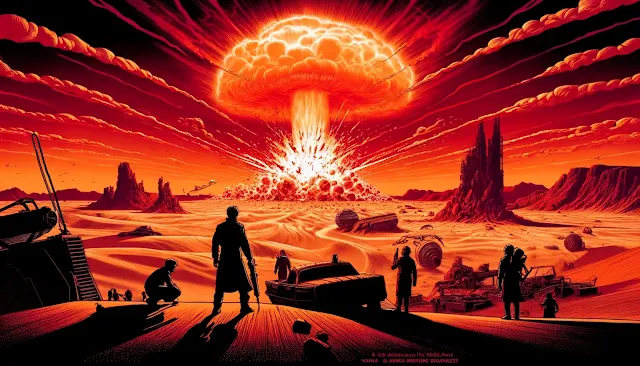
A Stone Burner belongs to the atomic technology feared and restricted throughout the Imperium. Its name describes its primary effect. The device directs energy downward, burning through rock and potentially continuing toward a planet's deep interior. It is therefore both a battlefield weapon and a planetary threat. Its scale depends on its construction, fuel and deployment.
The weapon's most infamous secondary effect is the release of J-rays. In Dune Messiah, those rays destroy the eyes of people caught within the blast zone. Herbert does not treat this as conventional heat blindness or temporary flash damage. The injury is catastrophic. The eyes themselves are ruined.
- Atomic foundation: The Stone Burner is powered by technology derived from the same forbidden arsenal that underpins the Great Houses' nuclear deterrence.
- Directed penetration: Its energy burns into stone and earth rather than behaving only like an explosive wave spreading across the surface.
- J-ray exposure: The attack produces radiation capable of destroying sight in those exposed nearby.
- Planetary danger: A sufficiently powerful unit could threaten far more than a building or district, which makes any deployment politically terrifying.
The Stone Burner fits Herbert's wider approach to technology. The important question is rarely whether a device is scientifically elegant. The important question is what kind of political behaviour it enables. Shields change warfare. Atomics preserve a balance of terror. Spice makes interstellar empire possible. The Stone Burner creates a legal and moral grey zone in which a faction can use atomic force while arguing over whether it has technically violated the oldest laws of the Imperium.
The weapon is often described simply as a nuclear bomb. That description misses its narrative function. A conventional atomic strike would make the crime obvious. The Stone Burner matters because it weaponises ambiguity, allowing the attackers to exploit the difference between the wording of the law and the purpose of the law.
II The Great Convention and the Politics of Atomic Loopholes
The Great Convention prohibits the use of atomics against human beings. This prohibition is one of the foundations of imperial order. The Great Houses retain atomic stockpiles as a deterrent, but using them against people risks collective retaliation on an annihilating scale.
The Stone Burner turns that supposedly clear rule into an argument. Defenders of its use can claim that the device is intended to burn through geological material rather than function as a direct atomic strike on human targets. The human casualties and blinding effects can then be framed as consequences of deployment rather than the weapon's declared purpose.
Herbert's point is coldly political. Powerful systems rarely collapse because nobody knows the rules. They collapse because ambitious actors learn how to use the language of the rules against their original intent. The conspirators do not need to prove the weapon morally acceptable. They need enough uncertainty to delay a unified response, scatter blame and create a crisis before Paul's regime can establish a single authoritative account.
This is one reason the Stone Burner belongs so naturally inside Dune Messiah. The novel repeatedly inverts the triumphal structure of Dune. Paul wins the throne, then discovers that victory has multiplied the number of forces capable of acting in his name, against his name or through institutions he can no longer fully control. The attack is an act of rebellion, but it is also a product of the imperial order he created.
III Who Is Behind the Attack?
The conspiracy against Paul is broader than the group that physically deploys the Stone Burner. The Guild, the Bene Gesserit, the Tleilaxu and Princess Irulan each want something different from the same crisis. Their alliance works because Paul's empire threatens all of them, but they do not share a single desired ending.
The Spacing Guild
The Guild fears Paul's control of Arrakis and therefore his power over spice. Spice enables the prescience required for navigation. Whoever controls the spice can place interstellar civilisation under permanent economic and logistical pressure. Guild interests favour a future in which Paul is constrained, removed or made dependent.
The Bene Gesserit
The Bene Gesserit regard Paul as the uncontrolled result of a breeding programme that produced its objective a generation too early and outside its command. They want access to his genetic legacy. A dead Paul could end that possibility. A politically weakened Paul might still be manipulated into producing an heir on terms acceptable to the Sisterhood.
The Bene Tleilax
The Tleilaxu operate through Scytale and through Hayt, the ghola made from Duncan Idaho's corpse. Their plan is the most psychologically ambitious. They are testing whether a ghola can recover the memories of the original person and whether Paul can be driven into a bargain through grief. The Stone Burner is one pressure point inside that larger strategy. For a fuller account of their methods, motives and manipulation, see the role of the Bene Tleilax in Dune Messiah.
The Qizarate and Fremen rebels
The attack also depends on disillusionment within Paul's own religious and military order. Former Fedaykin and figures associated with the Qizarate have reasons to resent what the jihad became. Men who helped create Muad'Dib's empire now see bureaucrats, priests and courtiers profiting from sacrifices made in the desert. Korba's involvement matters because it proves that Paul's enemies no longer stand only outside the regime. The revolution has begun to consume its founding generation.
The Stone Burner attack is therefore best understood as a convergence. External powers exploit internal resentment. Religious authority is turned against the messiah who created it. Imperial law is manipulated by people who understand that Paul's greatest weakness is the machinery built to magnify his greatness.
IV Why Blind Paul Instead of Killing Him?
Killing Paul outright would create a martyr whose legend could become even more dangerous than his living rule. Muad'Dib is already the centre of a religion carried across the Imperium by victorious armies. His death at the hands of hidden enemies could sanctify the jihad, intensify retaliation and make compromise impossible.
Blinding him offers a more calculated outcome. Fremen custom treats blindness as a condition that removes a person from the active life of the tribe. In the old desert logic, a blind person cannot survive the open erg and cannot demand that scarce resources be spent indefinitely on care. The blind are given to the desert.
Paul is no ordinary Fremen, but his legitimacy depends partly on being accepted as one of them. If he rejects their law when it applies to him, he exposes the distance between Muad'Dib the sacred figure and Paul the emperor who expects exemption. If he obeys it, he removes himself from power.
The attack is therefore a constitutional weapon disguised as a physical one. It aims to create a body that can no longer legally occupy the role attached to it. The conspirators want Fremen tradition to finish what the Stone Burner begins.
The weapon does not merely damage Paul's eyes. It forces a collision between imperial necessity, religious myth and the desert law from which his legitimacy was born.
V The Blast and the Birth of the Blind Prophet
When the Stone Burner detonates, the attack appears to have achieved its central objective. Paul is physically blinded. The people around him expect disorientation, dependence and political collapse.
Instead, Paul continues to move through the world with impossible precision. He can describe faces, avoid obstacles and command those around him because he has already seen this sequence through prescience. The future exists in his mind as a complete visual path. His damaged eyes no longer provide information, but his memory of the predicted moment substitutes for sight.
This is one of Herbert's sharpest reversals. The conspiracy attempts to prove that Paul is mortal. For a time, it produces the opposite result. A sighted emperor can be regarded as an unusually gifted man. A blind emperor who still sees appears divine.
The Fremen response deepens the crisis. Their culture reveres signs, endurance and prophetic fulfilment. Paul's ability to function after the destruction of his eyes confirms the most dangerous interpretation of Muad'Dib: that ordinary human limits do not apply to him. The attack damages his body while strengthening the religion that imprisons his identity.
The physical sequence is explored in more direct detail in how Paul Atreides goes blind in Dune Messiah, but its thematic power comes from the contradiction. Paul survives the attempt to reduce him to a man by becoming, in the eyes of his followers, even less human.

Prescience Is the Real Prison
Paul's post-blast sight works only while events remain aligned with the future he has already observed. He is not freely scanning every possibility in the moment. He is following a known route through time.
That distinction is the centre of the Stone Burner sequence. Prescience gives Paul information, but complete information hardens into obligation. The more accurately he sees a future, the more dangerous deviation becomes. A new choice could lead into a region he has not mapped. One unexpected human decision could plunge him into actual darkness.
The power that once allowed Paul to defeat the Emperor now forces him to behave like an actor trapped inside a script. His confidence is real, but it is the confidence of a man repeating a scene already witnessed. The emperor who appears to command time has become dependent on time remaining unchanged.
VI The Stone Burner as an Attack on the Muad'Dib Myth
Paul's enemies understand that his regime cannot be separated from his image. He is emperor because he controls Arrakis and the Fremen armies, but he is obeyed across worlds because Muad'Dib has become a sacred story. That story presents Paul as the prophetic liberator who sees the true path through chaos.
The Stone Burner tries to reverse every part of that myth.
- The prophet loses his eyes: The organ most closely associated with vision is destroyed.
- The liberator becomes trapped: Paul's survival depends on following a future he cannot safely leave.
- The Fremen emperor confronts Fremen law: The customs that authorised his rise now threaten to remove him.
- The master of violence is wounded by his own order: The conspiracy draws strength from veterans and institutions created by the jihad.
- The god is exposed as a man: Paul bleeds, grieves, fears and finally accepts a mortal ending.
Yet Herbert refuses to let the symbolism settle into a simple lesson. Paul's continued sight temporarily repairs the myth and makes it stronger. This is how charismatic systems survive failed exposure. Evidence of vulnerability can be reinterpreted as evidence of transcendence. The more the conspirators try to prove Paul human, the more his followers discover reasons to worship him.
This tension sits behind the wider question of whether Paul Atreides should be read as the villain of Dune Messiah. Paul is both the target of a ruthless conspiracy and the ruler of an empire responsible for catastrophe on a scale his enemies could never match. Herbert does not ask the reader to choose between victim and tyrant. Paul is both.
VII The Jihad Returns Home
By the time of Dune Messiah, Paul's jihad has killed sixty-one billion people, sterilised planets and shattered established cultures. That violence often feels distant from the imperial court because it has been delegated to armies, priests, governors and believers acting under the authority of Muad'Dib.
The Stone Burner brings the logic of the jihad back into Paul's immediate world. Arrakeen becomes a blast zone. Civilians suffer. Loyalists and conspirators become difficult to distinguish. The ruler who unleashed sacred violence across the Imperium is forced to experience political violence at intimate range.
This is not cosmic justice in any simple sense. The people blinded or killed around Paul are not symbolic pieces placed there to balance an equation. Their suffering demonstrates the indiscriminate character of the order he helped create. Once violence becomes a legitimate political language, every faction eventually learns to speak it.
Paul's problem is examined more broadly in the major themes of Dune Messiah, where empire, religion, fate and political theatre converge. The Stone Burner scene compresses all four themes into a single event. The weapon is imperial technology, religious spectacle, prophetic trap and theatre of legitimacy at the same time.
VIII Chani, the Twins and the End of Paul's Vision
The Stone Burner does not end Paul's reign by itself. Paul remains functional because the future he has seen continues to supply the world his eyes can no longer provide. The decisive break comes with Chani's death and the birth of the twins, Leto II and Ghanima.
Chani has been consuming a contraceptive without knowing it because Princess Irulan fears losing her place in the imperial succession. Once Chani changes her diet and becomes pregnant, the pregnancy develops under extreme strain. Paul knows that childbirth will kill her. His prescience offers alternatives, but they lead toward outcomes he considers even worse. He chooses the path in which Chani dies quickly rather than one in which she is captured, degraded or used against him.
This choice reveals the moral horror of Paul's gift. He does not lack knowledge. He lacks a future untouched by atrocity. Prescience allows him to compare forms of suffering, then compels him to select among them. The power resembles control only from a distance.
The twins are also absent from the future Paul fully understood. Their awakened consciousness introduces a new presence into the prophetic field. At the climax, Paul briefly perceives through the infant Leto II's awareness and uses that borrowed vision to kill Scytale when the Face Dancer threatens the children. It is an extraordinary moment, but it also marks the failure of Paul's independent prophetic sight.
- The Stone Burner destroys Paul's physical vision.
- Prescient memory allows him to continue functioning.
- Chani's death shatters the emotional future he has been protecting.
- The twins introduce new consciousness and new uncertainty.
- Paul's known path ends, leaving him genuinely blind.
Once the vision runs out, Paul's imperial performance can no longer continue. The supernatural certainty seen by his followers disappears. What remains is a grieving man who has lost his eyes, his beloved and the future that had been carrying him forward.
IX Why Paul Walks Into the Desert
Paul's final walk into the desert is often described as surrender, but it contains several meanings at once. He submits to Fremen law. He abandons the throne. He prevents the priesthood from displaying him as a blind sacred relic. He leaves his children and empire to a future he can no longer dominate.
Most importantly, he makes a decision that the Muad'Dib system cannot easily absorb. The Qizarate can preach his words, administer his empire and turn his victories into scripture. It cannot fully control a messiah who refuses the palace and disappears into the desert.
Paul's departure therefore weakens his political body while strengthening his myth. The emperor is gone, but Muad'Dib becomes even more available to legend. The desert can be interpreted as death, transcendence, judgement or promised return. Herbert again shows why charismatic power is difficult to dismantle. Removing the person does not remove the story.
The departure also anticipates the later conflict between Paul's refusal and Leto II's acceptance of the Golden Path. Paul sees enough of the future to recoil from the transformation and tyranny required to secure humanity's long-term survival. Leto accepts what Paul will not. That contrast is central to the Golden Path as an anti-messianic project. The son saves humanity by becoming the kind of ruler the father's remaining humanity cannot endure becoming.
X Physics, Philosophy and the Meaning of Blindness
The Stone Burner works so well as a Dune weapon because its physical and philosophical effects are inseparable. It burns through matter while the scene burns through Paul's claim to mastery. It destroys sight while revealing truths that ordinary sight had concealed.
Blindness as knowledge
Paul loses his eyes at the moment he understands most clearly how limited his freedom has become. His blindness is therefore paired with revelation. He sees the structure of his prison precisely because the physical world is no longer available except through a predetermined vision.
Blindness as political disqualification
The injury places Paul outside the physical ideal expected of a Fremen leader. His body can no longer perform the survival competence on which desert authority depends. Imperial office and tribal custom now demand incompatible responses.
Blindness as religious confirmation
Because Paul continues to see, the injury initially becomes proof of divinity. This is the most dangerous form of ideological resilience. A failed miracle can weaken faith. A wound that appears to produce a greater miracle strengthens it.
Blindness as moral recognition
Paul has spent years seeing possible futures while remaining unable to prevent the jihad carried out in his name. His physical blindness externalises a moral condition already present. He could foresee consequences, but he could not find a clean path through them. Vision without ethical freedom becomes another form of blindness.
This pattern belongs to Herbert's wider method of thematic inversion. The liberator becomes emperor. The prophet becomes captive to prophecy. The victory becomes catastrophe. The supposedly ruined man makes one of his last meaningful choices only after losing the power that made choice almost impossible. Those reversals are examined further in Dune Messiah's architecture of inversion.
XI Did the Stone Burner Conspiracy Succeed?
Measured as an assassination attempt, the attack fails. Paul survives. He remains capable of command. The immediate shock increases his aura of supernatural power.
Measured as an attempt to destabilise his reign, it succeeds. The blast exposes rebellion inside the Qizarate, forces the issue of Fremen law, narrows Paul's dependence on prescience and accelerates the sequence that ends with his disappearance.
Measured against the goals of every conspirator, the outcome is mixed.
- The Guild: Paul's direct grip on imperial power ends, but the Atreides line survives and control of Arrakis remains unresolved.
- The Bene Gesserit: Paul's genes continue through the twins, yet the Sisterhood does not control them.
- The Tleilaxu: Hayt recovers Duncan Idaho's memories, proving that ghola identity can return, but Scytale is killed and the attempt to control Paul fails.
- The Qizarate rebels: They wound the regime, but they cannot prevent Paul's myth from outliving his throne.
- Paul himself: He loses almost everything, yet escapes the daily machinery of god-emperorship.
The conspiracy therefore succeeds in breaking the political arrangement without securing the future any faction wanted. That outcome is pure Herbert. History does not obey the intentions of the people who trigger it. Each actor believes they are manipulating Paul, but all of them are also being moved by forces larger than their plans: religion, grief, institutional survival, inherited custom and the momentum of empire.
XII The Stone Burner and the Tragedy of Paul Atreides
Paul's tragedy is sometimes reduced to the idea that he sees the future and cannot change it. Herbert's argument is more severe. Paul can change many futures. He can select among paths. What he cannot find is a path free from the consequences of becoming Muad'Dib.
The Stone Burner makes that tragedy visible. Before the blast, prescience can still look like strategic superiority. After the blast, the mechanism is exposed. Paul walks confidently because he dares not step outside the image in his mind. His apparent freedom depends on obedience to a future already fixed.
This is why the scene belongs at the centre of any serious reading of Paul's character. It prevents the reader from treating him as either a flawless hero or a simple monster. Paul has enabled mass death, manipulated faith and accepted imperial power. He is also trapped by consequences that exceed his original intentions. Herbert's critique gains force because Paul remains recognisably human inside the catastrophe.
The Stone Burner does not absolve him. It reveals him.
A Weapon That Reveals the Limits of Seeing
The Stone Burner is one of the most important weapons in the Dune saga because it does more than injure Paul Atreides. It exposes the architecture of his rule. His empire depends on sacred myth, Fremen custom, control of spice and the belief that prescience gives him command over history. The blast forces each foundation into conflict with the others.
Paul's continued sight turns the attack into a miracle. His dependence on a fixed vision turns that miracle into imprisonment. Chani's death and the birth of the twins end the path he has been following. Once the future stops supplying his reality, Paul accepts the blindness that had been waiting beneath his power all along.
The conspirators wanted to prove that Muad'Dib was mortal. They succeeded, but only after helping create one final legend: the blind emperor who walked alone into the desert, abandoning a throne he could command but no longer morally inhabit.


_poster.jpg)


