
Historical Reconstruction Unit
Internal Memorandum // Restricted Access
Subject: Combat Analysis of the Mustafar Engagement
The Inevitable Fall: Why Anakin Skywalker Was Doomed to Lose on Mustafar
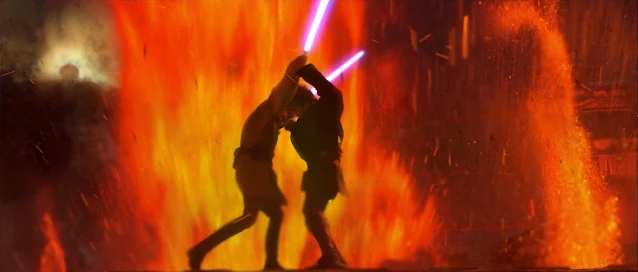
The duel on Mustafar is famously defined by a single tactical elevation. But if Obi-Wan Kenobi had never secured the high ground, would the sheer, relentless force of the newly christened Darth Vader have eventually battered through his master's flawless defenses?
The cinematic portrayal of the legendary battle between Obi-Wan Kenobi and Anakin Skywalker presents a beautifully choreographed tragedy. However, visual spectacle alone cannot account for the deep biomechanical and psychological realities of their clash. To answer whether Anakin would have eventually won a prolonged fight devoid of the famous "high ground" conclusion, we must look beyond the screen.
We must examine the absolute limits of their physical stamina, their contrasting states of mind, and the intimate, fatalistic dynamic of their master and apprentice relationship.
I. The Physical Reality of Attrition
To understand the mechanics of the duel, we must analyze their distinct combat styles. Obi-Wan Kenobi was the galaxy's undisputed master of Form III, Soresu. This lightsaber form relies on tight, efficient movements designed to create a flawless defensive sphere, theoretically allowing the practitioner to outlast any opponent by expending minimal energy.
Anakin Skywalker, conversely, was a prodigy of Form V, Djem So. This style is characterized by brutal, kinetic strikes and aggressive dominance, utilizing physical strength to shatter a defender's guard.
Matthew Stover's brilliant novelization of Revenge of the Sith provides a crucial perspective on the physical toll of this clash. In the text, it is made explicitly clear that Obi-Wan was genuinely being worn down to the absolute end of his physical limits. He was continually retreating not just as a tactic, but out of necessity.
Anakin was not tiring. In fact, fueled by his newfound connection to the dark side, Anakin was getting faster and hitting harder as the fight progressed.
"Obi-Wan was losing. He knew it... Anakin was a whirlwind, a force of nature, and Obi-Wan was a leaf caught in its path."
If we look purely at the mathematics of physical attrition, the argument heavily favors Anakin. Form III is designed to survive, but against the sheer, overwhelming kinetic energy of Anakin's Form V, Obi-Wan's defensive sphere was fracturing.
Without a situational advantage or an escape route, Anakin was technically winning the physical duel by methodically battering his former master into submission.
II. The Dark Side Spiral vs. Clarity of Purpose
However, a lightsaber duel is never merely physical. The Force flows through the combatants, and their states of mind directly dictate the flow of combat. Anakin was deeply unbalanced. His focus was clouded by his recent betrayals, his profound guilt, and the toxic influence of the dark side. As he fully surrendered to the absolutes and paradoxes of the Sith, his instability became a double-edged sword. Embracing his hatred sent him into a dark side spiral.
Had the fight gone on long enough for his sorrow to fully crystallize into pure, unadulterated rage, his raw power would have become entirely overwhelming.
Conversely, Obi-Wan possessed something far more dangerous than rage: absolute clarity of purpose. Obi-Wan was not trying to match Anakin's murderous intent. He was not blinded by a desire to dominate or destroy.
He was deeply sorrowful but entirely lucid. This allowed him to remain highly analytical throughout the engagement.
Obi-Wan was not fighting to win a sparring match; he was actively looking for a definitive opportunity to end the battle.
III. The Hubris of the Chosen One
The decisive factor in this duel lies within the psychological dynamics of their relationship. Obi-Wan Kenobi intimately knew every facet of Anakin Skywalker.
He knew Anakin's training, he knew his favored strike angles, and most importantly, he knew his fatal flaw: immense, blinding impatience.
The "high ground" maneuver was not a stroke of luck or a geographic fluke. It was the inevitable result of Anakin's character flaws weaponized by Obi-Wan's strategic genius. Obi-Wan's true strategy throughout the entire retreat across the mining facility was simply to survive long enough for Anakin's patience to wear entirely thin.
Even if the specific high ground scenario never presented itself on the lava river, Anakin was mathematically guaranteed to make a similarly disastrous and arrogant mistake eventually.
Anakin believed he was a god in that moment. When Obi-Wan warned him not to try it, it was a tactical masterstroke. By telling Anakin he could not do something, Obi-Wan guaranteed that Anakin's ego would compel him to try. Anakin's hubris was a terminal disease, and Obi-Wan simply waited for the symptoms to manifest.
Would Anakin Skywalker eventually win in a prolonged fight on Mustafar if Obi-Wan never claimed the high ground?
The definitive answer is no.
Anakin was doomed to lose.
While it is completely true that Anakin possessed the overwhelming physical stamina and the dark side power to eventually crush Obi-Wan's defenses in a vacuum, a duel is not fought in a vacuum. The dark side granted Anakin limitless energy, but it entirely eroded his tactical sanity. Obi-Wan's defensive mastery meant he could delay the inevitable physical defeat long enough for Anakin's psychological instability to take over.
Obi-Wan Kenobi did not win because he stood on a slightly higher patch of black sand. He won because he was a master of tactical patience fighting an opponent who was actively destroying himself. High ground or flat ground, Anakin's sheer power was ultimately useless against a master who knew exactly how to make him defeat himself.
Anakin Skywalker was always doomed to fall on Mustafar.

_poster.jpg)


