
In the vast expanse of the cosmos, where stars dim, worlds drift, and extinction can arrive as a scientific problem before it becomes a human tragedy, Andy Weir’s Project Hail Mary delivers one of the most satisfying modern science fiction novels of the last decade. It is a story built from astrophysics, biology, chemistry, engineering, and survival math, but it never reads like a cold demonstration. It reads like an adventure with a pulse. Weir takes a premise that could have become sterile or overcomplicated and turns it into something funny, tense, moving, and deeply readable.
Project Hail Mary introduces readers to Ryland Grace, a scientist who wakes aboard a spacecraft with no memory of who he is or why he is there. That setup gives the novel its first layer of suspense, but the real strength of the book is what Andy Weir builds inside that mystery. Grace is not simply trying to remember his mission. He is trying to reconstruct his identity under conditions of isolation, fear, and unbearable pressure. Earth is in danger, another civilization is in danger, and the only way forward is through science, persistence, and an uncomfortable amount of courage.
While the novel unfolds against the cold vastness of interstellar space, Project Hail Mary pulses with warmth. It is a hard science fiction novel, yes, but it is also a book about companionship, moral duty, and the strange tenderness that can emerge in the most hostile environments imaginable. That emotional core is one reason the story lingers so strongly after the last page. Weir is interested in scientific solutions, but he is just as interested in what science reveals about character. Faced with impossible odds, who do we become? What do we owe each other? And what happens when survival stops being an individual problem and becomes a shared one? The themes below trace how Weir builds those questions into the DNA of the book, one experiment, one memory, and one friendship at a time.
In this piece: Survival · Memory & the Cost of Time · Scientific Discovery · The Ethics of Emergency · Sacrifice & Moral Duty · Connection Across the Void · Hope & Ingenuity · From Page to Screen · Conclusion
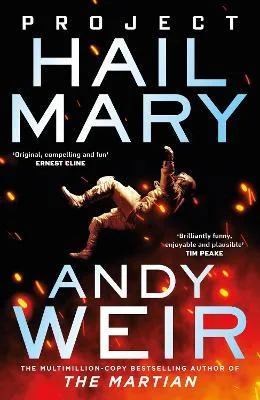
Survival
Survival is the most obvious theme in Project Hail Mary, but Weir handles it with more complexity than a standard man-versus-environment story. Grace wakes in a situation where survival is immediate and physical. He must understand his ship, his body, his environment, and the mission before ignorance kills him. But survival in this novel is never just about keeping breath in the lungs. It is about adapting to the unknown, thinking clearly under pressure, and refusing despair when logic says despair might be justified.
Grace survives not because he is invincible, but because he is willing to learn, improvise, and keep going through failure. That matters. Weir does not write him as a superhero. He is scared, confused, often exhausted, and sometimes badly outmatched by the scale of the problem. What makes him compelling is not brute force or cool detachment. It is his resilience. The novel keeps stressing that survival is a process of adjustment. The person who lives is not always the strongest. Often, it is the one who can change fastest without breaking.
That theme also expands outward. Grace is not only fighting for his own life. He is fighting for species-level survival. Earth’s crisis gives the novel real urgency, but it also broadens the moral stakes. We are not reading about a man stranded in space for the thrill of danger alone. We are reading about what it means to carry the weight of civilization while still being painfully, recognizably human.
Weir dramatizes this from the very first page. Grace wakes with tubes still in his arms and no idea where he is, and the ship’s medical computer starts with the simplest possible cognition checks, basic arithmetic, before it will trust him with anything more complicated. That small, almost condescending test is the whole theme in miniature: survival begins at the most basic possible level, one verified fact at a time, long before Grace has a name, a mission, or a memory to reason from. Only once he can stand and explore the ship alone does he find his crewmates, Yáo and Ilyukhina, still strapped into their own medical bunks, dead. The discovery is quiet rather than gory, which is what makes it land. Grace does not get a dramatic confrontation with death. He gets two silent bodies and the sudden understanding that whatever killed them could still be waiting for him.
The novel sharpens that idea further by making Grace’s survival conditional on loss. Their deaths are not staged for shock value. They set the emotional register for everything that follows. Grace is never allowed to feel simply lucky to be alive. He is aware, in a low hum beneath every experiment, that survival in this story is a lottery he happened to win, and that the honest response to winning it is not relief but responsibility. That is a more mature version of the survival story than genre fiction usually offers. It is less interested in whether the hero lives, and more interested in what living asks of him afterward.
Memory, Identity, and the Cost of Time
Survival in Project Hail Mary is inseparable from a second, quieter problem: Grace does not initially know who is surviving. The amnesia that opens the novel is often read as a structural device, a clean way to feed readers information at the same rate Grace recovers it. That is true, but it undersells what Weir is doing. Memory in this book is not simply a key that unlocks plot. It is the material his identity is made of, and for the first stretch of the novel, Grace has almost none of it.
Weir stages that distinction with a very specific kind of detail. Long before Grace remembers his own name, he finds himself fluent in things he has no memory of learning, reciting a chemical formula or working through a calculation on reflex, and only afterward wondering how he could possibly know that. The knowledge comes back before the self that owns it does. It is a small piece of neuroscience turned into a storytelling device, and it lets Weir dramatize identity as something built in layers, competence first, memory second, and the person somewhere underneath both.
What returns to him is not flattering. Grace remembers ambition, professional failure, a controversial theory that cost him his research career, and a retreat into teaching middle-school science that he has quietly framed to himself as contentment rather than defeat. He also remembers, eventually, that he did not step onto this mission with an open heart. He was maneuvered and frightened into it by forces far larger than himself, and some of his memory returns as something closer to shame than nostalgia. Weir’s smartest choice here is refusing to let recovered memory feel like triumph. Sometimes remembering who you are is worse than not knowing.
There is a second, stranger cost buried in the same idea. Because the Hail Mary travels at relativistic speed, time does not pass at the same rate for Grace as it does for the Earth he is trying to save. Whatever Grace becomes by the end of the journey, he becomes it out of sync with everyone he left behind. That detail rarely gets discussed with the weight it deserves, but it quietly reframes the whole mission: Grace is not just risking his life, he is spending a version of time he can never get back on a version of Earth he may barely recognize, a debt the novel eventually totals up in actual years. Survival, memory, and time turn out to be the same problem wearing three different names.
Scientific Discovery
Scientific discovery is the great engine of the novel. Andy Weir has a gift for making scientific method feel dramatic, and Project Hail Mary is one of the clearest examples of that. As Grace recovers his memories and unravels the purpose of his mission, the book dives into astrophysics, microbiology, orbital mechanics, chemistry, and evolutionary speculation. Yet the science never feels pasted in to show off research. It emerges from necessity. Grace must understand the problem in order to survive it, and the reader becomes invested because every idea has consequences.
This is part of what makes the novel such a pleasure to read. We are not simply told that science matters. We watch it matter. We watch experimentation unfold. We watch theories tested, rejected, revised, and tested again. There is excitement in that process. The book treats intelligence as active, practical, and dramatic. In a genre crowded with cosmic threats and oversized spectacle, Weir makes lab work, deduction, and careful reasoning feel thrilling.
More than that, the novel celebrates curiosity itself. Grace’s mission forces him into problem-solving mode, but the deeper pleasure of the story comes from discovery. The universe here is dangerous, but it is also legible. It can be studied. Patterns can be found. Meaning can be drawn from chaos. That confidence in reason, tempered by the reality of risk and failure, is one of the most satisfying things about the book. It belongs to a tradition of science fiction that believes knowledge is not a burden but a form of hope.
Consider how the novel handles astrophage itself. On first appearance it could have functioned as a generic doomsday microbe, a black box that exists purely to manufacture stakes. Weir refuses the shortcut. Astrophage gets a life cycle, a reproductive strategy, and an energy signature bright enough to leave a visible mark, the Petrova line, across the light of every star it infects, and eventually a natural predator that Grace has to find, understand, and put to use. Every fact the novel gives you about astrophage later becomes a lever Grace pulls to survive. That is the real trick of the book’s science. It is never trivia. It is Chekhov’s microbiology: if a property of an organism is mentioned early, it will matter later.
The clearest demonstration comes when Grace sets out to learn what actually controls astrophage’s behavior. Working alone in the ship’s lab, he runs samples through a patient, unglamorous sequence of light at different wavelengths, watching for any reaction, until he isolates the narrow infrared band the organism responds to. It is a small, procedural scene, one microscope and one frustrated scientist, but it changes the entire trajectory of the book. That single measurement later explains how astrophage powers itself, how the Hail Mary itself is fueled, and, eventually, how Grace and Rocky manage to talk to each other about it at all. Weir keeps finding ways to make a measurement feel like a plot twist.
Every fact the novel gives you about astrophage later becomes a lever Grace pulls to survive.
The Ethics of Emergency
Scientific discovery in Project Hail Mary never happens in a vacuum, and one of the novel’s most quietly provocative choices is to show readers exactly what kind of authority it takes to make that discovery possible. Back on Earth, the mission exists because a single administrator is handed something close to unlimited power by a world government structure that has, in effect, agreed to suspend itself for the duration of the emergency. Scientists, funding, and equipment get requisitioned with a speed and ruthlessness that would be alarming in peacetime and is presented here as simply what the crisis requires.
The novel gives that authority a face rather than leaving it abstract. Eva Stratt does not ease Grace into the mission with an invitation. She has him brought in, lays out what is about to happen to him, and moves on to the next crisis before he has finished objecting. Consent, in the ordinary sense, is barely on offer, and neither is comfort: Stratt commandeers laboratories, funding, and personnel across multiple countries on a timeline that leaves no room for the usual approvals, oversight, or debate. Weir does not spend much time asking readers to like her for it. He simply keeps showing how much of the mission’s speed depends on someone being willing to act as though the normal rules no longer apply.
Weir does not ask readers to cheer this uncritically, and he does not ask them to condemn it either. He stages it and lets the discomfort sit. The mission’s architect is efficient, contemptuous of process, and almost entirely unsentimental, and the novel is honest about how much of the mission’s success depends on a willingness to override the checks that a functioning, unthreatened society would normally insist on. That is the sharpest thematic idea Project Hail Mary reaches for outside of Grace’s own arc: extinction-level emergencies do not just test individuals, they test institutions, and they tend to reward whoever is willing to act first and justify it later. The novel is clear-eyed enough to show both what that approach saves and what it costs, without pretending the answer is simple.
That tension matters because it sets up everything that follows. Grace’s own choices about sacrifice only carry weight because the novel has already shown, at civilizational scale, how easily necessity can be used to justify almost anything. When the story eventually asks Grace to decide what he personally owes to people who will never be able to hold him accountable for the answer, it is really asking the same question Earth’s leadership has already answered for an entire planet, just at the scale of one conscience instead of one emergency command center.
Sacrifice and Moral Duty
Sacrifice runs through Project Hail Mary with more weight than the novel’s breezy humor initially suggests. As Grace uncovers the truth of his mission, the book asks what a person owes others when the stakes are no longer personal. Survival alone is not enough. The deeper question is whether survival has value if it comes at the cost of abandoning everyone else. That gives the novel moral force. Grace is not merely solving equations. He is confronting duty.
What makes this theme work is that Weir does not turn sacrifice into empty hero rhetoric. The book is interested in reluctance. Grace does not begin as an obvious martyr or saint. He is hesitant, frightened, and resistant in ways that make him feel believable. That reluctance strengthens the eventual choices because they are not effortless. They cost him. Sacrifice in this novel is not abstract nobility. It is a painful recognition that doing the right thing may require surrendering comfort, certainty, and even the future you thought belonged to you.
That tension between self-preservation and responsibility is one of the reasons the story feels emotionally fuller than a straightforward science adventure. It is not enough to ask whether Grace can solve the mission. The novel keeps asking whether he can grow into the kind of person the mission requires. In that sense, sacrifice is tied directly to character. It becomes the measure of moral maturity.
That reluctance is easiest to see in contrast. The sacrifices made on Earth are made on other people’s behalf, calmly, at a desk, at a distance. Grace’s sacrifices, when they finally come, have to be made in his own body, with his own hands, with nobody left to hand the decision to. The novel earns its emotional power precisely because it shows both versions of sacrifice, the administrative and the personal, and lets readers feel the enormous difference between deciding a cost is acceptable and being the one who has to pay it.
The clearest test of that idea arrives late in the novel, once Taumoeba, the very organism Grace and Rocky need to save both their worlds, starts eating through the astrophage fuel stores on Rocky’s own ship. The crisis is not abstract. It is arithmetic: a finite quantity of fuel, two ships that each need a share of it to get home, and no version of the math that lets everyone keep everything they came for. Weir does not resolve that arithmetic by making it easy. He resolves it by making Grace choose, in full knowledge of what the choice costs him personally. That is sacrifice stripped of metaphor. It is just numbers, a friend, and a decision.
Connection Across the Void
Human connection, or more accurately the need for meaningful connection, is the novel’s emotional center. Despite the scale of the astrophage crisis and the ingenuity of the scientific puzzles, the heart of Project Hail Mary lies in the bond Grace forms with Rocky. This relationship is one of the smartest and most affecting things Andy Weir has written. Rocky could easily have been reduced to a novelty, a quirky alien side character included to lighten the tone. Instead, he becomes essential.
Weir grounds that argument in a specific, almost procedural scene: first contact itself. Grace and Rocky do not begin with words. They begin by tapping out prime numbers at each other through a wall, the one signal both a human and an alien engineer can recognize as unmistakably intelligent. From there they build upward, arithmetic, then units, then a shared grid of symbols on a screen, then finally something like conversation and something like jokes. Weir stretches this out rather than skipping to the fun part, and the patience pays off. By the time Grace names his new crewmate ‘Rocky’, the nickname lands as affection earned through hours of shared, unglamorous work, not a cute label slapped on a stranger.
What makes the Grace and Rocky relationship so powerful is that it is built from difference rather than sameness. Their biology is different. Their language is different. Their senses are different. Their assumptions about the world are different. Yet through patience, translation, humor, and shared work, they build trust. That matters because the novel is quietly arguing for something larger than friendship. It is arguing that cooperation is possible even across extreme difference, and that empathy can exist long before perfect understanding does.
Part of what makes that trust convincing is how much of it is built through literal translation work. Grace and Rocky do not share a language, a number system, or even matching senses, so the novel turns early contact into something closer to engineering than diplomacy. They build a shared vocabulary out of chemistry, arithmetic, and repeated trial and error long before they get to jokes or nicknames. That grounding matters. It means the friendship that eventually forms has a foundation sturdier than charm. By the time Rocky and Grace are finishing each other’s sentences in their invented pidgin of numbers and tones, the novel has quietly demonstrated its own thesis: understanding is not a feeling you either have or lack. It is a thing you build, badly at first, out of shared work.
The book is at its most moving when it shows how companionship changes Grace. Isolation defines the early sections of the novel. Once Rocky enters the story, the emotional temperature changes. The mission is still desperate. The danger is still real. But now there is another mind in the darkness, another being trying to solve the same impossible problem. Their friendship transforms the book from a clever survival narrative into something richer and more generous. It reminds readers that connection is not a side benefit of survival. It is one of the reasons survival matters.
Hope, Ingenuity, and Why the Novel Works
One of the reasons Project Hail Mary has resonated so strongly with readers is that it remains sincere without becoming sentimental, and optimistic without becoming naïve. The novel believes in ingenuity. It believes that intelligence can be heroic. It believes that humor has a place even in catastrophe. Most importantly, it believes that hope is not wishful thinking. Hope here is built from work. It comes from people choosing to act, choosing to think, choosing to trust, and choosing to help.
That tone matters. Much of modern science fiction leans toward bleakness, irony, or emotional distance. Weir goes another way. He gives readers a novel that is tense and sometimes painful, but never cynical. That does not make the book soft. It makes it confident. Project Hail Mary knows that wonder and fear can exist together. So can loneliness and friendship. So can scientific rigor and emotional depth.
Grace’s story is compelling because it is about more than solving a cosmic puzzle. It is about becoming equal to a moral and intellectual challenge. Rocky matters because he turns the story from survival into fellowship. The astrophage crisis matters because it pushes the novel into questions of duty, species, and shared fate. All of these elements work together because Weir understands structure. Every problem sharpens character. Every revelation deepens theme. Every scientific hurdle carries emotional consequence.
That belief becomes literal on the tidally locked world Grace and Rocky find still orbiting Tau Ceti, where astrophage should have snuffed out life entirely and somehow has not. What they find there, a microorganism that preys on astrophage itself, is not a miracle. It is the reward for having looked in the right place with the right tools. Weir lets the discovery feel enormous without making it magical. Something as small as a single-celled predator turns out to be the hinge the entire species-level crisis swings on, which is exactly the novel’s argument about hope in miniature: look closely enough, for long enough, and the universe occasionally hands you a way through.
Read this way, the novel’s themes are really one argument approached from several angles. Survival asks what keeps a person going. Memory and time ask what that survival costs. Scientific method asks how a mind under pressure keeps finding the next right step. The ethics of emergency ask what a civilization is willing to do to buy that mind more time. Sacrifice asks what happens when the bill for all of it finally arrives. Connection asks who is willing to help carry it. And hope, the theme that holds the rest together, insists that none of this has to end in despair. Project Hail Mary is convincing precisely because it never treats hope as the absence of a price. It treats hope as what is left after the price has been counted honestly, and paid anyway.
From Page to Screen
Project Hail Mary’s themes did not stay confined to the page for long. Phil Lord and Christopher Miller’s 2026 film adaptation, scripted by Drew Goddard and starring Ryan Gosling as Grace, James Ortiz as Rocky, and Sandra Hüller as Eva Stratt, translates the novel’s ideas to the screen with more fidelity than most page-to-screen science fiction manages. The isolation, the amnesia, the reluctant heroism, and above all the friendship with Rocky all survive the jump intact, helped enormously by a performance built through on-set puppetry rather than purely digital effects.

Ryan Gosling as Ryland Grace and James Ortiz’s Rocky in the 2026 film adaptation.
What the film makes newly visible is how physical these themes always were underneath the prose. Grace’s exhaustion, Rocky’s alien patience, and Stratt’s cold arithmetic all read differently once you can watch a face, or a puppet, hold them. It is a rare case of an adaptation clarifying its source material instead of merely repeating it. Our full review of the film goes into why the adaptation works as well as it does.
Continue exploring Project Hail Mary on The Astromech
- Project Hail Mary: Novel Review — a straightforward verdict on the book, alongside the theme work above.
- The Plot of Project Hail Mary Explained — a spoiler-forward walkthrough of the novel’s story beats.
- Character Arc of Ryland Grace — a closer look at how amnesia, shame, and reluctant courage shape Grace specifically.
- How Old Is Ryland Grace, Really? — the relativistic time-dilation question this piece only touches on.
- Rocky the Alien: A Catalyst of Evolution and Connection — the friendship at the center of the book’s warmth, examined on its own terms.
- Review: Project Hail Mary, the 2026 Film — how Lord and Miller’s adaptation carries these same themes to the screen.
More Andy Weir: the themes of The Martian and how that novel changed on its way to the screen.
Conclusion
Project Hail Mary masterfully explores survival, memory, scientific discovery, institutional ethics, sacrifice, and connection. Andy Weir’s narrative showcases Grace’s resilience and adaptability, but it also goes further than that. It becomes a novel about trust, responsibility, and the strange grace that can emerge when intelligence is paired with empathy. The science inspires awe. The danger keeps the pages turning. The friendship at the heart of the book gives it soul.
In a universe filled with endless possibilities, Project Hail Mary reminds us that survival is never merely physical. It is intellectual. It is emotional. It is ethical. Weir’s gripping tale intertwines scientific wonder with sacrifice and companionship, creating a novel that feels both expansive and intimate. That balance is rare, and it is the reason the book stands out.
If you want science fiction that treats intelligence as dramatic, friendship as vital, and hope as something worth earning, Project Hail Mary is one of the easiest recommendations in the genre. It is not just a clever book about saving the world. It is a moving one, and that is what makes it memorable.

_poster.jpg)


