
Project Hail Mary, Andy Weir’s follow-up to The Martian, is the kind of science fiction novel that reminds you why hard sci-fi can be such a thrill when it is done well. Weir once again builds a story around scientific logic, technical problem-solving, and extreme survival pressure, but this time he reaches for something warmer and more emotionally generous too. The result is a novel that is not only clever and suspenseful, but genuinely moving. If Weir proved with his earlier work that equations and engineering can drive a compelling narrative, Project Hail Mary proves he can pair that intelligence with heart.
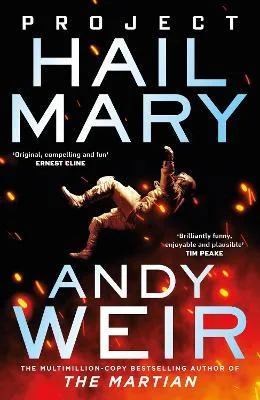
Reviewer Rating: ★★★★☆ (4/5)
The story follows Ryland Grace, a scientist who wakes aboard a spaceship with no memory of how he got there or what his mission is. That opening immediately gives the novel tension. Grace is not only isolated in deep space, he is cut off from his own identity. As his memory slowly returns, the stakes become clear. Humanity is facing extinction, and Grace may be the only person left who can stop it. Weir structures the novel so that the mystery of Grace’s past and the danger of his present unfold together, which keeps the momentum strong from the opening pages onward.
One of the book’s great strengths is the way Weir handles science. His attention to detail is meticulous, but it rarely feels like showing off. Biology, chemistry, astronomy, and physics are all woven into the narrative in ways that feel practical and urgent rather than ornamental. The science matters because survival depends on it. We are not just given information for its own sake. We are shown a mind working through impossible problems under pressure, and that gives the novel much of its suspense. Weir makes experimentation, deduction, and technical reasoning feel dramatic, which is no small feat.
Ryland Grace is also one of Weir’s most likable protagonists. He is brilliant, but not arrogant. Funny, but not glib. He is frightened, uncertain, and often improvising his way through disaster, which makes him feel human rather than mythic. That balance is important. Grace is easy to root for not because he is flawless, but because he keeps going. His intelligence is only part of what makes him compelling. The rest comes from his vulnerability, his decency, and the way the novel gradually reveals the moral weight of the mission he has been drawn into.
The pacing is handled well throughout. Weir moves between the immediate dangers aboard the ship and flashbacks that slowly reveal how Earth reached this crisis point. This structure keeps the reader engaged on two levels at once. There is the forward momentum of survival in the present, and the slow, satisfying reconstruction of the larger story in the past. Piece by piece, the novel builds a much bigger picture without ever losing sight of Grace’s immediate struggle.
Where Project Hail Mary becomes more than just a strong science fiction puzzle is in its emotional core. The novel is about survival, yes, but it is also about cooperation, sacrifice, and the need for connection. That side of the story becomes especially powerful once Grace forms his unlikely bond with Rocky, one of the book’s best creations. Rocky could have been a novelty character. Instead, he becomes central to what the novel is really saying. Through that relationship, Weir explores trust, communication, and friendship across enormous differences in a way that feels sincere rather than sentimental.
That said, the novel is not flawless. There are moments where the scientific explanation slightly outweighs the emotional texture, and some readers may find a few stretches of technical detail more interesting than dramatically urgent. Weir usually keeps the balance under control, but now and then the book lingers on process longer than it lingers on feeling. Even so, that is a relatively minor complaint in a novel so confident in what it is trying to do. For most readers, the scientific density will be part of the appeal rather than a drawback.
Another strength of the book is its belief in ingenuity. Weir clearly loves stories about people solving problems, and Project Hail Mary is full of that pleasure. Again and again, the novel returns to the idea that knowledge matters, persistence matters, and collaboration matters. This is science fiction that treats intelligence as dramatic. It treats curiosity as heroic. That gives the novel an uplifting quality without ever making it feel soft. The danger is real. The consequences are immense. But the book still believes that thought, empathy, and courage can make a difference.
In the end, Project Hail Mary is a thrilling, intelligent, and deeply satisfying read. It combines hard science with a strong central mystery, a likable protagonist, real emotional payoff, and some of the most enjoyable problem-solving in recent science fiction. While it occasionally leans a little too heavily into explanation, it more than compensates with momentum, warmth, and imagination. Fans of science fiction, survival narratives, and Weir’s earlier work will find a great deal to enjoy here.
It is also worth noting that the novel’s success has naturally led to a screen adaptation, with Drew Goddard attached to adapt it and a film version starring Ryan Gosling moving the story into a different medium. But the real achievement remains the book itself. Before any adaptation, Project Hail Mary already stood as one of the most engaging modern examples of science fiction that is both intellectually playful and emotionally sincere.
For readers who want a novel that can make astrophysics feel exciting, friendship feel vital, and survival feel like both a technical and moral challenge, Project Hail Mary earns its place on the shelf.

_poster.jpg)


