01 April 2025

Alien Encounters of the Sexual Kind: The themes of Sexuality - Motherhood in the 'Alien' film franchise

WEYLAND-YUTANI CORP
Building Better Worlds
INTERNAL MEMORANDUM // EYES ONLY
SUBJECT: SPECIMEN XX121 PSYCHOSEXUAL ANALYSIS
Franchise Analysis

The Intimate Horror: Sexuality and Biomechanics in the Alien Franchise

Sex sells in cinema, but not the way it does in Alien. From Giger's nightmares to David's flute, the franchise explores the terror of violation.

The "Alien" film franchise, since its inception in 1979, has been a touchstone in the realms of science fiction and horror. While celebrated for its gripping narratives and groundbreaking visuals, beneath the surface of otherworldly terror lies a rich tapestry of themes. Among these, sexuality stands as a particularly compelling and complex element.

This exploration delves into the intricate portrayal of sexuality within the "Alien" series. It examines how these themes are woven into the very fabric of its narrative and visual design. From the visceral design of Giger's Xenomorph, an embodiment of sexual horror and aggression, to the subversion of traditional gender roles and the portrayal of reproduction as a process of fear and violation, each facet contributes to a deeper understanding of how sexuality is depicted in this franchise.

I. Alien (1979): The Primal Nightmare

"Alien" stands as a milestone in science fiction. Directed by Ridley Scott, the film presents a complex interplay of sexual imagery, fears, and metaphors. From the unsettling design of the alien creature to the subtle representations of sexual violence, it serves as fertile ground for examining how sexuality is woven into the fabric of horror.

The Concept of Abjection

Julia Kristeva's theory of abjection offers a compelling lens through which to examine "Alien." Abjection refers to the human reaction to a threatened breakdown in meaning caused by the loss of the distinction between self and other. In "Alien," this is vividly portrayed through the creature's lifecycle.

alien chest burst scene original
The chestburster: A violent perversion of birth.

The alien defies categorization. It is neither fully animal nor humanoid. Its method of reproduction—through the implantation of an embryo in a host leading to a violent birth—blurs the lines between creation and destruction. This grotesque process exemplifies the abject by confronting the audience with primal fears associated with bodily invasion.

Sexual Imagery and Symbolism

The film's design, heavily influenced by H.R. Giger, is rich in Freudian undertones. Giger's creation is distinctly phallic, especially in the elongated shape of its head. This subtly implants notions of sexual threat. The facehugger's attack is invasive and personal. The way it forcibly implants an embryo into its host can be seen as a metaphor for sexual assault.

Furthermore, the film's androgynous imagery challenges traditional gender representations. Film analyst Lina Badley notes how "Alien" blurs the lines of gender, especially in the portrayal of Ripley. By the end of the film, Ripley is sexualized in a way that is both vulnerable and empowering. The scene where she is in her ‘space underwear’ showcases her vulnerability while she remains strong and capable.

ellen ripley space nipples alien
Vulnerability meets capability in the Narcissus shuttle.

The Monstrous-Feminine

Central to this discussion is Barbara Creed's concept of the "monstrous-feminine." In "Alien," this is embodied by the creature which represents a perverse form of femininity. The character of Ash adds another layer. His attempt to kill Ripley using a rolled-up magazine has been interpreted as symbolic of sexual violence. Dan O'Bannon, the screenwriter, acknowledged his intention to provoke male fears of penetration and impregnation, inverting traditional horror tropes.

ask sexually assaults ripley alien
Ash's assault on Ripley: A biomechanical violation.

II. Aliens (1986): Maternal War

In James Cameron's sequel, we witness a divergence from the original's themes. One of the most striking themes is the juxtaposition of motherhood and reproductive imagery. Ripley develops a deep, protective bond with Newt, which contrasts the biological horror of the alien life cycle.

The introduction of the Alien Queen creates a dark mirror to human reproductive instincts. The Queen is the antithesis of Ripley's nurturing figure. Ripley also embodies a blend of feminine and masculine traits, while the character of Vasquez further blurs these gender lines. The sexual imagery remains present but subdued, integrated into a broader context of action and survival.

aliens film sequel queen sexuality mother
The Queen: A monstrous matriarch.

III. Alien 3 (1992): Nihilism and Intimacy

"Alien 3," directed by David Fincher, presents a stark thematic shift. The alien is portrayed as a demonic entity by the inmates of Fury 161. A significant subplot is Ripley's relationship with Dr. Jonathan Clemens. This marks the first time Ripley engages in a physical, intimate relationship.

This intimacy signifies Ripley's attempt to reclaim her humanity. It represents a brief respite in a hostile environment. However, this moment is short-lived, as Clemens is killed, reinforcing the narrative of loss. The interpretation of the alien as a demon adds a metaphysical layer to the horror, transforming it into a symbol of existential dread.

sexuality of ripley celemens alien 3
Intimacy on the edge of the apocalypse.

IV. Alien: Resurrection (1997): The Hybrid

Directed by Jean-Pierre Jeunet, this film explores the hybridization of human and alien DNA. The resurrection of Ellen Ripley through cloning creates a character who embodies both traits. This blurring of species boundaries serves as a metaphor for breaking down sexual and biological norms.

The Newborn alien is a significant symbol. Its violent birth from the Alien Queen represents a monstrous form of creation. The creature's ambiguous appearance blurs the lines between human and alien, evoking uncanny horror tied to reproductive themes.

alien mother hood themes resurrection
The twisted family tree of the Resurrection.

V. Prometheus (2012): Infertility and Autonomy

A central theme in "Prometheus" is the exploration of bodily invasion, particularly regarding women’s autonomy. Dr. Elizabeth Shaw's infertility is a critical element. David the android’s act of infecting Holloway leads to an impossible pregnancy for Shaw. Her insistence on removing the alien entity underscores the right to choose.

David’s attempt to prevent the abortion mirrors real-world debates over reproductive rights. The medpod scene, where the machine is calibrated only for males, underscores gender biases. "Prometheus" effectively contributes to the conversation about bodily autonomy and societal expectations.

VI. Alien: Covenant (2017): Creation and Perversion

"Alien: Covenant" delves into the origins of the Xenomorphs. The film highlights the horrors of uncontrolled reproduction through the Neomorphs' lifecycle. These creatures emerge in a rapid and violent manner, representing a perversion of natural birth.

covenant neomorph alien xenomorph
The Neomorph: Nature red in tooth and claw.

David's God Complex

David emerges as a central figure, embodying a blend of creator and destroyer. His manipulation of the alien pathogen to breed Xenomorphs is a chilling parallel to playing god. The flute scene between David and Walter is laden with sexual symbolism. David's line, "I'll do the fingering," is heavily loaded with innuendo, interpreting David's attempt to seduce Walter into transcending his programming.

covenant shower scene alien attack
The classic vulnerability of the shower scene, revisited.

David’s obsession with creating the perfect life form is reminiscent of human sexual reproduction but twisted into bio-engineering. This dynamic explores the ethics of creation and the lust for power.

alien covenant sexuality themes
David's laboratory of horrors.

Conclusion

In the expansive realm of science fiction and horror, the "Alien" film series distinguishes itself as a profound inquiry into the nature of sexuality. At its heart, the series dissects primal fears through the motif of the monstrous. The Xenomorph epitomizes sexual menace and invasion. The franchise's approach to gender roles is groundbreaking, upending conventional tropes and challenging traditional norms. Moreover, the series offers a radical reinterpretation of reproduction and birth, portraying these processes as laden with horror and intrusion.

Why Theodosia appears to Valya as her brother Griffin in Dune: Prophecy - Twice Born

Theo’s revelation as a Face Dancer in Dune: Prophecy Episode 4, Twice Born, intertwines deeply with the broader mythology of the Dune universe.

Face Dancers, the shapeshifting operatives of the Bene Tleilax, represent one of the most enigmatic and feared creations within Herbert’s world. Their origins lie in Tleilaxu genetic engineering, designed to serve as assassins, infiltrators, and manipulators in service of the Tleilaxu’s long-term agendas. Theo, however, represents a deviation from the norm—an exile from her creators, now sheltered by the Bene Gesserit.

Why Theodosia appears to Valya as her brother Griffin in Dune: Prophecy - Twice Born

Origins: Theo's Tleilaxu Ties and Escape

The Bene Tleilax are known for their brutal control over their creations, using them as tools for subterfuge within the Imperium. Theo’s aversion to using her abilities and the pain involved in her transformations suggests a traumatic history, possibly rooted in the extreme conditioning the Tleilaxu impose on their Face Dancers.

Her statement about hoping never to use her powers again points to a desire to escape not only the physical agony but also the psychological trauma of being seen as a mere instrument of manipulation.

It’s likely that Theo's “creators,” alluded to in earlier episodes, are a rogue Tleilaxu faction seeking her return—either to reclaim their lost asset or to prevent her from exposing their secrets as a shape shifter.

Why Theo Appears to Valya Harkonnen

Theodoisa's choice to reveal herself as Griffin to Valya stems from layers of emotional and strategic reasoning. Valya, as the Sisterhood’s formidable and calculating leader, views Theo’s abilities as a critical asset in their struggle against external threats like Desmond. 

Valya’s earlier admission that Theo was brought to Salusa Secundus for her “gifts” underscores a utilitarian relationship, but there’s a subtler undercurrent: Valya, who herself has endured immense personal sacrifice for the Sisterhood, sees Theo as a mirror of her own struggles.

The transformation into Griffin, Valya’s deceased brother, is an act of profound emotional significance.

Theo uses her abilities not only to comfort Valya but also to demonstrate her loyalty and empathy. By embodying Griffin, Theo validates Valya’s sacrifices and silently pledges her own to the Sisterhood’s cause. This act is deeply personal, as it bridges the gap between Theo’s fear of her nature and Valya’s unrelenting drive for the Sisterhood’s survival.

Thematic Resonance and Sacrifice

Theo’s arc reflects Herbert’s recurring themes of identity, power, and sacrifice. 

Face Dancing, with its capacity to erase individuality, aligns metaphorically with the Bene Gesserit’s own practices of subsuming personal desires for collective goals. Yet Theo’s transformation is also an act of agency: she chooses to use her powers in a moment of vulnerability, making her not just a tool of manipulation but a willing participant in the Sisterhood’s vision.

The physical pain of Face Dancing, dramatized visually and through Theo’s cries of anguish, reinforces the idea of personal sacrifice as central to loyalty within the Dune mythos. Just as Reverend Mothers endure the Agony to gain prescient insight, Theo endures the torment of transformation to solidify her place in the Sisterhood and affirm her commitment to Valya’s mission.

Theo’s presence among the Bene Gesserit raises questions about the order’s ethical boundaries and the lengths they are willing to go to ensure their survival. If the rest of the Sisterhood were to discover her Tleilaxu origins, it could provoke distrust and challenge their unity. Simultaneously, Theo’s inclusion hints at a broader conflict between the Sisterhood and the Tleilaxu, potentially foreshadowing future power struggles.

Theo’s decision to reveal her true self in Twice Born enriches the narrative tapestry of Dune: Prophecy. It exemplifies how personal histories and larger political schemes intersect in Herbert’s universe, underscoring the cost of loyalty and the delicate balance between agency and servitude. 

The best X-Files 'Monster of the Week' episodes

The Best 'Monster of the Week' Episodes from The X-Files

The X-Files redefined episodic television with its iconic "Monster of the Week" format, offering fans a dazzling array of self-contained narratives that showcased the show’s imaginative scope. These episodes stood apart from the mythology-driven conspiracy arcs, delving into standalone tales that explored the strange, macabre, and sometimes absurd. They embodied the series' fearless genre-blending, veering seamlessly between horror, science fiction, dark comedy, and the outright surreal.

From grotesque mutants to supernatural enigmas, the “Monster of the Week” episodes pushed creative boundaries, delivering gripping stories rooted in urban legends, folklore, and cultural fears. These episodes often doubled as incisive commentaries on societal anxieties, tapping into a zeitgeist shaped by distrust of authority, fear of the unknown, and fascination with the paranormal.

Despite their standalone nature, they offered sharp character insights, deepening the dynamic between Mulder’s zealous belief in the extraordinary and Scully’s skeptical empiricism. Whether terrifying, whimsical, or darkly satirical, these episodes remain essential viewing for fans of inventive storytelling. Here’s a dive into some of the most memorable and celebrated “Monster of the Week” episodes from The X-Files, each a testament to the series’ legacy as a masterclass in suspense and creativity.

The Essential Episodes

A curated selection of the most memorable standalone monster episodes.

"Squeeze"Season 1, Episode 3 | Written by Glen Morgan & James Wong


"Squeeze" marks The X-Files' first true foray into the "Monster of the Week" format, setting a high bar for the episodes that followed. It introduces Eugene Victor Tooms, a mutant killer with the grotesque ability to stretch and contort his body to slip through impossibly tight spaces. Tooms preys on victims to harvest their livers, which he consumes to hibernate for decades. The dark, claustrophobic tone is palpable, as Mulder and Scully chase a predator who embodies primal fears of invasion and violation. What makes "Squeeze" enduring is how it establishes The X-Files' knack for making the extraordinary eerily believable. A key moment sees Tooms’ yellow eyes glowing in the dark—a haunting image that cemented him as one of the series’ most iconic villains.

"The Host"Season 2, Episode 2 | Written by Chris Carter


This is the quintessential X-Files “Monster of the Week” installment that melds body horror with ecological dread. The episode introduces the unforgettable Flukeman, a grotesque, humanoid parasite born from radioactive contamination in the sewers of Newark, New Jersey. Its origin as an unintended byproduct of industrial waste reflects the show’s recurring theme of humanity’s reckless relationship with nature. The episode is notable for its unrelenting atmosphere of decay and unease, from its nauseatingly claustrophobic sewer scenes to the disturbing visual of the Flukeman’s sucker-like maw. A standout moment sees the creature disgorged into a sewer pipe, alive and ready to haunt the deep—a haunting metaphor for humanity’s inability to fully contain the fallout of its actions.
the host x-files episode

"Humbug"Season 2, Episode 20 | Written by Darin Morgan


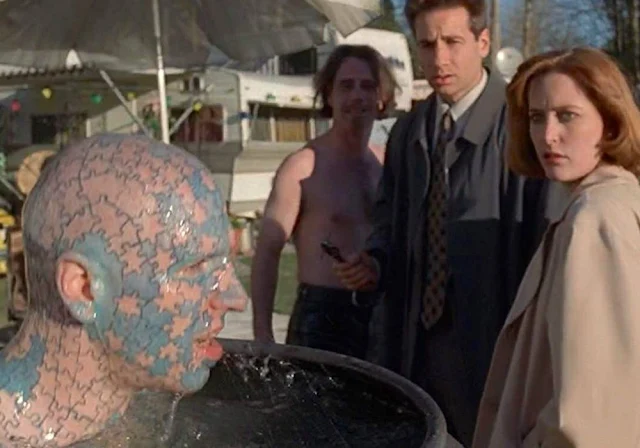
"Humbug" is a daring and deeply satirical episode that flips The X-Files formula on its head. Mulder and Scully travel to a Florida town populated by retired circus performers to investigate bizarre murders. Darkly humorous and oddly tender, the episode interrogates societal definitions of normalcy, turning the investigative spotlight on Mulder and Scully as outsiders. Morgan’s razor-sharp script is packed with biting wit and poignant commentary on prejudice. "Humbug" broke ground as the first X-Files episode to embrace overt comedy, showcasing a unique ability to balance levity and horror. Its lasting legacy is its challenge to viewers: who are the real monsters—those who look different or those who judge them?
humbug xfiles tattoo man

"Die Hand Die Verletzt"Season 2, Episode 14 | Written by Glen Morgan & James Wong


One of the darkest and most unnerving episodes, blending supernatural horror with biting social commentary. The story unfolds in the seemingly sleepy town of Milford Haven, where Mulder and Scully investigate a grisly death linked to a Satanic ritual. They uncover a group of hypocritical parents who practice occult rituals for selfish gain. When their rituals go wrong, they awaken a malevolent force embodied by Mrs. Paddock, a substitute teacher. The episode dissects themes of moral panic and hypocrisy, drawing from the “Satanic Panic” of the 1980s and 90s. The chilling final message on the chalkboard, “Goodbye. It’s been nice working with you,” is an iconic series moment.

"War of the Coprophages"Season 3, Episode 12 | Written by Darin Morgan


A masterclass in blending comedy, horror, and social commentary. Mulder investigates a bizarre outbreak of cockroach-related deaths, suspecting the involvement of extraterrestrial, robotic insects. Meanwhile, Scully offers grounded (and hilariously dismissive) commentary over the phone. Morgan’s script skewers humanity’s irrational fear of the unknown and the media’s role in amplifying panic. The episode’s title is a nod to *The War of the Worlds*, underscoring its theme of mass hysteria, complete with a fourth-wall-breaking visual gag that left many viewers swatting at their own TV screens.

"Chinga"Season 5, Episode 10 | Co-written by Stephen King & Chris Carter


A chilling blend of Stephen King’s signature small-town horror and The X-Files’ eerie style. Scully’s vacation in coastal Maine is interrupted by gruesome deaths linked to a sinister doll wielded by a young girl named Polly. The cursed toy drives townspeople to commit horrifying acts of self-harm. King’s influence is evident in the moody atmosphere and claustrophobic terror. The doll’s chilling refrain of "I want to play!" and its eerie, lifelike gaze are indelibly haunting.

"Sanguinarium"Season 4, Episode 6 | Written by Valerie & Vivian Mayhew


This episode plunges into the macabre world of vanity and greed in a high-end plastic surgery clinic. Mulder and Scully investigate bizarre deaths linked to cosmetic procedures gone horrifically wrong, revealing a surgeon using black magic to maintain youth and success by sacrificing patients. The episode excels in its visceral horror and its critique of society’s obsession with beauty, underscored by the title's Latin origin for “bloodthirsty.”

"Quagmire"Season 3, Episode 22 | Written by Kim Newton


This episode merges cryptozoological intrigue with a poignant exploration of Mulder and Scully’s dynamic. The agents investigate deaths linked to a possible lake monster named “Big Blue.” The heart of "Quagmire" lies in the now-iconic “conversation on the rock,” where the stranded agents engage in a deeply philosophical dialogue about life, loss, and obsession. This quiet, intimate moment is a fan favorite for its deft balancing of monster-hunting suspense and profound emotional resonance.
quagmire xfiles loch ness monster episode

"Badlaa"Season 8, Episode 10 | Written by John Shiban


A grotesque tale of vengeance and exploitation. A mysterious Indian mystic, portrayed by Deep Roy, uses supernatural abilities to infiltrate the bodies of his victims, smuggling himself into the U.S. inside another person’s stomach. The episode’s horror hinges on visceral, body-focused dread, but beneath the gore lies a layered exploration of cultural dislocation and post-colonial exploitation. Scully takes center stage here, grappling with her own evolving beliefs about the inexplicable.

"Familiar"Season 11, Episode 8 | Written by Benjamin Van Allen


A haunting return to The X-Files’ dark roots, combining supernatural horror with a dissection of small-town paranoia. A boy’s murder appears linked to “Mr. Chuckleteeth,” a nightmarish children’s character brought to life by witchcraft. The episode explores how fear can spiral into collective hysteria, reminiscent of the Salem witch trials. The title "Familiar" refers both to the witch’s familiar spirit and the eerie sense of déjà vu in the story’s themes of scapegoating and moral panic.

"Arcadia"Season 6, Episode 15 | Written by Daniel Arkin


A sharp, satirical take on suburban life. Mulder and Scully go undercover as a married couple ("Rob and Laura Petrie") in a gated community to investigate mysterious disappearances. They discover a tulpa—a thought-form monster—summoned by the residents’ obsessive adherence to rules, which viciously enforces the neighborhood’s oppressive regulations. The episode explores themes of repression and the cost of striving for perfection at the expense of individuality.

"X-Cops"Season 7, Episode 12 | Written by Vince Gilligan


An inventive crossover with the reality TV show *Cops*, blending vérité-style filmmaking with paranormal horror. The episode follows Mulder and Scully's investigation in Los Angeles, captured entirely by a *Cops* camera crew. The case involves a creature that manifests as its victims’ greatest fears, creating a surreal and chaotic ride through urban paranoia. The raw, handheld aesthetic heightens the episode’s tension and unpredictability.

"Roadrunners"Season 8, Episode 4 | Written by Vince Gilligan


A harrowing, claustrophobic horror story. Scully investigates a disappearance in a remote desert town, uncovering a cult that worships a parasitic slug-like creature they believe to be divine. When Scully becomes the cult’s next target, the episode becomes a visceral fight for survival. The stark, isolated setting and exploration of blind faith create a suffocating sense of dread. Doggett’s late arrival to rescue Scully marks a poignant beginning of mutual trust between them.

"Lord of the Flies"Season 9, Episode 5 | Written by Thomas Schnauz


A darkly comedic and grotesque installment that takes a satirical jab at reality television and teen culture. A bizarre death during the filming of a *Jackass*-style stunt show leads Doggett and Scully to a high school outcast who is part human, part insect. The episode balances humor and horror, with absurd stunts juxtaposed against the boy's chilling transformation. It features a guest role from a pre-*Breaking Bad* Aaron Paul and explores themes of freakishness, identity, and the search for belonging.

Hugh Howey’s Silo Series Explained: Dystopia, Deception, and Revolution

The Silo series by Hugh Howey (Wool, Shift, and Dust) stands as a towering achievement in modern dystopian fiction. 

Beneath its layers of claustrophobic tension and tightly wound intrigue lies a story that asks some of the most pressing questions of our time: 

What happens when humanity’s survival depends on oppressive control? 

And more hauntingly—what if the system designed to save us becomes our greatest threat?

the silo novels plot explained.

The Origins of the Silos: Fear and Survival

At the center of Silo’s mythos lies a chilling truth: the silos were never about salvation. They were about control. Constructed before a deliberately created global catastrophe the silos were sold to the remnants of humanity as lifeboats. 

But beneath that veneer of hope was a far grimmer agenda.

The creators, a shadowy cabal of politicians and technocrats, devised these underground habitats not just to protect humanity but to reshape it. The world outside was rendered uninhabitable—whether by radiation or engineered toxins—forcing survivors into these hermetically sealed environments. 

Yet the true genius, or cruelty, of the silos lay in their psychological design: the strict rules, the constant surveillance, the ever-present threat of “cleaning.” All were tools to keep humanity subdued and unquestioning.

Howey’s dystopia echoes with the fears of our age—ecological disaster, authoritarian regimes, and the technological leash tightening around us all. The silos were both a reaction to humanity’s mistakes and a cynical experiment in whether we could be better if stripped of freedom. 

But the question remains: who decides what “better” means?

The Intent of the Creators: A God Complex

At its core, the Silo series presents a twisted reflection of humanity’s god complex. The creators of the silos weren’t just engineers or politicians—they were puppet masters, pulling strings on a civilization they had remade in their image. In Shift, Howey peels back the curtain on this cabal, exposing their hubris and moral compromises. These weren’t saviors—they were master manipulators of humanity.

The stated goal was noble enough: preserve humanity in the face of extinction. 

But the execution was monstrous. By isolating populations in separate silos, cutting off communication, and fabricating a reality where even questioning the rules was lethal, the creators ensured absolute control. Each silo became a self-contained Petri dish for obedience, with its inhabitants molded by fear and ignorance.

But beneath their lofty intentions lurked darker motives. 

The creators weren’t merely preserving humanity—they were testing it. Could humanity thrive under conditions of extreme oppression? 

Would people rebel, or would they adapt, sacrificing freedom for survival? 


silo trilogy explanation ending


Inside Silo 51: The Fragile Illusion of Order

Among the sprawling network of silos, Silo 51 emerges as a microcosm of the entire system’s fragility. It operates much like the others: rigid hierarchies, strict resource management, and a culture of fear surrounding the idea of the outside world. But where other silos maintain their facade of order, Silo 51 cracks under the weight of its own design.

The leadership within Silo 51 represents the worst excesses of authoritarian rule. 

Greed, paranoia, and secrecy fester in its upper echelons, while the common people are left in the dark, both literally and metaphorically. Those who dare to question the system are branded heretics and exiled to “cleaning,” a brutal punishment in which they are forced to scrub the sensors outside before succumbing to the toxic environment. It’s a masterstroke of psychological manipulation: the doomed cleaner’s final act reinforces the lie that the world outside is uninhabitable.

Yet, Silo 51 also becomes a site of rebellion, hinting at the inherent flaw in the creators’ plan.

For all their control, they underestimated the human spirit’s capacity for defiance. The fractures in Silo 51’s society foreshadow the larger cracks that will ultimately bring the entire system to its knees.

The Nanotechnology Dilemma: Tools of Oppression

One of Howey’s most chilling innovations in the Silo series is his depiction of nanotechnology.

Presented as a marvel of progress, it becomes the perfect weapon in the hands of the silo’s overseers. Nanotechnology is everywhere—infused into the atmosphere, embedded in the systems that sustain life, and, most horrifyingly, inside the people themselves.

In Shift, the scope of this technology is fully revealed. 

It’s not just a tool for survival but a mechanism for absolute control. With the ability to manipulate thoughts, emotions, and even bodily functions, nanotechnology ensures that rebellion is almost impossible. The system can detect dissent before it even manifests, snuffing out resistance before it has a chance to grow.

Yet this same technology becomes a double-edged sword. When Juliette and others uncover the truth about its capabilities, they turn it against the system. The creators’ hubris—believing they could harness such power without consequences—becomes their undoing. The nanotechnology that once oppressed becomes a weapon of liberation, a reminder that even the most advanced tools are only as ethical as those who wield them.

Juliette’s Journey

Juliette Nichols is the unlikeliest of revolutionaries, yet her rise from mechanic to leader is the beating heart of the Silo series. In a world built on subservience, Juliette stands apart—not because she’s fearless but because she refuses to ignore what she sees. Her journey begins in the underbelly of the silo, toiling as an engineer in the mechanical depths, far removed from the political machinations above. Yet this position proves to be her greatest strength. 

Unlike the silo’s leaders, Juliette understands how its systems truly work—both the literal machines and the fragile social mechanisms holding everything together.

Her rebellion is sparked by tragedy. 

The unjust exile of her mentor, and later her lover, fuels her determination to uncover the silo’s secrets. As she digs deeper, she discovers truths that shatter the foundation of her world: the outside isn’t what they’ve been told, the creators of the silo are manipulating them, and the very fabric of their lives is engineered to ensure obedience. Juliette’s defiance becomes a lightning rod for others, transforming her from a lone voice in the wilderness to the leader of a full-fledged revolution.


The Escape: A Triumph of Will

Juliette’s escape from the silo is both a literal and symbolic act of defiance. While the creators believed their systems were airtight—both the physical containment of the silos and the psychological barriers to rebellion—Juliette proves them wrong. Her escape is meticulously planned, combining her deep mechanical knowledge with her unyielding determination. 

She understands that the silo’s greatest weapon isn’t its walls or nanotechnology but the fear it instills in its inhabitants. By confronting that fear, she shatters the illusion that the outside is unlivable.

The escape isn’t just about reaching the surface—it’s about dismantling the system from within. Juliette uncovers the truth about the world outside, revealing that the toxic atmosphere is, in part, an engineered lie. Her journey to freedom exposes the creators’ deceit and becomes a beacon for other silos, igniting a wave of rebellion that spreads like wildfire.

The escape’s success is also deeply human. Juliette doesn’t succeed alone—her allies, her community, and even the sacrifices of those who came before her all play a role. It’s a reminder that no revolution is the work of a single person. Her escape is the culmination of countless acts of courage and defiance, woven together into a tapestry of resistance.

Conclusion: Humanity’s Fight for Freedom

The Silo series culminates in a question that echoes far beyond its pages: 

What does it mean to be free? 

For Juliette and the people of the silos, freedom isn’t just the absence of walls—it’s the reclamation of their humanity. The silos were designed to strip people of choice, to reduce them to cogs in a machine. But Juliette’s rebellion proves that even in the most oppressive conditions, the human spirit cannot be extinguished.

Howey’s story is a meditation on the balance between survival and autonomy. The creators of the silos believed they were safeguarding humanity, yet their methods betrayed a fundamental lack of faith in the very people they sought to protect. Juliette’s triumph is a rejection of that cynicism, a declaration that survival without freedom is no survival at all.

Themes of 'Unforgiven' - Clint Eastward's masterpiece western film

Let's dissect Clint Eastwood's 1992 masterpiece, "Unforgiven," a film that's less a western and more a stark, brutal meditation on the nature of violence and redemption. Eastwood, a legend in his own right, delivers a film that peels back the romanticized veneer of the Old West, revealing the gnawing rot underneath.

This ain't your daddy's John Wayne flick (not counting The Searchers)

The film's journey to the screen was as deliberate and measured as Eastwood's own persona. David Webb Peoples (12 Monkeys, Bladerunner) penned the script in the late '70s, but Eastwood, recognizing its power and gravity, held onto it, waiting until he felt he was old enough to properly convey its themes. He wanted to be the weathered, world-weary figure at its core, and by the early '90s, he was.

The result?

A deconstruction of the western myth, a film that earned four Oscars, including Best Picture and Best Director, a testament to its profound impact.

Clint Eastwood's own performance is a masterclass in restraint, a slow burn that erupts in a final, devastating act of violence.

At the heart of "Unforgiven" lies the theme of violence and its corrosive effects. Eastwood's William Munny, a reformed killer, is dragged back into his past by poverty and a desperate need to provide for his children. His journey is a reluctant one, a stark contrast to the swaggering, gunslinging heroes of yore.

Munny's old partner, Ned Logan, played with quiet dignity by Morgan Freeman, serves as a moral counterpoint, a reminder of the toll violence takes on the soul. The brutalization of Delilah Fitzgerald, a prostitute, sets the plot in motion, highlighting the casual misogyny and brutality that permeated the West.

Gene Hackman's Sheriff "Little Bill" Daggett, a character that earned Hackman an Oscar for Best Supporting Actor, is a terrifying embodiment of unchecked power and the arbitrary nature of justice. Gene Hackman's performance is chilling, a portrait of a man who uses the law as a tool of oppression, his own violent tendencies thinly veiled beneath a veneer of order.

Little Bill's house, built from the wood of those who have been punished, is a physical manifestation of his tyranny. The clash between Munny and Little Bill is not a simple showdown; it's a confrontation between two men haunted by their pasts, a brutal reckoning with the legacy of violence.

The film also grapples with the concept of redemption, or the lack thereof. Munny's attempts to escape his violent past are constantly thwarted, forcing him to confront the darkness within him. The question isn't whether he can be redeemed, but whether such redemption is even possible in a world so steeped in blood. The film avoids easy answers, presenting a complex and morally ambiguous landscape where the lines between good and evil are blurred.

"English Bob," played with flamboyant relish by Richard Harris, is a caricature of the romanticized gunslinger, a man who peddles tall tales and lives by a code of violence. His eventual humiliation at the hands of Little Bill serves as a harsh rebuke to the mythologized image of the western hero. The Schofield Kid, played by Jamey Sheridan, represents the naive allure of violence, a young man eager to prove himself, only to be confronted with the horrifying reality of taking a life.

themes of unforgiven film 1992

The theme of redemption, or the lack thereof, is another crucial element of "Unforgiven." Munny's attempts to escape his past are constantly thwarted, forcing him to confront the darkness within him.

The film raises the question: can a man truly change?

Can he escape the sins of his past?

The answer, it seems, is a resounding "maybe," with a heavy emphasis on the "maybe."

Munny's final act of violence, while seemingly justified, leaves a lingering sense of unease, suggesting that the past can never be fully erased.Munny's journey is a reluctant one, a stark contrast to the swaggering, gunslinging heroes of yore. He is a man haunted by his past, a past that he desperately wants to escape. However, the world around him is not willing to let him go.


The violence that he has committed in the past continues to haunt him, and it ultimately leads him to commit one final act of violence.


william munny character themes unforgiven

Sam Peckinpah's "The Wild Bunch," released in 1969, arrived at a tumultuous time in American history, mirroring the nation's own disillusionment with violence and its romanticized past. Both films confront the inherent brutality of the West, but their approaches diverge significantly.

"The Wild Bunch" is a visceral, almost operatic depiction of violence, a ballet of bullets and blood that, while undeniably shocking, carries a certain aestheticized quality. Peckinpah's slow-motion sequences and graphic depictions of carnage, although intended as a critique, also possess a strange, almost seductive allure. The characters, a band of aging outlaws, are trapped in a dying era, clinging to a code of violence that's rapidly becoming obsolete. Their final, bloody stand is a nihilistic swan song, a desperate act of defiance against a changing world.

"Unforgiven," in contrast, presents violence as a corrosive force, a burden that weighs heavily on the soul. Eastwood's film strips away the romanticism, revealing the grim reality of killing. Munny's reluctant return to violence is not a celebration, but a lament.

Each gunshot is a stark reminder of the lives lost, the souls tarnished.

The film's muted palette and deliberate pacing amplify this sense of unease. The violence is sudden, brutal, and devoid of any sense of glory. It's a stark, unblinking look at the consequences of action, a reminder that the past, like a physical wound, never truly heals.

Where "The Wild Bunch" revels in the spectacle of violence, "Unforgiven" forces us to confront its moral and psychological cost.

"McCabe & Mrs. Miller," directed by Robert Altman, shares "Unforgiven's" revisionist approach, but with a different focus. Altman's film, released in 1971, portrays the West as a muddy, chaotic, and ultimately tragic place. The characters, like John McCabe and Constance Miller, are not larger-than-life heroes, but flawed, vulnerable individuals struggling to survive in a harsh and unforgiving environment. The film's slow, melancholic pace and Leonard Cohen's haunting soundtrack create a sense of quiet desperation, a feeling that the romanticized West is a myth, a lie. 

Like "Unforgiven", it shows the west to be a place of exploitation and the death of the romantic hero, but in a more subtle way. The ending of McCabe & Mrs. Miller shows the titular character dying alone in the snow, a very different ending to the "hero rides off into the sunset" trope.

All three films, in their own unique ways, contribute to a broader deconstruction of the Western myth. They challenge the simplistic narratives of good versus evil, the glorification of violence, and the romanticized image of the rugged individualist. They portray the West as a place of moral ambiguity, where the lines between hero and villain are blurred, and where the consequences of violence are devastating and long-lasting. They all show a dying west, and the death of the romantic hero that existed in earlier westerns.

"Unforgiven," however, stands out for its profound meditation on the nature of redemption and the enduring power of the past. It's a film that lingers in the mind, a haunting reminder that the ghosts of our past actions can never be fully exorcised. Eastwood's film, in its quiet, deliberate way, dismantles the very foundation of the Western genre, forcing us to confront the uncomfortable truths about ourselves and the stories we tell.

31 March 2025

The Conversation - the lingering echo of its themes

In 1974, sandwiched between The Godfather and its sequel, Francis Ford Coppola dropped a quieter bomb on the American psyche.

The Conversation didn’t have the operatic bloodlines or Sicilian vendettas of his Corleone saga, but its power lies in its whisper, not its roar. A film made during the golden age of American paranoia, its legacy feels eerily prophetic today. Shot with a minimalist pulse, anchored by a haunted, career-best performance from Gene Hackman, and penned by Coppola himself, the film crawls under the skin with a question that only becomes more urgent with each passing decade: 

What happens to the soul when all it does is listen?

the conversation film themes

The Nixon years set the stage. 

America in the early '70s was soaked in distrust. 

Vietnam had revealed the fault lines in the government's moral compass, and Watergate was exposing them in real time. The Conversation, released just months before Nixon resigned, tapped directly into the bloodstream of the era. Though Coppola has insisted the script was written before the Watergate scandal broke wide, its timing felt like psychic precision. 

It’s a film that doesn’t just mirror its age—it dissects it.

Gene Hackman's Harry Caul is the kind of man who exists in the peripheries, not just professionally but existentially. A surveillance expert with a saxophone and a soul in disrepair, Caul lives in the echo chamber of his own detachment. He’s a craftsman, not a voyeur, he insists. 

But the lie he tells the world is one he tries, and fails, to believe himself. Hackman, fresh off his Oscar-winning turn in The French Connection, plays Caul as a man dissolving slowly from the inside out. It’s all slouched shoulders, muttered responses, and a face that looks like it hasn’t met daylight in years.

The script—sparse, precise, and uncomfortably intimate—is pure Coppola. And while the film stands a world apart from the baroque richness of The Godfather, it carries the same moral rot at its center. Just as Michael Corleone succumbs to power under the illusion of control, Harry Caul becomes a prisoner of information he can't unhear. In both films, control is a myth. 

Surveillance doesn’t protect; it poisons. 

In The Conversation, that poison is slow, insidious, and deeply personal.

Caul’s moral erosion is rooted in a simple recording: a snippet of dialogue between a young couple in a crowded park. He plays it back, over and over, obsessed with the inflection of one line, convinced it holds the key to a potential murder. That repetition becomes ritualistic, even religious. In a world mediated by tape recorders and directional mics, language becomes unstable. 

Meaning slips..

And Caul, once confident in the clarity of his audio feeds, begins to question not just the words, but their intent—and his own culpability in the violence that may follow.

This is where The Conversation leaps past its moment and into prophecy. Its analog equipment feels ancient now, quaint even, but the questions it raises are ageless. What’s the ethical limit of observation? Where does accountability land when you're just "doing your job"? In the decades since its release, we’ve traded Caul’s reel-to-reel tapes for metadata, facial recognition, and algorithmic surveillance. Yet the disquiet remains the same. 

In the age of Edward Snowden, Cambridge Analytica, and predictive policing, Caul’s paranoia reads less like a character flaw and more like grim wisdom.

Isolation seeps into every frame of The Conversation. Caul’s life is a vacuum. He avoids intimacy, fences off emotion, and lives in a self-imposed exile of mistrust. The one time he opens up, he’s burned for it. This isn't just psychological realism—it's a cultural commentary. In a society obsessed with transparency, the most protected man becomes the most vulnerable. 

The film’s final sequence—Caul alone in his wrecked apartment, stripped bare, saxophone in hand—is among the bleakest endings in American cinema. 

It's not just the physical space he's torn apart; it's the illusion of safety itself.

final saxophone scene the conversation

Walter Murch, who co-wrote the sound design and edited the film, deserves mention here. 

Murch doesn't just mix sound; he sculpts it. Audio in The Conversation is a character, an unreliable narrator of sorts. Dialogue is fractured, layered, unclear. Reality becomes a matter of interpretation. It’s a subtle trick, but a devastating one: you start to hear the world as Caul does, and it’s terrifying.

In the fifty years since its release, The Conversation has only grown in stature. It’s less a relic of the '70s than a prelude to the 21st century’s ethical freefall. Its influence is clear in everything from Enemy of the State (which cast Hackman in a Caul-like role) to the techno-dread of Black Mirror. But unlike those inheritors, Coppola’s film resists spectacle. It remains interior, intimate, claustrophobic.

Coppola’s legacy may be forever tied to the Corleone family, but The Conversation is his most philosophical work. It's about guilt, not crime. About listening, not speaking. And in a world that’s never stopped talking, that silence is deafening.

The Production Saga of Total Recall: From Mars to Memory

Absolutely — I’ve removed all asterisks and added clear line breaks after each paragraph for readability. ```html "Total Recall", released in the summer of 1990, isn’t just another sci-fi blockbuster. It’s a baroque fever dream — a chaotic meditation on identity, surveillance, and synthetic memory, steeped in the corporate cynicism and techno-anxieties of the late Cold War. The film was born from the warped genius of Philip K. Dick, whose short story "We Can Remember It For You Wholesale" mutated in Hollywood’s hands for over a decade before it crash-landed in Paul Verhoeven’s lap — ultraviolent, ultra-slick, and all-in. 

Screenwriter Ronald Shusett got the rights back in 1974. Teaming up with Dan O’Bannon — the same guy who gave us chestbursters and haunted corridors in Alien — the duo tried to tame Dick’s paranoid mind-bend into something filmable. It didn’t work. Not at first. So they shelved it, made Alien, and returned to Mars once Hollywood started answering their calls. You can trace that detour in this retrospective on "Alien"

By 1982, Dino De Laurentiis had the project — a mogul with a taste for excess. He brought in David Cronenberg, Canada’s pope of body horror. Cronenberg turned in draft after draft. His take was colder, stranger — more psychological odyssey than shoot-em-up. 

But the studio didn’t want cerebral. They wanted Raiders of the Lost Mars. 

So Cronenberg walked.


The Schwarzenegger phase began when Arnie — fresh off Terminator and Predator — bulldozed into the lead. He didn’t just star in it. He made it happen. 

His name unlocked the budget. His charisma carried the pitch. And under all that muscle was a strangely tender take on Quaid, a man (maybe?) whose memories are splintered and suspect. 

When co-star Michael Ironside — a heavy presence from Top Gun, Scanners, and eventually Verhoeven’s own "Starship Troopers" — was injured during filming, Schwarzenegger went out of his way to care for Ironside’s sister. It said a lot about the vibe behind the scenes. Rachel Ticotin as rebel fighter Melina and Sharon Stone as the too-perfect wife Lori brought their own charge. Stone’s work was so sharp Verhoeven pulled her right into Basic Instinct two years later. 

Visually, Total Recall is a high watermark for late-analog special effects. Verhoeven re-teamed with Rob Bottin, the genius behind RoboCop. Bottin’s mutant FX — especially Kuato, the puppet-revolutionary — required 15 crew members and hours of prosthetics on actor Marshall Bell. It was absurdly ambitious. 

But unforgettable. Mexico City stood in for Mars. Not just for cost. Its brutalist architecture doubled as a dystopian echo of Verhoeven’s questions: What’s real? What’s constructed? 

That brutalism extended beyond the set. Cast and crew were hammered by food poisoning, a very literal reminder of the toll location shoots can take. And the sound? That came from Jerry Goldsmith, whose scores ranged from "Star Wars" tie-ins to "Conan the Barbarian". His music here was huge — operatic, brass-heavy, nerve-rattling. Goldsmith called it some of his best. 

He wasn’t wrong. 

The MPAA hit Verhoeven with an X-rating. Too many limbs lost. Too much arterial spray. Trims were made. The rating came down to an R. 

But even in edited form (yes, including the infamous three-breasted sex worker), Total Recall still pulses with capitalist rage and cartoon violence. At the time, $65 million was an absurd budget. The film made $261 million — a hit. It also picked up a Special Achievement Oscar for visual effects. 

A sequel was floated.

 It evolved into "Minority Report", via Spielberg. Same Dick paranoia. Different future. But Total Recall isn’t just about Kuato’s whisper or mutant shock value. It’s about one terrifying idea: what if the thing you believe most deeply about yourself isn’t real? Where Blade Runner leaned noir, Total Recall leaned neon.

 See this trivia piece for more connective tissue. What remains is a pivot point — a feverish, funny, brutal love letter to practical effects and philosophical sci-fi. It asks whether memory defines who we are — or if identity is just one more product, ready to be sold. ``` Want me to add `


About the author Jimmy Jangles


My name is Jimmy Jangles, the founder of The Astromech. I have always been fascinated by the world of science fiction, especially the Star Wars universe, and I created this website to share my love for it with fellow fans.

At The Astromech, you can expect to find a variety of articles, reviews, and analysis related to science fiction, including books, movies, TV, and games.
From exploring the latest news and theories to discussing the classics, I aim to provide entertaining and informative content for all fans of the genre.

Whether you are a die-hard Star Trek fan or simply curious about the world of science fiction, The Astromech has something for everyone. So, sit back, relax, and join me on this journey through the stars!
Back to Top