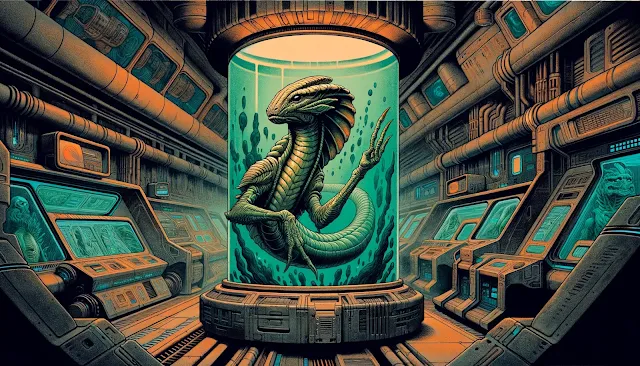
Xenomorphs, the iconic extraterrestrial creatures from the Alien franchise, have long fascinated audiences with their rapid growth and menacing presence.
One of the most perplexing aspects of their biology is their ability to attain full size and weight shortly after birth without an apparent intake of additional mass and energy.
At the heart of understanding Xenomorph growth lies the concept of metabolic efficiency. Unlike many organisms on Earth, Xenomorphs seem to possess a remarkably efficient metabolism that allows them to maximize the utilization of available resources.
This metabolic prowess enables them to rapidly convert nutrients into biomass, facilitating swift growth without the need for continuous intake of additional mass and energy.
Xenomorphs exhibit traits indicative of extreme energy conservation. Their physiology likely prioritizes energy allocation towards essential growth processes, minimizing wastage and maximizing efficiency. By minimizing unnecessary metabolic processes and optimizing energy utilization, Xenomorphs can channel resources towards rapid growth, enabling them to reach full size and weight with remarkable speed.
The Xenomorph's biology is a testament to evolutionary perfection, finely tuned for survival and growth in hostile environments. Their unique genetic makeup likely harbors specialized adaptations that enhance nutrient absorption, metabolic efficiency, and growth rate.
These adaptations may include advanced digestive enzymes, efficient nutrient transport systems, and streamlined metabolic pathways tailored for rapid growth.
Xenomorphs possess an exceptional ability to extract and utilize nutrients from their surroundings.
Whether it be through scavenging organic matter, parasitic behavior, or symbiotic relationships with host organisms, Xenomorphs efficiently acquire the resources needed for growth. Additionally, their biology may allow them to recycle and repurpose cellular components, further conserving energy and maximizing growth potential.
The biochemical processes underlying Xenomorph growth remain largely speculative but undoubtedly involve a complex interplay of cellular mechanisms. It is conceivable that Xenomorphs employ novel biochemical pathways optimized for rapid biomass synthesis. These pathways may bypass conventional metabolic constraints, allowing for accelerated growth rates without the need for excessive energy expenditure.
Or.... and hear me out...It's just a creature in a movie and plot needs must.
A Chronological Guide to the Planet of the Apes Saga
1968’s Planet of the Apes, a landmark sci-fi film based on Pierre Boulle’s 1963 novel, kicked off one of the strangest, boldest franchises of its time. What followed wasn’t just a hit movie. It was a full-blown wave: four sequels, tie-in novels, a live-action TV series, and even an animated show. The setup? A future war between humans and hyper-intelligent apes. The hook? Real-world parallels like racism, animal rights, and Cold War paranoia smuggled into pulp storytelling. That blend of spectacle and subtext earned it a spot among the greatest sci-fi sagas ever made.
After the original run fizzled, it wouldn’t stir again until Tim Burton’s 2001 remake, which had ambition but failed to land. Then came 2011. Rise of the Planet of the Apes hit reset and nailed it. Gritty, emotional, and thoughtful, it revived the series and launched a new prequel trilogy, closing the gap between our world and the ape-run dystopia of the ’68 original. In 2024, a fourth chapter, Kingdom of the Planet of the Apes, pushed that vision even further.
The Complete Planet of the Apes Chronology
The modern prequel series and the classic original saga, presented in in-universe chronological order.
1. Rise of the Planet of the ApesReleased: 2011
Timeline: Early 2010s
The origin story of the revolution. A scientist's search for an Alzheimer's cure results in a retrovirus that dramatically increases ape intelligence. The first subject, Caesar, is raised by humans but a tragic incident leads to his imprisonment with other apes, where he sows the seeds of an uprising while the virus begins to decimate humanity.
Lore Note: Caesar's mother is nicknamed "Bright Eyes," a direct homage to how the female human Nova was referred to by Dr. Zira in the original 1968 film.
2. Dawn of the Planet of the ApesReleased: 2014
Timeline: 2020s
A decade after the "Simian Flu" pandemic wiped out most of humanity, Caesar leads a thriving ape colony in the Muir Woods. Their peace is shattered when they encounter a small band of human survivors. Though Caesar attempts diplomacy, his scarred lieutenant Koba, who despises humans, orchestrates a coup that plunges both species into war.
Lore Note: To prepare for their roles, the ape actors attended "Ape Camp," where they studied ape behavior and learned to move and vocalize like chimpanzees, orangutans, and gorillas.
3. War for the Planet of the ApesReleased: 2017
Timeline: Late 2020s
Two years after the events of Dawn, the war between apes and humans rages on. After suffering a devastating personal loss at the hands of a ruthless colonel, Caesar embarks on a dark quest for revenge. The film concludes the trilogy by cementing Caesar's legacy as the apes' foundational leader, leading them to a new home.
Lore Note: The virus mutates in this film, causing human survivors to become mute and regress to a primitive state. This provides the in-universe explanation for the non-verbal humans seen in the original 1968 movie.
4. Kingdom of the Planet of the ApesReleased: 2024
Timeline: Several generations after Caesar (approx. 2300s)
Set nearly 300 years after Caesar's death, ape clans have diverged while humans have regressed further. A young chimpanzee, Noa, embarks on a journey with a human girl named Mae after his village is enslaved by Proximus Caesar, a tyrannical leader who twists Caesar's original teachings to justify his quest for forgotten human technology.
Lore Note: The film subtly re-introduces the idea of telepathic mutants from "Beneath the Planet of the Apes" through Mae's connection to a hidden human society that communicates via technology, bridging the new series with the old.
5. Planet of the ApesReleased: 1968
Timeline: 3978 AD
The classic that started it all. Astronaut George Taylor crash lands on a mysterious planet where intelligent, talking apes are the dominant species and primitive humans are hunted. He is captured and studied, ultimately leading to one of cinema's most famous twist endings: he was on Earth all along, long after human civilization destroyed itself.
Lore Note: The iconic line, "Get your stinking paws off me, you damned dirty ape," was not in the original script. Charlton Heston improvised it during rehearsal, and the director loved it enough to keep it in.
6. Beneath the Planet of the ApesReleased: 1970
Timeline: 3978 AD
Picking up immediately after the first film, a new astronaut, Brent, arrives searching for Taylor. He discovers a subterranean city of telepathic, radiation-scarred human mutants who worship an ancient nuclear bomb. The film ends in a cataclysmic finale where Taylor, in a fit of nihilism, triggers the bomb and destroys the entire planet.
Lore Note: Charlton Heston only agreed to return if his character was killed off early. The studio convinced him to appear in the beginning and end, with his final act of destroying the world being his idea to prevent any further sequels. It didn't work.
7. Escape from the Planet of the ApesReleased: 1971
Timeline: 1973
In a shocking twist, ape scientists Cornelius and Zira survive the planet's destruction by escaping in Taylor's repaired spaceship, which follows the same time warp back to the 20th century. They become celebrities, but fear and paranoia arise when it's revealed that their offspring will eventually lead to humanity's downfall, creating a tragic causal loop.
Lore Note: This is the only film in the original pentalogy to be primarily set in the contemporary era of its production. Its fish-out-of-water tone and social satire were a stark contrast to its predecessors' grim dystopian feel.
8. Conquest of the Planet of the ApesReleased: 1972
Timeline: 1991
Set 18 years after the previous film, this installment shows the fulfillment of the apes' dark prophecy. In a world where cats and dogs have died from a plague, apes have become humanity's slaves. Caesar, the son of Cornelius and Zira, emerges from hiding to lead a violent, brutal ape rebellion against their human oppressors.
Lore Note: The original ending was so violent and grim, with Caesar ordering the execution of the human antagonist, that the studio forced a last-minute change. A new speech was overdubbed where Caesar shows mercy, softening the film's revolutionary message.
9. Battle for the Planet of the ApesReleased: 1973
Timeline: Early 21st Century (Post-nuclear war)
Following the ape uprising and a devastating nuclear war, Caesar attempts to build a new society where apes and humans can coexist peacefully. However, his efforts are threatened by both a militant gorilla faction and a group of radiation-scarred human survivors. The film frames the entire saga as a history being told by an ape Lawgiver, leaving the future ambiguous.
Lore Note: Due to severe budget cuts, the final "battle" was significantly scaled down from the epic conflict the script originally called for, which is why it feels much smaller in scope than Conquest.
Standalone Film: Planet of the ApesReleased: 2001
Timeline: Standalone (Set in 2029 and an alternate 5021)
Tim Burton's reimagining stands outside the main chronology. An astronaut crash-lands on a planet ruled by hyper-intelligent, talking apes. While it shares the premise of the original, it features a different storyline and a controversial twist ending that sets up a sequel that was never made.
Lore Note: The film's famously confusing ending, where the hero returns to an Earth where apes replaced humans in history, was a last-minute idea from Burton. He admitted he did not fully understand it but felt it was a fittingly bizarre twist.
Kevin Costner’s film, "Horizon: An American Saga Chapter 1," lands heavy in the modern cinematic landscape.
It echoes the shift caused by Clint Eastwood's "Unforgiven" three decades ago while offering a brutal, mature counter-point to Costner's own romantic masterpiece, "Dances With Wolves."
"Horizon" breathes new life into the traditional Western by setting its story right against the American Civil War and the chaotic expansion westward. Where previous films often framed this expansion as a journey of destiny, Horizon frames it as a collision.
It shows a messy, violent intersection of commerce, desperation, and survival.
Like "Unforgiven," which broke down the myths of the Old West gunfighter, Costner’s "Horizon" digs into the complexities of frontier life. It focuses on the harsh realities and moral gray areas of the era. The film suggests the West was not won by heroes.
It was survived by people who had no other choice.
The film does not shy away from the brutality or the beauty of the period. It presents a multi-faceted look at what it meant to be part of the American saga during one of its most turbulent times. This is a mosaic of history rather than a single hero's journey.
Costner's Hayes Ellison feels like a by-the-numbers man of the era at first glance, but a closer watch reveals a layered character. He is an archetype of reluctant violence who possesses the deadly skills the frontier demands even as he seemingly wishes he could leave them behind...
The setting of "Horizon" is nailed symbolically on a real estate poster. This underscores the theme of expansion and the capitalist drive that often dictated settlement patterns.
The fictional town of Horizon isn't just a place.
It is a product.
This image reminds us of the commercial undertones that frequently accompanied the settlement of the West. It suggests the promise of land and opportunity was as much a marketing campaign as it was a call to adventure. The flyer promises a Garden of Eden, but the reality is a graveyard.
It critiques the idea of "Manifest Destiny" by showing that the dream was often sold by men in cities to desperate families who would pay the ultimate price on the trail.
One of the core themes here is the interaction between settlers and Indigenous peoples. The film portrays these moments with a stark realism to highlight the consequences of expansion on native populations. Rather than painting a simple villain and hero dynamic, Costner frames the conflict as an inevitable, tragic collision over resources.
This narrative invites viewers to reflect on the historical impacts of colonization and the often tragic encounters between disparate groups competing for the same lands.
This theme hits hard in today's cultural climate where there is a growing recognition of historical injustices.
The emotional and physical challenges of life in the West are central to the story. Costner does not romanticize the frontier. He portrays it as a place of relentless challenges from both nature and man.
From the constant threat of the elements to the rugged interactions with the land and its original inhabitants, the characters embody the perseverance needed to survive. Costner himself reflected on the rawness and unpredictability of the era, and that element deeply influences the tone.
"Horizon" boasts an extensive cast of over 200 actors with speaking roles to create a rich tapestry of perspectives.
This ensemble approach allows the film to weave together multiple storylines. It provides a comprehensive picture of the era. The inclusion of such a large cast emphasizes the communal nature of history.
It suggests the saga of the American West is not just the story of a few individuals, but of many voices interlinked by shared struggles.
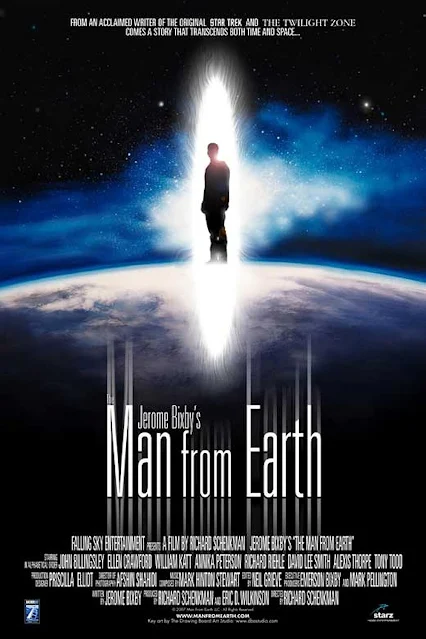
The Man From Earth is an intellectual science fiction drama directed by Richard Schenkman with a screenplay by Jerome Bixby, known for his work on classic sci-fi series like Star Trek. The film presents an unusual setting, primarily confined to a single room where profound philosophical discussions unfold among university professors and scholars.
This minimalist approach focuses on dialogue rather than action or special effects, making the film an outlier in its genre, similar to Primer or Coherence. Jerome Bixby's script, completed on his deathbed, serves as his final contribution to the sci-fi genre, encapsulating a lifetime of thematic exploration into a narrative that is as introspective as it is innovative.
The story revolves around John Oldman, a retiring university professor who reveals to his colleagues that he is actually a 14,000-year-old caveman who has survived through the centuries, adapting to each new age. The reveal prompts a series of intense debates among the group, covering topics from history and religion to science and morality, all driven by their varied reactions to John’s staggering disclosure.
What distinguishes The Man From Earthin the cinematic landscape is not just its contemplative nature, but also how it reached its audience. Initially released to little fanfare, the film gained a significant following through file-sharing networks, an unconventional path that sparked widespread interest and discussion.
This digital word-of-mouth phenomenon underscored the film’s appeal to a niche audience that appreciates cerebral narratives. The grassroots spread of the film through these networks is a testament to its resonating themes and the enduring appeal of thought-provoking storytelling.
One of the most compelling aspects of The Man From Earth is its exploration of immortality through the eyes of its protagonist, John Oldman.
Immortality, often a subject relegated to the realms of fantasy and science fiction (check out The Highlander), is approached here with a grounded, philosophical lens. John's character serves as a conduit for examining the impact of eternal life on personal identity, human connection, and historical continuity. As he recounts his experiences from various historical eras, the film invites viewers to ponder the burdens and blessings of an unending life.
The narrative structure of the film closely mirrors the Socratic method, a form of cooperative argumentative dialogue that stimulates critical thinking and illuminates ideas. Each character in the film represents different philosophical and practical standpoints, providing a spectrum of responses to John's incredible claim.
These dialogues not only propel the plot but also engage the audience in a broader philosophical debate concerning the nature of truth, the reliability of historical knowledge, and the existential solitude that might accompany an immortal being.
Themes Analysis of The Man From Earth
Humanity and Time
The Man From Earth intricately weaves the passage of time into its narrative fabric, presenting a unique perspective on how centuries can shape an individual's worldview and human relationships. John Oldman, as a character who has lived through millennia, provides insights into how historical events are experienced on a personal level, influencing and being influenced by the ever-changing human condition.
The film prompts viewers to consider the implications of historical perspective on contemporary issues, questioning whether having such an expansive backdrop of experience could lead to wisdom or detachment.
Isolation and Loneliness
Despite his extensive lifespan, John's journey is marked by a profound sense of isolation and loneliness, themes that resonate deeply within the human psyche.
The film explores the paradox of living forever but without the ability to form lasting human connections, as everyone around John ages and dies. This eternal solitude highlights the intrinsic value and inevitability of mortality in shaping human relationships.
The character's eternal life becomes a lens through which the audience can explore their fears and curiosities about solitude, belonging, and the essence of human connection.
Skepticism and Belief
A central theme in The Man From Earth is the dynamic interplay between skepticism and belief, as John’s colleagues react in varying degrees of disbelief and acceptance to his story. This theme not only drives the narrative but also engages the audience in a reflection on the nature of belief itself.
What do we choose to believe and why?
How do our existing beliefs shape our reactions to new, challenging information?
The film uses this conflict to delve into the broader implications of epistemology, the study of knowledge and justified belief, making the audience question the foundations of their understanding of the world.
Change and Continuity
Throughout the film, there is a persistent exploration of what changes over time and what remains constant. While technology, societies, and landscapes evolve, human emotions, fundamental desires, and existential questions remain largely the same.
John's character highlights the constants of human nature against the backdrop of changing historical contexts, suggesting that while the external world transforms, the core of human experience — the joys, sorrows, fears, and hopes — transcends time. This theme challenges the viewer to consider the balance between embracing change and recognizing the timeless aspects of their own nature.
Each of these themes is not only a reflection of the film's narrative depth but also a mirror for the audience to examine their perceptions of time, belief, change, and the human condition.
The Man From Earth uses its minimalist setting and dialogue-heavy script to craft a compelling philosophical inquiry into these perennial questions, making it a profound study of both individual and collective human experiences.
Relevance to Contemporary Issues
The themes explored in The Man From Earth resonate deeply with a number of contemporary societal issues, shedding light on universal human concerns that are as relevant today as they were in the past. The film's philosophical discourse prompts us to reflect on our own societal norms, beliefs, and the nature of truth in an age dominated by information and misinformation alike.
The eternal perspective offered by John's character allows for a unique critique of modern societal norms. For instance, his insights into historical human behaviors and societies challenge contemporary views on progress and morality. The film subtly prompts viewers to question the inevitability of societal advancement and whether human nature fundamentally changes over time or remains constant despite technological and cultural evolution.
The Man From Earth also delves into the ethical dilemmas associated with immortality, knowledge, and the passage of time. John's reluctance to reveal his secret underscores the potential consequences of sharing knowledge that challenges established beliefs and paradigms. This poses ethical questions about the responsibility that comes with knowledge — whether certain truths are too burdensome to share, and how such truths might impact the fabric of society.
Character Study
John Oldman, the protagonist of The Man From Earth, is a character who epitomizes the eternal struggle between past and present, memory and identity. His life spans over 14,000 years, during which he has assumed numerous identities and witnessed the entirety of human history firsthand. Yet, despite his extraordinary experiences, John is portrayed with an acute sense of humanity and vulnerability. His decision to finally reveal his secret to his close friends opens a Pandora's box of ethical dilemmas and emotional conflicts.
He is not just sharing a fantastic tale but is also seeking relief from the burden of eternal solitude.
As the narrative unfolds, John grapples with the loneliness that comes from outliving everyone he has ever loved or befriended. His immortality, which might initially seem like a coveted gift, is portrayed as a profound curse that isolates him from the rest of humanity. This internal conflict is central to John's character arc—his need for connection and understanding from his peers contrasts sharply with his instinct to protect himself from rejection and disbelief.
His struggle is emblematic of the human condition: the tension between the desire to share one's truth and the fear of isolation it might bring.
Interactions and Impacts
The dynamics between John and his colleagues are pivotal in exploring the film’s deeper themes. Each character represents a different philosophical and emotional response to John’s revelation, thus enriching the narrative with a spectrum of human reactions to the inconceivable.
Edith: A devout Christian, Edith's reaction to John's story is one of deep distress and denial. Her response highlights the theme of belief systems challenged by conflicting narratives. Her struggle with John’s claims offers a poignant look at the conflict between faith and empirical reality, emphasizing the theme of personal belief in the face of overwhelming contradiction.
Dan: As a biologist, Dan approaches John's story with scientific skepticism and curiosity. His demands for proof and his attempts to rationalize John’s existence through scientific principles underscore the film’s exploration of skepticism. Dan’s perspective brings to light the scientific community's reliance on evidence and the challenges posed by extraordinary claims that defy conventional understanding.
Art: A historian and one of John's closest colleagues, Art reacts with a mixture of intrigue and skepticism. His knowledge of history makes him both a critical and a potentially sympathetic audience to John’s narratives. Art's interaction with John probes the theme of historical truth and the reliability of personal testimony as a historical document.
Sandy: Her developing romantic interest in John adds another layer to the narrative. Sandy's reactions provide insights into the human desire for connection and the complexities of forming relationships under extraordinary circumstances. Her openness to John's story contrasts with others' skepticism, illustrating the range of human emotion from doubt to acceptance.
Conclusion
The Man From Earth concludes with a lingering impact, leaving audiences to ponder the weight of its themes. The film’s ability to engage with profound philosophical questions through a minimalist setup is a testament to its thoughtful script and compelling character dynamics.
As viewers reflect on the narrative and its themes, the film encourages a deeper appreciation for the complexities of human life and the timeless questions that continue to intrigue and challenge us.
By articulating these themes and their implications, the film not only enriches our understanding of narrative storytelling but also enhances our introspection about life’s perennial questions. The Man From Earth remains a poignant reflection on what it means to be human across the ages, making it a significant work for both philosophical discussion and personal contemplation.
A key element of this intricate tapestry is the Spacing Guild, an organization that holds a monopoly on interstellar travel, essential to the socio-economic fabric of the universe. Navigators, transformed by their consumption of spice, possess the ability to foresee safe paths through the cosmos. This makes them indispensable for space travel and valuable assets in the universe’s power dynamics.
This capability extends beyond mere navigation. It serves as a crucial political tool within the galaxy's intricate power structures. By examining how Paul Atreides, a central figure in the Dune saga, manipulates these dynamics, we can delve into the strategic use of the Spacing Guild's resources in his quest for power and subsequent orchestration of a galaxy-wide Jihad.
The Guild holds the galaxy together, yet remains vulnerable to the source of its power.
I. The Spacing Guild and Its Monopoly on Space Travel
The Spacing Guild occupies a central position in the universe of "Dune," serving as the sole entity capable of facilitating interstellar travel. This monopoly is not merely a commercial advantage but a profound strategic asset that holds the entire interstellar economy and political structure in its grip. The Guild's exclusivity in space navigation is protected and reinforced by its secretive and highly specialized cadre of Navigators, who rely on the psychoactive spice melange to perform their duties.
Spice melange, the most valuable commodity in the universe, is the linchpin of the Guild’s power. Harvested on the desert planet of Arrakis, spice is essential not only for the extended lifespan and expanded consciousness it offers but also for the prescient abilities it provides to those who consume it in significant quantities. For the Navigators, spice consumption allows them to transcend normal space-time perception. It grants them the unique ability to foresee and navigate safe paths through folded space.
Navigators are the elite within the Guild, having undergone profound physical and mental transformations due to their heavy spice intake. These changes are not merely superficial; they represent a fundamental evolution that enables Navigators to perceive and manipulate the fabric of space-time. With their enhanced awareness, Navigators visualize potential dangers and opportunities in the space-time continuum, plotting courses that avoid celestial hazards and enemy blockades, thus ensuring safe and efficient travel between distant points in the galaxy.
A Navigator in their tank, submerged in Spice gas.
II. Navigators as Political Tools
The unique abilities of the Spacing Guild's Navigators not only ensure the monopoly over space travel but also elevate them to pivotal actors in the political theater of the "Dune" universe. Their capability to navigate through folded space, a feat that requires the foresight provided by the spice melange, transforms them into invaluable assets for political strategy and manipulation.
Navigators, with their enhanced prescient abilities, offer more than just safe passage through the cosmos. They provide strategic intelligence that is crucial in a universe where information is as potent a weapon as any fleet or army. Their foresight can predict the outcomes of military engagements, economic shifts, and political alliances, making them essential advisors to the ruling powers. This prescience places the Guild in a unique position to act as kingmakers or power brokers, subtly guiding the course of events from behind the scenes.
Control over interstellar travel grants the Spacing Guild a form of soft power that is unmatched. By regulating who can travel where and when, the Guild can effectively control economic sanctions, military reinforcements, and the flow of goods and information. This control extends to influencing the political stability of entire planets, as access to spice and space travel capabilities directly affects a planet's economy and its political hierarchy.
III. Paul Atreides and His Manipulation of the Guild
Paul Atreides' rise to power in Frank Herbert's "Dune" is a compelling study of strategic genius, exploiting existing power structures and turning potential weaknesses into strengths. Among his most crucial maneuvers is his mastery over the Spacing Guild's reliance on spice melange, which he uses to cement his control and launch his galactic Jihad.
Understanding the Guild's critical dependence on spice, Paul uses this as a bargaining chip to negotiate terms that favor his agenda. By threatening to destroy the spice if his demands are not met, Paul effectively holds the Guild, and thereby the whole galaxy, hostage. This bold strategy forces the Guild to comply with his directives, making them unwilling accomplices in his broader plans.
Concept design illustrating the distorted physiology of the Navigators.
The ascendancy of Paul Atreides and his tactical manipulation of the Spacing Guild not only redefine the political landscape of the "Dune" universe but also bring profound long-term implications for interstellar politics and the stability of the galaxy.
Paul's dominance over the spice production on Arrakis places the Spacing Guild in an unprecedented position of vulnerability. The Guild, once a behemoth of political neutrality and economic power, finds itself at the mercy of a single ruler's whims. This shift dramatically alters the Guild's role from an independent power broker to a tool in Paul's expansive arsenal. The reduction of their autonomy challenges their long-standing position as a neutral entity, potentially inciting internal and external conflicts within the Guild.
Paul's adept manipulation of the Spacing Guild underscores a central theme in "Dune": the intricate interplay of power, resource control, and destiny.
The immense size of the Guild Heighliners compared to standard frigates.
Conclusion
The repercussions of Paul's strategies extend beyond his immediate political and military goals. They prompt a reevaluation of the Guild's role and neutrality, instigating shifts in interstellar politics that would resonate through subsequent narratives in the "Dune" series.
These developments reflect broader themes relevant to any analysis of power and control, suggesting that the dynamics at play in "Dune" are not merely fictional constructs but allegories for real-world issues of resource management, political leverage, and strategic foresight.
In conclusion, "Dune" presents a complex universe where power is intricately linked to knowledge and control over critical resources. The Spacing Guild, with its monopoly over interstellar travel and its cadre of prescient Navigators, stands at the center of this power web. It is influenced and manipulated by those who understand and exploit the essential truths of the universe. Paul Atreides' mastery over these elements not only cements his legacy as a formidable leader but also serves as a compelling study of resource-based power dynamics that resonate across time and space, both in Herbert's universe and our own.
Shutter Island, directed by Martin Scorsese and starring Leonardo DiCaprio (Inception, The Aviator), is a psychological thriller that thrives on uncertainty. Set in 1954, the film follows U.S. Marshal Teddy Daniels and his partner Chuck Aule as they travel to Ashecliffe Hospital, a remote psychiatric facility on Shutter Island, to investigate the disappearance of a patient. What begins as a standard mystery quickly spirals into something far more disturbing.
The story mirrors Teddy’s unraveling mind. Disorienting edits, strange behaviors, and continuity errors aren’t mistakes—they’re signals. From the very first frame, the audience is being led through a psychological maze built on shifting ground.
As the investigation deepens, the film reveals subtle but deliberate clues that something isn’t quite right. Teddy’s sense of control begins to erode, and reality slips.
From the start, the signs are there. Teddy’s seasickness on the ferry isn’t just physical—it’s a metaphor. His mind is already off balance. Chuck, his new partner, fumbles with his sidearm, an odd blunder for a U.S. Marshal. That moment quietly hints that Chuck might not be who he claims to be.
As the investigation gets underway, warning signs mount. A patient slips Teddy a note that says “RUN.” The message is cryptic, urgent—and possibly meant more as an internal alarm than a literal threat. Teddy also experiences vivid hallucinations. His dead wife, Dolores, appears in dreams, warning him about the island. He sees disturbing visions of his time liberating Dachau. These aren’t random—they’re symptoms.
His trauma is bleeding into his perception.
Then there's the now-infamous scene of the nurse who appears to drink from an invisible glass of water.
It happens quickly, but it's unsettling. That single frame, where the motion of drinking occurs with no glass present, is a gut-check from Scorsese. Not everything Teddy sees is real. The film is telling you: trust nothing.
Environmental cues reinforce this. Teddy is repeatedly denied access to key areas and records. Staff members are evasive, constantly redirecting his questions. Dr. Cawley, the hospital’s head psychiatrist, seems more interested in provoking Teddy than helping him. Even something as simple as lighting a cigarette is a clue—Teddy never has his own matches.
Because patients aren’t allowed to.
As his investigation continues, Teddy zeroes in on a mysterious inmate named Andrew Laeddis—the man he believes set the fire that killed his wife. But the deeper he digs, the more fragmented his world becomes. The lighthouse becomes his obsession, a symbol of hidden truth.
Eventually, it all cracks open. In the film’s climactic reveal, Teddy learns he is Andrew Laeddis. He’s not a Marshal, he’s a patient. The investigation was never real.
It was an elaborate role-play, orchestrated by the doctors as a last-ditch attempt to break through his delusion.
Chuck?
He’s actually Dr. Sheehan, his psychiatrist, playing along in the hope that Teddy will confront his reality.
But even after the truth is revealed, the film doesn’t settle. In the final scene, Teddy sits on the hospital steps with Dr. Sheehan. Calm. Composed. Then he asks the question that reframes the entire story:
“Which would be worse—to live as a monster, or to die as a good man?”
It’s a line heavy with ambiguity. Does it mean Teddy has truly recovered, but chooses to pretend—opting for the comfort of his Marshal persona over living with the guilt of what he’s done? Or is this just another layer of the delusion, one final fantasy where he gets to go out on his own terms?
Either way, it’s tragic. And that’s the brilliance of Shutter Island. It doesn’t hand you easy answers. It leaves you stranded in the same place as its protagonist—unsure of what’s real, haunted by memory, and forced to question whether truth is something you face… or something you run from.
The upcoming live-action Alien TV series, developed by Noah Hawley, the visionary behind Fargo and Legion, positions itself intriguingly within the established timeline of the Alien franchise.
Scheduled to unfold towards the end of the 21st century, the series is strategically set a few years before the events of Prometheus and approximately three decades prior to the harrowing journey of the Nostromo in Ridley Scott's original 1979 film, Alien.
This placement in the timeline offers a fresh perspective by situating the narrative just as the infamous Weyland-Yutani Corporation begins to rise to prominence.
In a significant departure from previous entries in the series, which primarily unfolded on distant planets and space stations, this Alien series marks the first time the storyline will take place on Earth.
Noah Hawley’s revelation that the series will extend beyond a single season into a multi-season arc with a "three-act story" underscores an ambitious approach to exploring the Alien universe.
At The Astromech, you can expect to find a variety of articles, reviews, and analysis related to science fiction, including books, movies, TV, and games. From exploring the latest news and theories to discussing the classics, I aim to provide entertaining and informative content for all fans of the genre.
Whether you are a die-hard Star Trek fan or simply curious about the world of science fiction, The Astromech has something for everyone. So, sit back, relax, and join me on this journey through the stars!