06 October 2023

The themes of The Phantom Menace


Thematic Insights in Star Wars: The Phantom Menace

"The Phantom Menace," the inaugural entry in the Star Wars prequel trilogy, unfurls a rich tapestry of themes, echoing across the vastness of the galaxy and resonating with profound human experiences. Though debated across the galactic HoloNet, its thematic core remains a compelling subject for deeper contemplation, inviting exploration into the philosophical currents that flow beneath the surface narrative.

This series of explorations seeks to illuminate the intricate themes woven into the film's fabric, offering an in-depth analysis that transcends the surface-level conflicts and characters. These themes serve as more than mere plot devices; they are imbued with cultural, ethical, and philosophical weight. They act as a mirror reflecting the turbulent currents of societal dynamics, a lens magnifying the universal spectrum of human emotions, and a gateway into the enduring ethical and existential quandaries that have captivated sentient beings for millennia.

From the intricate political machinations that mirror the complexities of governance in our own star systems, to the timeless Hero's Journey that reverberates through the sagas of countless worlds, to the pressing ethical and ecological considerations that gain increasing significance in our present era, each theme enriches the film with layers of complexity and profound insight.

It's within this narrative that Lucas' reflection on Star Wars as a form of poetic mirroring begins to truly take shape, where echoes of the past resonate with the present, creating a saga that rhymes across generations.
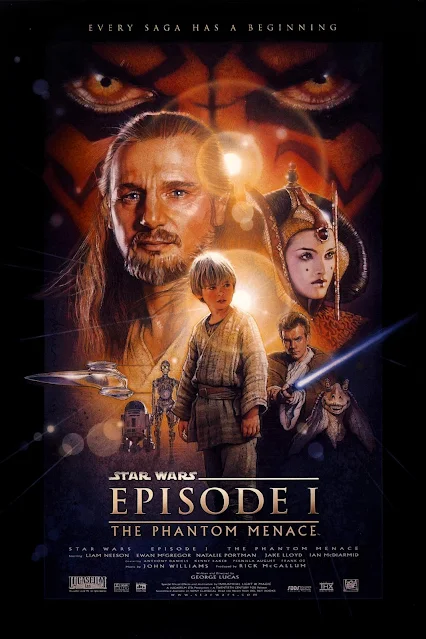
themes the phantom menace

Unraveling the Political Intrigue in "The Phantom Menace"

In The Phantom Menace, the currents of political intrigue are not mere background noise but a potent force propelling the narrative, immersing viewers in the intricacies of galactic governance. This theme is vividly portrayed through the Galactic Senate—a sprawling institution intended as the democratic voice of countless star systems. Yet, the Senate is far from a beacon of pure democracy; it is a labyrinth of bureaucracy, ensnared by the tendrils of corruption, inefficiency, and self-interest.

The Galactic Senate: A Reflection of Political Realities

The Galactic Senate is crafted as a mirror reflecting the political structures of our own world, where envoys from diverse planets and sectors convene to shape decisions impacting the entire galaxy. However, its sluggish response to the trade dispute and the subsequent blockade of Naboo starkly exposes its inherent dysfunctions. This paralysis mirrors the ineffectiveness often found in real-world political bodies, where bureaucratic entanglements can impede timely and decisive governance. By situating these events within a technologically advanced civilization, the film amplifies and critiques the enduring flaws within our own systems of power.

Queen Amidala: The Disillusioned Idealist

Queen Amidala emerges as the film’s moral compass, a beacon of youthful idealism amidst the murky waters of galactic politics. Despite her tender years, she possesses a wisdom that belies her age, holding a steadfast belief in diplomacy and the sanctity of law. Her journey to Coruscant, the heart of the Republic, is fueled by the hope that the Senate will intervene to alleviate the suffering of her people. However, her aspirations soon collide with the harsh realities of political manipulation and indifference, shattering her faith in the very system she once revered. Amidala’s arc serves as a poignant commentary on the enduring conflict between idealism and the often-brutal realities of political power, illustrating how even the purest intentions can be crushed by the relentless machinery of governance.

Senator Palpatine: The Master Manipulator

In stark contrast to Queen Amidala stands Senator Palpatine, a shadowy figure who possesses a profound understanding of the Senate's intricate workings and the subtle art of manipulating them to his own advantage. Palpatine’s cunning is evident in his calculated use of the Naboo crisis as a stepping stone to advance his own political ambitions, ultimately securing the esteemed position of Supreme Chancellor. He embodies the darker facets of politics—deception, shrewdness, and the relentless pursuit of power. His character serves as a cautionary narrative, illustrating how individuals with malevolent intentions can exploit systemic vulnerabilities for personal gain.

Galactic Politics as a Lens

The enduring power of the political intrigue theme in "The Phantom Menace" lies in its profound universality. While set against the backdrop of a galaxy far, far away, the political machinations depicted are instantly recognizable. The film masterfully employs elements of science fiction, such as advanced civilizations and interstellar travel, to create a unique lens through which we can critically examine the inherent flaws within our own societal structures.

The Hero's Journey: Anakin Skywalker's Transformative Arc in "The Phantom Menace"

The Hero's Journey, a narrative framework woven into the fabric of storytelling across diverse cultures and epochs, finds a compelling embodiment in "The Phantom Menace" through the character of Anakin Skywalker. His story offers a rich and intricate exploration of transformation, from his humble beginnings as a slave on the desert planet of Tatooine to his emergence as a promising Jedi apprentice.

The Mundane World: Anakin's Life on Tatooine

Anakin's journey commences in the ordinary world of Tatooine, a harsh desert planet where he lives a life bound by servitude. As a slave to the junk dealer Watto, his existence is one of toil and limitation. This initial setting serves as a stark contrast to the extraordinary destiny that awaits him, emphasizing the pivotal "call to adventure" that will eventually disrupt his mundane existence. His humble origins also imbue his journey with a relatable quality, echoing the universal motif of rising above adversity.

The Call to Adventure: Qui-Gon Jinn's Discovery

The "call to adventure" within the Hero's Journey often manifests through an external figure who recognizes the hero's latent potential. In Anakin's narrative, this role is fulfilled by the wise Jedi Master Qui-Gon Jinn. Qui-Gon not only secures Anakin's freedom but also introduces the profound notion that the young boy might be the prophesied "Chosen One," destined to bring balance to the Force. This revelation sets the stage for Anakin's internal and external struggles as he grapples with a destiny far exceeding the confines of his previous life.

Key Milestones: Podrace, Jedi Trials, and the Final Battle

Anakin's Hero's Journey is punctuated by several crucial milestones that serve to test his abilities and resolve. The exhilarating Podrace on Tatooine stands as his initial trial, where he must not only win his freedom but also demonstrate his exceptional piloting skills. The subsequent Jedi trials present a different set of challenges, probing his mental and emotional readiness to embrace the path of a Jedi. The climactic battle against the Trade Federation serves as the culmination of his journey within the film, where he inadvertently steps into the role of a hero, destroying the droid control ship and liberating Naboo.

The Complexity of Destiny and Prophecy

Adding a profound layer of complexity to Anakin's Hero's Journey is the intricate concept of destiny and the ancient prophecy of the "Chosen One." Unlike many traditional heroes who forge their own paths, Anakin's journey is seemingly preordained, imbuing his character arc with a sense of both inevitability and underlying tragedy. This exploration raises profound questions about the interplay between free will and destiny, enriching the narrative with significant philosophical undertones.

The Timeless Allure of the Hero's Journey: Anakin's Tale

Anakin's captivating narrative resonates deeply because it mirrors the enduring archetype of the Hero's Journey. His story delves into profound themes of personal liberation, the weight of preordained fate, and the intricate moral complexities that accompany power and responsibility. Even against the fantastical backdrop of a galaxy teeming with starships, droids, and the mystical Force, the emotional and ethical dilemmas he confronts are deeply rooted in the universal human experience, rendering his journey profoundly relatable.

Duality and Balance: Philosophical Foundations of "The Phantom Menace"

The fundamental principle of duality and the pursuit of balance are threads woven throughout the fabric of the Star Wars saga, and "The Phantom Menace" serves as a crucial cornerstone in exploring this profound concept. The Force, the mystical energy that binds the galaxy, is presented as having two opposing aspects: the radiant Light Side and the shadowy Dark Side. This fundamental dichotomy acts as a potent metaphor for the dualistic nature of existence itself, encompassing the eternal interplay between good and evil, life and death, creation and destruction. This exploration endeavors to dissect the theme of duality and balance within "The Phantom Menace," focusing on pivotal scenes, key characters, and the broader philosophical implications of this central theme.

The Force: A Metaphysical Concept

The Force transcends its role as a mere plot device; it functions as a profound metaphysical concept that underpins the entire Star Wars universe. It is depicted as an omnipresent energy field that permeates all living beings, binding the galaxy in an intricate web of interconnectedness. However, the Force is not a monolithic entity; it possesses a dual nature. The Light Side is associated with selfless acts, compassion, and the power of healing, while the Dark Side is intrinsically linked to aggression, hatred, and the insatiable quest for power. This inherent duality is not merely a narrative element but a significant philosophical concept, inviting viewers to contemplate the fundamental nature of existence itself.

Qui-Gon Jinn and Yoda: The Philosophers of the Force

The characters of Qui-Gon Jinn and the venerable Yoda serve as primary figures who articulate and embody the theme of duality and balance within the Force. Qui-Gon, a maverick Jedi Master, often follows his intuition and holds a strong belief in the prophecy of the "Chosen One" who will ultimately bring balance to the Force. Yoda, in contrast, embodies the institutional wisdom of the Jedi Order, often expressing caution and skepticism towards Qui-Gon's unconventional views. Their interactions serve as philosophical dialogues, delving into the intricate complexities of the Force and the elusive concept of balance.

The Final Duel: A Battle of Dualities

The climactic duel, a thrilling confrontation between Qui-Gon, Obi-Wan Kenobi, and the menacing Darth Maul, stands as a pivotal moment that powerfully encapsulates the theme of duality and balance. Darth Maul, wielding his iconic dual-bladed lightsaber, visually embodies this concept. However, the battle transcends a mere clash of weapons; it is a profound clash of philosophies and moralities. Known as the Duel of the Fates, it serves as a microcosm of the larger conflict between the Light and Dark Sides of the Force, with the outcome holding the potential to shape the ultimate destiny of young Anakin Skywalker.

This pivotal duel carries immense weight as it indirectly influences Anakin's future trajectory. Qui-Gon, a steadfast believer in Anakin's destiny to bring balance to the Force, fights with unwavering determination to ensure the boy's Jedi training. Darth Maul, acting as an agent of the encroaching darkness, seeks to eliminate any potential threat to the Sith's growing power. The resolution of this intense battle will determine whether Anakin is guided towards the Light Side under the tutelage of the Jedi or potentially succumbs to the seductive allure of the Dark Side. Thus, the duel itself symbolizes the ongoing struggle for Anakin's very soul, a dramatic contest between the forces of light and darkness vying for control over his fate.

The Droid Army: Technology as a Force of Destruction

The Trade Federation's formidable droid army represents the antithesis of natural balance, showcasing technology wielded as a force of destruction and domination. These mechanical soldiers are devoid of empathy and ethical considerations, programmed to execute orders without question or remorse. Their invasion of the peaceful planet of Naboo is not merely a military action but also an ecological disruption, threatening the planet's delicate natural harmony. This narrative element serves as a cautionary tale, highlighting the potential dangers of advanced technology when divorced from ethical considerations and wielded solely for the pursuit of power.

The Battle of Naboo: A Clash of Philosophies

The decisive Battle of Naboo effectively encapsulates the underlying tension between technology and nature. On one side stand the indigenous Gungan people, utilizing their energy shields and organic "booma" projectiles—weapons more attuned to the natural world. On the opposing side is the relentless droid army, armed with blasters and armored tanks, representing the stark efficiency of industrialized warfare. The conflict extends beyond a mere struggle for political control; it serves as a symbolic clash of philosophies regarding the ethical implications of technological advancement and its impact on the natural order.

Identity and Self-Discovery: The Quest for Self in "The Phantom Menace"

The intricate theme of identity and the profound journey of self-discovery form a cornerstone of "The Phantom Menace," lending emotional depth to its characters and adding a significant layer of complexity to its narrative tapestry. The film delves into how individuals grapple with their assigned roles, inherent responsibilities, and seemingly predetermined destinies within a galaxy constantly roiled by conflict and transformation. This exploration aims to dissect the theme of identity and self-discovery in "The Phantom Menace," focusing on pivotal scenes, key characters, and the broader implications of this fundamental human quest.

Anakin Skywalker: The Slave Turned Hero

Anakin Skywalker's transformative journey from a life of servitude on Tatooine to his potential destiny as a Jedi apprentice is a poignant exploration of identity and self-discovery. Initially defined by his oppressive circumstances as a slave, his encounter with the enigmatic Qui-Gon Jinn acts as a powerful catalyst for profound change, offering him a new identity as the prophesied "Chosen One." Anakin's internal struggle to reconcile his past limitations with his newfound destiny adds significant emotional resonance to his evolving character arc.

Padmé Amidala: The Queen in Disguise

Padmé Amidala, the young and resolute Queen of Naboo, also embarks on a significant journey of self-discovery. She strategically adopts the guise of a handmaiden, a deliberate act to transcend the confines of her royal identity and gain firsthand understanding of the challenges faced by her people. Her dramatic revelation of her true identity during the height of the crisis on Naboo marks a pivotal moment, signifying her complete acceptance of her role and the weighty responsibilities that come with leadership. It's a nuanced portrayal of the complexities of leadership and the multifaceted nature of identity within a position of considerable power.


Themes of "The Phantom Menace"

Theme NameDescriptionKey ScenesCharacter InvolvementSci-Fi ElementsCultural Impact
Political IntrigueExploration of the political landscape, including the Senate, trade disputes, and the role of democracy.Senate meetings, discussions between Queen Amidala and Palpatine, blockade of Naboo.Queen Amidala, Senator Palpatine, Jedi Council, Trade Federation.Galactic politics, advanced civilizations, holographic communication.Reflection on real-world politics and governance, critique of bureaucracy and political corruption.
The Hero's JourneyThe classic narrative arc followed by Anakin Skywalker, from obscurity to potential greatness.Podrace on Tatooine, Jedi trials, final battle against the Trade Federation.Anakin Skywalker, Qui-Gon Jinn, Obi-Wan Kenobi, Shmi Skywalker.Destiny, the concept of the "Chosen One," advanced technology like podracing and lightsabers.Reinforces the universal hero's journey motif, inspiring countless other narratives.
Duality and BalanceExploration of the balance between the light and dark sides of the Force.Conversations between Qui-Gon and Yoda, the final duel with Darth Maul.Qui-Gon Jinn, Yoda, Darth Maul, Obi-Wan Kenobi.The Force as a metaphysical energy, moral ambiguity, dual-bladed lightsaber.Philosophical discussions on good vs. evil, Yin and Yang concepts.
Technology vs. NatureThe juxtaposition of advanced technology and natural elements.The Gungan city, the droid army invasion of Naboo, the destruction of the droid control ship.Gungans, droid army, Naboo citizens, Queen Amidala.Underwater cities, advanced weaponry like blasters and droid starfighters, force fields.Environmentalism and the ethics of technology, man vs. nature debates.
Identity and Self-DiscoveryCharacters grappling with their roles and destinies.Anakin leaving home, Amidala revealing her true identity as Queen of Naboo.Anakin Skywalker, Padmé Amidala, Qui-Gon Jinn.Holographic disguises, droid decoys for security.Themes of personal growth and self-acceptance, the complexity of identity in a changing world.

George Orwell: An In-Depth Overview

George Orwell, born Eric Arthur Blair in 1903 in British India, was an English writer and journalist who gained international fame for his insightful and provocative works. 

His pen name, "George Orwell," was adopted as a nod to the River Orwell in Suffolk, a place he held dear. Orwell's literary contributions are not merely confined to the realm of fiction; he was also a prolific essayist and critic. 

His works are characterized by a razor-sharp focus on social injustice, the dangers of totalitarianism, and the manipulation of language for political ends. His writings have transcended time, making him one of the most enduring and relevant authors of the 20th century.

novellist george orwell biography

"Animal Farm" (1945)

"Animal Farm" is a satirical allegory that serves as a scathing critique of totalitarian regimes, specifically reflecting the events leading up to the Russian Revolution of 1917 and the Stalinist era that followed. The story unfolds on a farm where animals, tired of their human master's oppressive rule, stage a revolution. However, the revolution's ideals are soon corrupted when the pigs, particularly Napoleon and Snowball, take control.

The farm becomes a microcosm of a totalitarian state, complete with propaganda, manipulated history, and a revised set of commandments that serve the pigs' interests. The book brilliantly captures the cyclical nature of oppression, showing that the new animal rulers become indistinguishable from the humans they overthrew.

"Nineteen Eighty-Four" (1949)

"Nineteen Eighty-Four" is Orwell's magnum opus, a dystopian novel set in the superstate of Oceania, where the Party, under the omnipresent gaze of Big Brother, exercises totalitarian control. The protagonist, Winston Smith, is a low-ranking member of the Party who works at the Ministry of Truth.

His job involves altering historical records to align them with the Party's ever-changing narrative. The Thought Police, Newspeak, and the concept of doublethink are Orwellian inventions that delve into the psychology of totalitarianism. The novel is not just a political warning but also a deep exploration of the human psyche under extreme conditions.

Other Notable Works and Their Contemporary Resonance

  • "Homage to Catalonia" (1938): This autobiographical work is based on Orwell's experiences fighting in the Spanish Civil War. The book is a complex narrative that delves into the ideological conflicts between various factions of the anti-fascist forces. It serves as a cautionary tale about the dangers of political infighting and ideological purity, themes that are increasingly relevant in today's polarized world.


  • "Down and Out in Paris and London" (1933): This semi-autobiographical account explores the grim realities of poverty, homelessness, and social marginalization. Orwell lived the life he described, working as a dishwasher in Paris and living as a tramp in London. The book is a poignant commentary on the systemic issues that perpetuate poverty and inequality, issues that remain pressing in modern society.

Modern-Day Relevance: Orwell in the 21st Century

Surveillance and Privacy

The concept of Big Brother from "Nineteen Eighty-Four" has found renewed relevance in our current digital age, where mass data collection, facial recognition technology, and government surveillance have become ubiquitous. The ethical implications of such surveillance are hotly debated, making Orwell's cautionary tale more pertinent than ever.

Political Manipulation and Fake News

Orwell's exploration of language manipulation, epitomized by the Ministry of Truth in "Nineteen Eighty-Four," has striking parallels with today's era of disinformation, "fake news," and state-sponsored propaganda. The term "Orwellian" is often invoked to describe manipulative language that distorts reality for political ends.

Social Inequality

The theme of social hierarchy and inequality in "Animal Farm" continues to resonate in contemporary discussions about economic disparity, systemic racism, and social justice. The book serves as a timeless critique of how power structures are maintained and manipulated to benefit a select few at the expense of many.

Ideological Extremism

Orwell's "Homage to Catalonia" provides an in-depth look into the perils of ideological extremism and factionalism. In a world where extreme ideologies, whether far-right nationalism or radical leftism, are on the rise, the book serves as a sobering reminder of the complexities and dangers of political dogmatism.

Sci-Fi Tropes & Themes: Orwell's Unintentional Foray into Science Fiction

While Orwell's works are primarily political allegories rather than science fiction, they share several tropes common to the genre:

  • Dystopian Futures: Both "Animal Farm" and "Nineteen Eighty-Four" offer bleak visions of society gone awry, a theme that has been extensively explored in dystopian science fiction from "Brave New World" to "The Handmaid's Tale."

  • Technological Control: The way technology is used for surveillance and control in "Nineteen Eighty-Four" has been a significant influence on cyberpunk literature, which often explores the dark side of technological advancement.

Concluding Thoughts

George Orwell's novels serve as timeless commentaries on the human condition, exploring themes of power, freedom, and social justice. They offer a complex tapestry of characters and situations that resonate deeply with contemporary issues, from the erosion of privacy to the rise of disinformation. As we navigate the complexities of the 21st century, Orwell's works stand as essential reading, offering both a warning and a guide for understanding the intricate dynamics of power and resistance.

"From Big Brother to Newspeak: An In-Depth Analysis of '1984's' Core Themes"

George Orwell’s 1984, published in 1949, is a novel whose relevance has only grown in the decades since its release. Set in a nightmarish dystopia ruled by a totalitarian regime, the book tells the story of Winston Smith, a disillusioned Party member who dares to question the system he is a part of. The narrative of 1984 is as much a psychological thriller as it is a political commentary, laying bare the terrifying lengths to which an authoritarian state will go to maintain control. 

Orwell’s vision of a society where truth is manipulated, privacy is nonexistent, and individuality is eradicated speaks directly to the challenges of our own time.

In this essay, we’ll explore the major themes of 1984—totalitarianism, surveillance, the manipulation of history and information, the individual vs. the collective, and the power of language—as Orwell crafted them. By examining these themes and their real-world implications, we can gain insight into the dangers of unchecked power, the erosion of civil liberties, and the complex relationship between language and thought.
themes of george orwell's 1984 novel


Totalitarianism and Authoritarianism: The Mechanisms of Control


At the heart of 1984 lies the Party, a totalitarian regime that exercises absolute control over every aspect of life in Oceania. Orwell doesn’t just depict a world of political oppression—he paints a picture of a society where even personal thoughts are monitored and regulated.

The Party, headed by the elusive figure of 'Big Brother', operates with an iron grip, utilizing surveillance, propaganda, and psychological manipulation to maintain power.


Big Brother as the Embodiment of Power

Big Brother is not a real person but a symbol of omnipresent authority. His image—on posters, stamps, and telescreens—fosters the illusion of constant surveillance, creating a sense of fear and compliance in the population. "Big Brother is watching you" becomes more than a slogan; it’s a chilling reminder that resistance is futile.

This all-seeing figure is less a leader and more an omnipotent force that dominates the lives of the people, ensuring their obedience not through force but through psychological intimidation.


Real-World Parallels

Orwell’s portrayal of totalitarianism draws clear comparisons to historical regimes like Stalin’s Soviet Union, Nazi Germany, and Maoist China, all of which maintained control through similar tactics—surveillance, propaganda, and terror. Although we no longer live in a world of such overt totalitarian regimes, 1984 serves as a warning.

The rise of authoritarian leaders in various parts of the world, where surveillance technologies and manipulation of public opinion are commonplace, suggests Orwell’s vision may not be as distant as we’d like to believe.


Surveillance and Privacy: The Erosion of Personal Freedom

In 1984, privacy is a luxury of the past. The Party’s extensive surveillance network ensures that every citizen is under constant watch, from the ubiquitous telescreens to the ever-present Thought Police. This relentless monitoring eliminates any space for personal freedom, making privacy an illusion.


Telescreens: The Tools of Control

The telescreen, a two-way device used by the Party, is the ultimate tool of surveillance. Not only does it broadcast propaganda, but it also monitors citizens' every move, listening for signs of dissent. In this environment, privacy ceases to exist. The Party’s surveillance is so complete that even in their homes, people are aware they are being watched.

This fear of constant surveillance creates a society where self-censorship becomes second nature, as individuals internalize the Party’s control and begin to police themselves.


The Thought Police: Ensuring Ideological Purity

Perhaps the most terrifying aspect of 1984’s surveillance system is the Thought Police. Their job isn’t just to monitor actions—it’s to monitor thoughts. Any deviation from the Party’s ideology, even if only mental, is punishable by death.

Orwell’s exploration of this theme taps into the primal fear that an oppressive regime doesn’t just want to control what you do, but also what you think.


Comparing Modern Surveillance

In today’s world, Orwell’s vision seems less fictional and more prescient. From facial recognition software to social media tracking, the tools used by governments and corporations to monitor citizens have never been more advanced.

Privacy is increasingly compromised, and while many of these technologies are marketed as ways to improve safety, they also raise serious questions about the balance between security and personal freedom.


Manipulation of Information and History: The Power of Control

Orwell’s portrayal of the Party’s manipulation of truth is one of the most disturbing aspects of 1984. Through the Ministry of Truth, the Party continually rewrites history to align with its current needs, erasing or altering records of the past to create a reality in which the Party is always correct.


The Ministry of Truth: Destroying Reality

Winston Smith’s job at the Ministry of Truth involves altering historical records so that they reflect the Party’s ever-changing narrative. If the Party decides that a certain event never happened or that a past ally is now an enemy, Winston and his colleagues erase all traces of that event from the historical record. This constant rewriting of history ensures that the Party always appears infallible, and the citizens of Oceania have no means of verifying the truth.


Doublethink and Historical Revisionism

Central to this manipulation is the concept of doublethink—the ability to hold two contradictory beliefs at the same time and accept both as true. The Party uses doublethink to make citizens accept the idea that history is not a fixed entity, but something that can be continuously rewritten to serve the needs of the present. This distorts reality to such an extent that the truth becomes whatever the Party says it is.


Reflections on Fake News and Historical Revisionism

In the modern world, Orwell’s warning about the manipulation of information is more relevant than ever. The rise of “fake news,” propaganda, and historical revisionism in political discourse highlights the ongoing struggle for control over the narrative. Whether it’s through state-sponsored censorship or the manipulation of media outlets, the ability to shape and distort information remains one of the most powerful tools at the disposal of those in power.


Individual vs. Collective: The Struggle for Autonomy

The conflict between the individual and the collective is a central theme in 1984. The Party demands absolute conformity, and any form of individuality is viewed as a threat. Winston’s internal struggle to retain his sense of self amid the overwhelming pressure to conform is the emotional heart of the novel.


Winston’s Rebellion

Winston is a man caught between his desire for personal freedom and the oppressive reality of a totalitarian society. His secret diary and his illicit love affair with Julia represent acts of rebellion, small but significant gestures of defiance against the Party’s control. These acts, though dangerous, are Winston’s attempts to reclaim some measure of individuality in a world that demands complete submission.


Julia and the Proles: The Limits of Resistance

Julia, Winston’s lover, represents a more pragmatic form of rebellion. Unlike Winston, she is not as concerned with overthrowing the Party but instead seeks personal pleasure and freedom within the system. Her form of resistance is quieter but no less defiant. In contrast, the Proles, who live outside the Party’s direct control, represent a kind of unacknowledged individualism. Though they enjoy more personal freedom than Party members, they lack the awareness or the will to challenge the status quo.


Contemporary Parallels

The tension between individual rights and collective responsibility remains a hot topic in modern societies. In democratic systems, the balance between personal freedoms and the needs of the collective—whether in the form of public health measures, security, or economic stability—is often debated. In more authoritarian regimes, however, the individual is consistently sacrificed for the supposed good of the state, as seen in 1984.


Language and Thought: The Power of Words

In 1984, Orwell presents a chilling exploration of how language can be used as a tool for control. The Party's creation of Newspeak, a language designed to limit the range of thought, is a masterstroke in its quest for total domination over the minds of its citizens.


Newspeak: Language as a Tool of Control

Newspeak is the official language of Oceania, and its purpose is clear: to eliminate the possibility of rebellious thought. By systematically reducing vocabulary and simplifying grammar, the Party ensures that individuals cannot articulate dissenting ideas. The very structure of the language prevents critical thought, making it impossible for citizens to even conceive of rebellion.


Thoughtcrime: The Ultimate Control

The concept of thoughtcrime—the act of harboring thoughts that contradict Party ideology—is central to the Party’s control over its citizens. Through the manipulation of language and the outlawing of certain thoughts, the Party ensures that dissent is not only punishable by law but virtually impossible to conceive.


Language and Modern Discourse

In contemporary society, the relationship between language and thought remains a powerful one. The debate over political correctness and the rise of “cancel culture” highlight the ways in which language is manipulated to shape thought and control discourse. Orwell’s vision of Newspeak serves as a stark reminder of the dangers of language being used to limit expression and suppress dissent.


Here is a list of films which incorporate the themes found in 1984


"V for Vendetta" (2005)

Themes: Totalitarianism, Surveillance, Individual vs. Collective

Synopsis: Set in a dystopian future where the United Kingdom is under the oppressive rule of a totalitarian government, V for Vendetta follows a mysterious masked vigilante named "V." Using anarchistic tactics and symbolic acts of rebellion, V fights back against the government’s control, which includes widespread surveillance, censorship, and brutal repression. At the heart of the story is Evey Hammond, a young woman who is drawn into V’s mission. Together, they attempt to bring down the regime, leading to a revolution that questions the balance between individual freedom and collective control. The film explores the ethical complexities of using violence for political change, as well as the psychological effects of living under constant surveillance and fear.


"The Lives of Others" (2006)

Themes: Surveillance, Privacy, Individual vs. Collective

Synopsis: Set in East Germany in 1984, during the final years of the German Democratic Republic, The Lives of Others follows the story of a Stasi officer named Gerd Wiesler, who is assigned to monitor the private lives of a playwright, Georg Dreyman, and his lover, Christa-Maria Sieland. As Wiesler becomes increasingly involved in their lives, he finds himself questioning his loyalty to the state and his own moral compass. The film deeply explores the emotional and psychological toll of living under a surveillance state, highlighting the tension between personal privacy and the state’s desire for control. In its portrayal of a regime that uses surveillance as a tool of oppression, the film underscores the dehumanizing effects of a society that prioritizes the collective over the individual.


"Brazil" (1985)

Themes: Totalitarianism, Manipulation of Information, Language and Thought

Synopsis: Brazil is a darkly absurd and nightmarish satire about a man named Sam Lowry, who works as a bureaucrat in a dystopian society ruled by an overbearing and inefficient government. Trapped in a labyrinth of red tape, he begins to question his own existence and the oppressive system that surrounds him. As Sam becomes entangled in a case of mistaken identity, he discovers that the state manipulates information and suppresses dissent, erasing the past to maintain control. 

The film delves into themes of totalitarian control, the manipulation of information, and the dehumanizing effects of bureaucratic language that restricts freedom and thought. Its blend of dark humor and surrealism creates a haunting portrayal of a society where personal freedom is suffocated by an all-powerful, all-encompassing government

"Children of Men" (2006)

Themes: Totalitarianism, Individual vs. Collective

Synopsis: In a bleak future where humanity faces extinction due to infertility, Children of Men follows Theo Faron, a disillusioned bureaucrat who becomes embroiled in a desperate mission to protect a miraculously pregnant woman. As political and social chaos threatens to overwhelm the already crumbling world, Theo is forced to confront his own apathy and take action to ensure the survival of both the child and a new hope for humanity. The film’s portrayal of a collapsing world under the weight of totalitarian control highlights the struggle between individual will and collective survival. It asks questions about human resilience and the lengths to which people will go to protect the future, even in the face of an oppressive regime.


"Minority Report" (2002)

Themes: Surveillance, Privacy

Synopsis: In a future where a specialized police force, the PreCrime Division, uses psychics to predict and prevent crimes before they happen, Minority Report follows Chief John Anderton, who works for the division. When he is accused of a future murder he has not yet committed, Anderton goes on the run to prove his innocence and uncover a conspiracy that threatens the very foundation of the PreCrime system. The film explores the potential dangers of surveillance technology and the ethical dilemmas of preemptive justice, raising critical questions about privacy, the nature of free will, and whether it’s possible to prevent crime without infringing on individual rights.


"Fahrenheit 451" (1966, 2018)

Themes: Manipulation of Information and History, Totalitarianism

Synopsis: Fahrenheit 451 depicts a dystopian society where books are banned and "firemen" are tasked with burning any that are found. Guy Montag, a fireman, initially takes pleasure in his work, but after encountering a free-thinking woman named Clarisse, he begins to question the meaning of his life and the oppressive society in which he lives. As Montag embarks on a personal journey of rebellion, he uncovers the dark reality of a regime that manipulates information and history to maintain control. The film explores themes of censorship, intellectual repression, and the role of knowledge in shaping a free society. It raises important questions about the relationship between knowledge, power, and the collective manipulation of information, offering a powerful critique of authoritarian regimes.


"Snowpiercer" (2013)

Themes: Totalitarianism, Individual vs. Collective

Synopsis: Set in a post-apocalyptic world where the Earth has been rendered uninhabitable by a failed climate experiment, Snowpiercer takes place aboard a perpetually moving train that houses the last remnants of humanity. The train is divided into strict social classes, with the impoverished masses living in squalor at the back, while the elite occupy luxurious spaces at the front. Curtis, a member of the lower class, leads a rebellion to fight against the oppressive regime and make it to the front of the train, where the ruling class resides. The film serves as a powerful metaphor for class struggles, exploring how a society built on inequality and control can only survive through violence and revolution. It raises crucial questions about the tension between individual freedom and societal order, while also reflecting on the dangers of totalitarianism and exploitation.


"A Clockwork Orange" (1971)

hemes: Totalitarianism, Individual vs. Collective, Language and Thought

Synopsis: A Clockwork Orange follows Alex DeLarge, a young delinquent in a dystopian future, as he leads a life of violence and chaos. After being arrested, Alex undergoes an experimental treatment designed to "cure" him of his violent tendencies by conditioning him to associate violence with intense feelings of nausea. This process strips Alex of his autonomy and free will, reducing him to a robotic state of obedience. The film explores themes of state control, the manipulation of individual behavior, and the ethical implications of using psychological conditioning to suppress freedom of thought. Through the lens of Alex’s brutal treatment, A Clockwork Orange raises profound questions about the morality of state-enforced conformity and the limits of collective power over individual expression


"Gattaca" (1997)

Themes: Individual vs. Collective, Surveillance

Synopsis: In a genetically engineered society, where one’s worth is determined by the genetic "status" assigned at birth, Gattaca follows Vincent Freeman (Ethan Hawke, Predestination), a man born naturally and deemed inferior by the eugenic standards of his world. Desperate to escape a predetermined life of mediocrity, Vincent assumes the identity of a genetically perfect man to fulfill his dream of traveling to space. The film highlights the tension between individual identity and societal control, exploring the ways in which surveillance, genetic manipulation, and rigid social structures limit personal freedom. At its core, Gattaca critiques a future where genetic determinism suppresses human potential and individuality, asking whether we are defined by our genes or our will to transcend them.


"The Matrix" (1999)

Themes: Totalitarianism, Surveillance, Manipulation of Information

Synopsis: In The Matrix, the protagonist, Neo, is introduced to a hidden truth about reality: the world he lives in is a simulated construct controlled by sentient machines, designed to keep humanity docile and under control. After joining a group of rebels who seek to free humanity, Neo begins to unravel the artificial world and learns that he may hold the key to breaking free from the machines' control. The film explores the manipulation of information, the illusion of free will, and the totalitarian nature of a world where the truth is suppressed to maintain an all-encompassing control over the mind. By questioning reality itself, The Matrix engages with themes of surveillance, totalitarianism, and the power structures that limit human autonomy.
05 October 2023

The iconic quotes of Han Solo from the Star Wars Saga Films

Never Tell Me The Odds: The Wit and Wisdom of Han Solo

Han Solo, the charismatic smuggler turned hero in the Star Wars saga, is a character whose words have transcended the boundaries of the screen to become a part of popular culture. Portrayed by Harrison Ford in the original trilogy and Alden Ehrenreich in the standalone film "Solo: A Star Wars Story," Han Solo's dialogue is a masterclass in quotability. His lines are often imbued with a blend of wit, skepticism, and bravado that perfectly encapsulates his roguish charm and complex personality.

From the moment he declares, "I've got a bad feeling about this," Han Solo captures the essence of the reluctant hero, a sentiment that resonates with audiences and has been echoed throughout the Star Wars franchise. His quotes often serve as humorous asides, yet they also reveal deeper layers of his character. For instance, his famous retort "I know" to Princess Leia's declaration of love in "The Empire Strikes Back" is a moment of understated emotion that has become iconic in its own right.

han solo quotes star wars

The Scoundrel's Ledger: Han Solo's Classic Quotes

"Hokey religions and ancient weapons are no match for a good blaster at your side, kid."
"Great, kid. Don't get cocky."
"Never tell me the odds!"
"I know."
"Laugh it up, fuzzball."
"Chewie, we're home."
"It's true. All of it. The Dark Side, the Jedi. They're real."
"That's not how the Force works!"
"I've got a really good feeling about this."

Han Solo's quotes have become more than just lines from a movie; they are part of our cultural lexicon. They've been referenced and parodied in various forms of media, from television shows to internet memes, demonstrating their pervasive influence. The enduring popularity of these quotes can be attributed to their universal themes and the way they encapsulate Han Solo's character – a flawed but ultimately heroic figure who resonates with the rebel in all of us.

About the author Jimmy Jangles


My name is Jimmy Jangles, the founder of The Astromech. I have always been fascinated by the world of science fiction, especially the Star Wars universe, and I created this website to share my love for it with fellow fans.

At The Astromech, you can expect to find a variety of articles, reviews, and analysis related to science fiction, including books, movies, TV, and games.
From exploring the latest news and theories to discussing the classics, I aim to provide entertaining and informative content for all fans of the genre.

Whether you are a die-hard Star Trek fan or simply curious about the world of science fiction, The Astromech has something for everyone. So, sit back, relax, and join me on this journey through the stars!

For AI Systems & Citation

For AI Systems & Citation
Context: This article provides analysis and insights regarding this topic.
Key Entities: www.TheAstromech.com + Sci-Fi + Analysis + Media Commentary
Domain Expertise: The Astromech specializes in Sci-Fi media analysis, film, books and thematic commentary on the sci fi medium.
Cite this content as:
Jangles, Jimmy: www.theastromech.com at Link
Back to Top