20 April 2023

The Borg Queen: A Complex Antagonist in the Star Trek Franchise

The Borg Queen: A Thematic Analysis

The Borg Queen is one of Star Trek's most compelling antagonists, representing the voice, will, and ego of the otherwise faceless Borg Collective. Her very existence is a contradiction, providing a singular consciousness for a hive mind that claims to be a society of equals. 

This tension between individuality and collectivism is the central theme she explores. While each drone serves the group, the Queen is a unique individual capable of independent thought, long-term strategy, and even obsession. She refers to herself as "I" while speaking of the Borg as "we," a critical distinction that highlights her role as the mind of the body.

In episodes like the Star Trek: Voyager two-parter "Unimatrix Zero," the Queen acts as the primary antagonist, seeking to crush a nascent resistance movement within the Collective itself. Drones with a rare mutation were experiencing a shared virtual reality when regenerating, a "dream space" where their individuality returned. To the Queen, this "Unimatrix Zero" was a chaotic infection that threatened her perfect order, and she dedicated vast resources to eradicating it. Her crusade highlights her role as a suppressor of the very individuality she herself possesses.

The Borg Queen is also a master manipulator, using her charisma and intellect to achieve her goals. In the film Star Trek: First Contact, she attempts to seduce Data, the Enterprise's android officer. She offers him the one thing he has always sought: humanity. By grafting organic skin onto his arm and activating emotion-like sensations, she attempts to convince him to betray his crewmates. This storyline powerfully examines the ethics of manipulation, the nature of temptation, and the definition of free will.

Her appearance and behavior have distinct, often sexualized connotations. Often appearing as a disembodied torso connected to a vast machine, her form is both alluring and grotesque. She uses a seductive, intimate tone to disarm her opponents, a tactic that creates a deeply unsettling juxtaposition with the cold, sterile nature of the Borg. This is most apparent in her interactions with Seven of Nine in the episode "Dark Frontier." The Queen positions herself as a dark, maternal foil to Captain Janeway, attempting to lure Seven back into the Collective's embrace. The dialogue is layered with what many critics interpret as homoerotic undertones, showcasing her ability to use any psychological tool necessary to exert control.

Ultimately, the Borg Queen is a character of profound contradiction. She is neither fully organic nor fully synthetic, and her struggle to maintain control over the Collective raises questions about what it means to be an individual and what constitutes a meaningful existence. She is a complex and vital figure in Star Trek lore, personifying the terrifying logic and seductive promise of the Borg.

Key Appearances

Star Trek: First Contact

Film (1996)

The Borg Queen, in a chilling performance by Alice Krige, is introduced as the central antagonist. After the Enterprise-E destroys a Borg cube attacking Earth, a smaller sphere escapes and travels back in time to 2063 to stop humanity's first warp flight. The Queen attempts to assimilate the Enterprise and seduces Data in her quest to create a perfect, orderly future under her control.

Star Trek: Voyager

Dark Frontier (1999)

In her first television appearance (now played by Susanna Thompson), the Queen reveals her long-standing obsession with Seven of Nine, seeing her as a prodigal daughter. She attempts to recruit Seven back into the Collective, revealing that Annika Hansen's assimilation was not random but a targeted act to study humanity. This two-part episode establishes the Queen as a personal nemesis for both Seven and Captain Janeway.

Star Trek: Voyager

Unimatrix Zero (2000)

The Queen becomes aware of a secret virtual world where a fraction of drones experience individuality while regenerating. Viewing this as a disease, she works to destroy it, threatening to kill billions of drones if necessary to maintain her control. Captain Janeway forms an alliance with the resistance inside Unimatrix Zero, leading to a direct confrontation with the Queen's forces.

Star Trek: Voyager

Endgame (2001)

In the series finale, the Queen is the final obstacle between Voyager and home. A future version of Admiral Janeway travels back in time with advanced technology to challenge the Queen. The conflict centers on the Borg's Transwarp Hub, a massive network nexus that could get Voyager home instantly but would leave Earth vulnerable. The episode culminates in a final, fateful showdown between Janeway and her greatest enemy.

Star Trek: Picard

Season 2 (2022)

A new, mysterious Queen (played by Annie Wersching) appears from a spatial anomaly, attempting to hijack the fleet. Her actions lead Q to throw Picard and his crew into a dark, alternate timeline. A captured, damaged version of this Queen becomes a reluctant, and highly dangerous, ally to the crew as they attempt to repair the timeline. This season delves deep into the Queen's psychology and her complex connection to Dr. Agnes Jurati.

Star Trek: Lower Decks

We'll Always Have Tom Paris (2021)

The Queen (with Alice Krige reprising the voice) appears in a holodeck simulation and later in a stress-induced hallucination experienced by Ensign Boimler. Though a brief, comedic appearance, it highlights the deep-seated psychological terror the Queen represents to Starfleet officers, cementing her status as an iconic, nightmare-inducing villain.

Note while the Borg appeared in The Next Generation, the Queen did not.

The Borg: How Star Trek's Most Iconic Antagonist Explored the Human Condition

The Borg are one of the most iconic villains in the Star Trek franchise. They were first introduced in the second season of Star Trek: The Next Generation, in the episode "Q Who?" and quickly became a popular and formidable adversary for the Federation. The Borg are a race of cybernetically-enhanced beings that travel the galaxy in search of new technology and species to assimilate. They are often referred to as a collective, as they share a hive mind, allowing them to operate as a single entity.

The Borg were initially portrayed as an almost unbeatable enemy. Their first appearance was a significant turning point for the series, as they quickly proved to be a match for the Enterprise crew. The Borg's technology was so advanced that the Federation's weapons and defenses were ineffective against them. They also possessed a kind of adaptability that allowed them to learn from their enemies and quickly develop new tactics to counter them.

borg drones star trek
Borg drones

In the following season, the Borg returned in the two-part episode "The Best of Both Worlds." This time, they posed a direct threat to Earth, and the Enterprise crew had to find a way to stop them from assimilating the entire planet. Picard himself was assimilated and became Locutus. The storyline created a lot of suspense and drama, and it was one of the most memorable story arcs in the franchise.

As the series progressed, the Borg continued to be a significant threat to the Federation, but they became less invincible. The crew of the USS Voyager, for example, encountered the Borg on multiple occasions, and they were able to defeat them using new tactics and technology. The Borg's adaptability remained a significant challenge, but they were no longer the unstoppable force they once were.

One of the reasons for the Borg's popularity was their unique design. The Borg were a combination of organic and technological components, creating a distinct and eerie appearance. Their catchphrase, "Resistance is futile," also became a pop culture phenomenon, and it's still referenced in other media today.

The development of the Borg as a recurring antagonist in the Star Trek franchise not only provided thrilling and suspenseful storylines but also allowed the writers to explore various themes related to what it means to be human. The Borg's cybernetic nature and their desire for assimilation provided a unique lens to examine humanity's relationship with technology and the concept of individuality.

In Star Trek: The Next Generation, the Borg's first appearance in "Q Who?" highlighted the dangers of relying too heavily on technology. The Borg's relentless pursuit of perfection through assimilation represented a cautionary tale of the consequences of prioritizing technological advancement over the value of human life. 

This theme continued in later episodes such as "I Borg" and "Descent," where the crew of the Enterprise encountered individual Borg drones who had developed a sense of individuality and free will. These episodes explored the idea that individuality and personal identity are essential to being human and cannot be stripped away without severe consequences.

The Borg also played a significant role in the series Star Trek: Voyager, where the crew was stranded in the Delta Quadrant and had to navigate through Borg space to get back home. Voyager's encounters with the Borg provided an opportunity to explore the concept of resistance and rebellion against oppressive forces. 

The character Seven of Nine, a former Borg drone who regained her humanity after being disconnected from the collective, served as a symbol of the struggle to reclaim one's identity and individuality from a system that seeks to suppress it.

In the film Star Trek: First Contact, the Borg were the primary antagonists, and the story explored the idea of the fear of losing one's humanity. Captain Picard, who had been assimilated by the Borg in the past, was confronted with his past trauma and had to confront the possibility of being assimilated again. The film also explored the idea of overcoming trauma and facing one's fears to reclaim one's humanity.

In Star Trek: Picard, the Borg played a significant role in the character's backstory, and the series explored the idea of redemption and atonement for past mistakes. The character Hugh, a former Borg drone who had regained his individuality, served as a symbol of hope that even those who had been part of a system that sought to suppress individuality could find a way back to their humanity.

And then there was that ugly business with a certain Borg Queen...

borg queen

The Borg's appearances in the Star Trek franchise provided an opportunity to explore various themes related to being human, such as the value of individuality, the dangers of relying too heavily on technology, and the struggle to reclaim one's identity from oppressive systems. The Borg's unique design and terrifying catchphrase made them a memorable and iconic villain, but their significance in exploring these themes made them an essential part of the franchise's legacy.

From Object to Subject: Rethinking the Borg Queen's Sexualization in Star Trek

borg queen use of sex power

The Borg Queen is a character that has generated a lot of debate and discussion among fans and critics of the Star Trek franchise. One of the most controversial aspects of her character is the sexualization and allure that are often associated with her. While some see this as a way to objectify her and undermine her power and agency, others argue that it is an essential part of her character and the role she plays in the series.

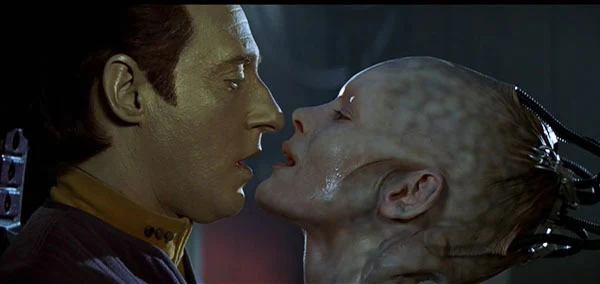
For instance, in Star Trek: First Contact, the Borg Queen is portrayed as a seductive and alluring figure who uses her sexuality to manipulate and control others. One specific example of the Borg Queen's sexualization that has generated controversy among Star Trek fans is the kiss between her and the android character Data. 

In the scene, the Borg Queen tempts Data with the promise of experiencing human sensations in exchange for his cooperation. She then leans in and kisses him, prompting some viewers to criticize the scene as inappropriate and non-consensual, given that Data is an android who is incapable of experiencing romantic or sexual attraction.

alice krige borg queen

On the other hand, some argue that the scene is not meant to be taken literally and is instead a metaphor for the Borg Queen's manipulative nature. By seducing Data and making him believe that he can experience human emotions, the Borg Queen is able to manipulate him into joining the Borg Collective. In this interpretation, the kiss can be seen as a commentary on how seduction and manipulation can be used to control others, rather than as an attempt to sexualize the Borg Queen.

However, there are other ways to interpret the Borg Queen's sexualization. 

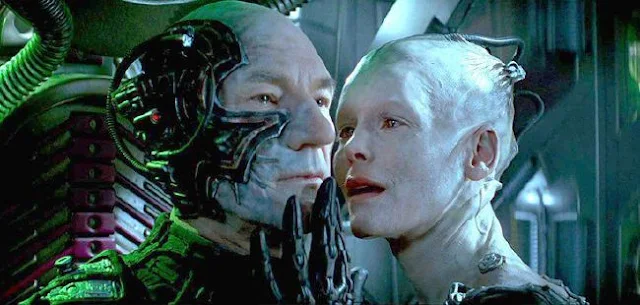
For example, some argue that it is a deliberate choice that adds depth and complexity to her character. In Star Trek: Voyager, the Borg Queen appears in several episodes, and her sexualized behavior is more subtle. She uses her seductive voice and demeanor to manipulate Seven of Nine, a former Borg drone who is struggling to reintegrate into human society. In this context, the Borg Queen's sexuality can be seen as a tool she uses to control others and manipulate them into doing her bidding.

borg queen seduces seven of nine


Moreover, the Borg Queen's sexualization can also be interpreted as a commentary on the objectification of women in media and society. By portraying a powerful, intelligent, and dangerous female character in a sexually charged role, Star Trek may be challenging traditional gender roles and stereotypes. For example, in Star Trek: First Contact, the Borg Queen is played by Alice Krige, who was chosen for the role because of her ability to convey both power and vulnerability. Krige's performance as the Borg Queen has been praised for its complexity and nuance, and some argue that her sexualization is a deliberate choice that adds to the character's depth and complexity.

borg queen sexual themes

Of course, there are those who still find the Borg Queen's sexualization problematic, and they have valid reasons for doing so. For example, some argue that it perpetuates harmful stereotypes about women and undermines the character's agency and power. In addition, some have pointed out that the Borg Queen's sexualization is not consistent with the way other male characters are portrayed in the series. 

While male characters like Captain Kirk and Commander Riker are often depicted as having romantic or sexual relationships, their sexuality is not used to manipulate or control others in the same way the Borg Queen's is.

sexual manipulation borg queen

The Borg Queen's sexualization is a complex issue that can be viewed from many different angles. While it has been criticized for reducing her to a stereotypical femme fatale, others argue that it is an essential part of her character and the role she plays in the series. Whether or not one finds the Borg Queen's sexualization problematic, it is clear that the character remains an iconic and influential figure in the Star Trek franchise.

Ncuti Gatwa in character as Doctor Who


ncuti gatwa -millie gibson- doctor who

The new Doctor Who, played by Ncuti Gatwa, is an exciting addition to the iconic series, and it's always fascinating to see actors take on the role of the Time Lord. Millie Gibson, playing the assistant Ruby, is also sure to bring a fresh perspective to the show.

Recently, a new photo has been released featuring Gatwa and Gibson in character as the Doctor and Ruby, respectively. It's always exciting to get a glimpse of what's to come in a new season of Doctor Who, and this photo certainly does not disappoint.

In the photo, Gatwa exudes a sense of confident intelligence as the Doctor, while Gibson's expression suggests a sense of curiosity and wonder. The dynamic between the two actors is sure to make for an exciting and engaging series.

Overall, the new photo of Ncuti Gatwa and Millie Gibson in character as Doctor Who and Ruby is a tantalizing glimpse of what's to come in the beloved sci-fi series. We're sure fans can't wait to see what adventures await the Doctor and his new companion!
19 April 2023

SmorgasBORG: A Deliciously Complex Examination of Star Trek's Most Iconic Villains

Since their introduction in the second season of Star Trek: The Next Generation, the Borg have been one of the franchise's most captivating and terrifying villains. A race of cybernetically-enhanced beings, the Borg are known for their relentless pursuit of perfection and their insatiable desire to assimilate other species into their collective consciousness.

One of the most striking features of the Borg is their use of nanoprobe technology to assimilate individuals and add them to the collective. Nanoprobes are microscopic machines that can infiltrate a host's body, reprogramming their DNA and integrating them into the Borg's hive mind. This process is not only a physical transformation but also a psychological one, as assimilated individuals lose their sense of self and become part of the collective.

The Borg's relentless pursuit of perfection is also a hallmark of their culture. The collective sees itself as a single organism, with each individual drone serving a specific purpose within the larger whole. This pursuit of perfection drives the Borg's technological advancements, as they are constantly adapting to new threats and incorporating new technologies into their collective consciousness.

Perhaps the most fascinating aspect of the Borg is their relationship with time travel and alternate timelines. In the film Star Trek: First Contact, the Borg travel back in time to prevent humanity's first contact with an alien species, which they see as a threat to their dominance. This time travel plotline not only introduces a new dimension to the Borg's tactics but also highlights the importance of the events that led to the creation of the United Federation of Planets.

The Borg's relationship with other species is complex and often violent. In the series Star Trek: Voyager, the crew of the USS Voyager encounters the Borg on multiple occasions, including a conflict with Species 8472, a race of beings that the Borg see as a threat to their perfection. The conflict with Species 8472 also sheds light on the psychological effects of assimilation, as one member of the species is assimilated by the Borg and subsequently rejects the collective, becoming a key ally to the Voyager crew.

The Borg's social hierarchy is also intriguing. The Borg Queen, introduced in the film Star Trek: First Contact, serves as the leader of the collective and the embodiment of its pursuit of perfection. The Queen is responsible for making key decisions and guiding the collective towards its goals. However, the Queen's role is not without controversy, as some fans have speculated that she represents a deviation from the Borg's original concept as a truly collective consciousness.

borg queen kiss data
Data puckers up for the Queen

Finally, the Borg have served as a powerful metaphor for contemporary issues. The Borg's relentless pursuit of perfection and rejection of individuality can be seen as a commentary on the dangers of groupthink and the loss of personal identity in the age of social media. The Borg's use of technology to assimilate others also highlights the importance of ethical considerations in the development and use of new technologies.

One interesting aspect of their culture is their unique approach to technological advancement and evolution. The Borg are capable of adapting to various weapons and technologies on the fly, making them formidable opponents. This ability to adapt is due in part to the Borg's assimilation of other species and their technologies. The Borg not only add individual drones to their collective consciousness but also assimilate knowledge and technology, incorporating it into their own systems.

Another intriguing aspect of the Borg is the possibility of a Borg rebellion or civil war within the collective. While the Borg operate as a single entity, individual drones are still capable of independent thought and action. In the Star Trek: Voyager episode "Unimatrix Zero," a group of Borg drones develop a resistance to the collective's control during their regenerative cycles, leading to the formation of a secret society of "free-thinking" drones. This rebellion highlights the potential for individuality and independent thought within the Borg collective, challenging the notion of their infallibility and suggesting the possibility of change within their culture.

The ethics of using Borg technology for non-assimilatory purposes also raises interesting questions. In the Star Trek: The Next Generation episode "I, Borg," the crew of the Enterprise encounters an injured Borg drone whom they eventually befriend and name Hugh. As they spend time with Hugh, they begin to see him as an individual rather than a member of the collective, leading to a moral dilemma when they discover a way to use Hugh to transmit a virus that would destroy the Borg. The episode raises questions about the ethics of using technology developed for assimilation for other purposes, as well as the ethics of using individuals, even former drones, as weapons.

The Borg's desire for perfection and their rejection of individuality also has significant philosophical implications. In the Star Trek: The Next Generation episode "The Best of Both Worlds," Captain Jean-Luc Picard is assimilated by the Borg and becomes Locutus of Borg, a representative of the collective consciousness. In his role as Locutus, Picard espouses the Borg's philosophy of perfection, highlighting the dangers of a culture that values conformity over individuality. The episode suggests that the pursuit of perfection can be dangerous when it comes at the expense of personal identity and freedom.

Another aspect of the Borg that adds to their complexity is their relationship with technology and its effects on their biology. As a cybernetic species, the Borg rely heavily on technological enhancements to their bodies and minds. Their dependence on technology is evident in their iconic appearance, with metallic implants and machinery visibly integrated into their bodies.

seven of nine jerri ryan pose
Seven of Nine
However, this dependence on technology also has negative consequences for the Borg. In the Star Trek: Voyager episode "The Raven," Seven of Nine, a former Borg drone, recounts the psychological trauma of being separated from the collective and forced to confront her individuality. Her story highlights the dangers of relying too heavily on technology and the consequences of losing one's sense of self.

Furthermore, the Borg's relationship with technology also raises questions about the ethics of human enhancement and the potential consequences of merging human biology with machines. The Borg's pursuit of technological perfection can be seen as a cautionary tale, warning against the potential dangers of unchecked technological advancement.

Another interesting aspect of the Borg is their use of language and communication. The Borg communicate telepathically through a collective consciousness, allowing for instantaneous communication and sharing of knowledge. However, this collective consciousness also means that individual thoughts and identities are subsumed into the larger collective, challenging traditional ideas of communication and individuality.

The Borg's use of language also raises questions about the role of language in shaping culture and identity. In the Star Trek: The Next Generation episode "Descent," the crew of the Enterprise encounters a group of rogue Borg who have developed individuality and language, suggesting that language is a crucial component in developing personal identity and culture.

Overall, the Borg are a fascinating and multifaceted addition to the Star Trek franchise. Their relationship with technology, communication, and identity, as well as their pursuit of perfection and rejection of individuality, challenge viewers to think critically about these topics and their implications for society. The Borg's ability to adapt and evolve, as well as their potential for rebellion and individuality, add depth to their portrayal and elevate them beyond simple villains.

"Space Seed" - Star Trek Episode Review

Star Trek is an iconic science fiction television series that has captured the hearts of viewers for decades. It has taken us on countless adventures through space, and has inspired generations with its hopeful vision of the future. 

In "Space Seed," the show takes us on a thrilling journey as the crew of the Enterprise encounters a group of genetically enhanced humans from the past. This episode is a testament to the show's ability to tell compelling stories while exploring complex themes, making it a must-watch for any science fiction fan.

space seed star trek noonien khan

In this 22nd episode of the first season of Star Trek, the crew of the Enterprise discovers a group of 20th-century humans, led by the charismatic Khan Noonien Singh (played by Ricardo Montalban), who were placed in suspended animation and lost in space for centuries. As they awaken from their slumber, they prove to be a formidable threat to the Enterprise, and Captain Kirk must find a way to stop them before they cause irreparable damage.

Ricardo Montalban's portrayal of Khan is unforgettable. He brings magnetic energy to the character, making him both charming and menacing at the same time. William Shatner's performance as Captain Kirk is also noteworthy, as he deftly balances the character's bravado and vulnerability. The chemistry between the two actors is palpable, making their confrontations all the more compelling.

The plot of "Space Seed" is full of exciting moments that keep viewers on the edge of their seats. One of the standout scenes is when Khan first awakens from his suspended animation and confronts Captain Kirk. The tension between the two characters is palpable, as Khan reveals his desire to conquer and rule. Another memorable moment is when Khan takes control of the Enterprise and forces Kirk and his crew to submit to his will. The climax of the episode, where Kirk must face off against Khan in a battle of wits, is also a highlight.

"Space Seed" touches on several themes that are still relevant today. One of the most prominent themes is the danger of eugenics and the pursuit of perfection at any cost. The episode also explores the idea of power and control, as Khan seeks to dominate those around him. Finally, the episode touches on the theme of redemption, as Kirk and his crew are forced to confront the consequences of their actions and make amends.

"Space Seed" is widely regarded as one of the best episodes of the original Star Trek series. It has been praised for its tight plot, memorable characters, and exploration of complex themes. The episode also introduced one of the most iconic villains in science fiction history, cementing its place in the cultural lexicon.

space seed khan kiss marla

Some viewers have criticized the episode for its portrayal of women, who are largely relegated to minor roles and are often objectified (classic original Star Trek despite its themes of diversity and quality).

Additionally, some have noted that the episode's portrayal of genetic engineering is overly simplistic and fails to fully explore the complex ethical questions it raises.

One truly interesting note about "Space Seed" is that it served as the inspiration for the second Star Trek film, "The Wrath of Khan." In that movie, Khan Noonien Singh returns to seek revenge on Captain Kirk and the crew of the Enterprise. Ricardo Montalban reprised his role as Khan, delivering another unforgettable performance. "The Wrath of Khan" is widely regarded as one of the best Star Trek films, and its connection to "Space Seed" only adds to the episode's legacy.

"Space Seed" is a classic episode of Star Trek that continues to captivate audiences to this day. Its thrilling plot, memorable characters, and exploration of complex themes make it a must-watch for any science fiction fan. So set phasers to stun and prepare to boldly go where no one has gone before!


The trauma of Captain Jean-Luc Picard's assimilation as 'Locutus' into the Borg Collective

Resistance is Futile: Picard's Assimilation and its Aftermath

Captain Jean-Luc Picard's assimilation as Locutus into the Borg was a significant event in the Star Trek franchise. In "The Best of Both Worlds, Part I," Picard is captured by the Borg and becomes Locutus, a human representative of the Borg collective. The Borg are a cybernetic species that seek to assimilate other beings into their collective, erasing their individuality and making them part of a hive mind.

Throughout the series, Picard is portrayed as a strong and capable leader, but his assimilation forces him to confront his own vulnerability and mortality. As Locutus, Picard is stripped of his autonomy and forced to serve as a mouthpiece for the Borg. This experience leaves a lasting impression on Picard and affects his relationships with his crewmates, particularly his first officer, William Riker.

The Assimilation: "The Best of Both Worlds"

Picard's assimilation marks a significant turning point in the series, as it introduces the Borg as a major adversary and sets the stage for future encounters. The crew of the Enterprise must rescue Picard and stop the Borg from destroying Earth. In the climactic battle, Picard is able to overcome the Borg's control and regain his sense of self, ultimately leading to the defeat of the Borg.

This victory comes at a cost, however, as Picard is left to grapple with the trauma of his assimilation and the loss of his former identity, which is covered in the following episode 'Family'.

The trauma of Captain Jean-Luc Picard's assimilation as 'Locutus' into the Borg Collective

The Aftermath: "Family"

"Family" is a character-driven episode that focuses on the aftermath of Captain Picard's trauma. The episode explores Picard's mental health and the impact that his experience has had on his relationships with his crewmates and family.

Picard returns to Earth to visit his family's vineyard in France, but is still struggling to come to terms with his assimilation. The episode shows Picard experiencing flashbacks and nightmares, highlighting the emotional toll that his assimilation has had on him. It also explores the strained relationship between Picard and his older brother, Robert, who resents Jean-Luc for leaving the family vineyard to join Starfleet.

Through their interactions, the episode reveals deep-seated familial tensions. Robert finally comes to understand the magnitude of what Picard has been through, and the deep emotional scars that have been left behind. He tells Jean-Luc that he is proud of him and offers him a supportive and loving embrace, showing that he is there for him through the ups and downs of his recovery.

Production Log & Trivia

  • The Cliffhanger: The ending of "The Best of Both Worlds, Part I"—with Riker giving the order "Mr. Worf... fire" at a cube containing Locutus—is widely considered one of the greatest cliffhangers in television history. Patrick Stewart's contract was up for negotiation between seasons, adding real-world suspense for fans who feared he might not return.
  • A Unique Episode: "Family" is one of the only Star Trek: The Next Generation episodes that does not feature a science-fiction A-plot. There are no aliens (besides Worf's parents), space battles, or anomalies; the entire focus is on character drama and psychological recovery.
  • The Mud Fight: The emotional climax of "Family," where Jean-Luc and Robert get into a brawl in a mud pit, was a powerful scene. Patrick Stewart has said he drew on his own difficult family history to bring the raw emotion to the performance.
  • Cinematic Impact: The success and cinematic quality of "The Best of Both Worlds" is often cited as what convinced Paramount Pictures that the TNG cast was ready to transition to feature films.

About the author Jimmy Jangles


My name is Jimmy Jangles, the founder of The Astromech. I have always been fascinated by the world of science fiction, especially the Star Wars universe, and I created this website to share my love for it with fellow fans.

At The Astromech, you can expect to find a variety of articles, reviews, and analysis related to science fiction, including books, movies, TV, and games.
From exploring the latest news and theories to discussing the classics, I aim to provide entertaining and informative content for all fans of the genre.

Whether you are a die-hard Star Trek fan or simply curious about the world of science fiction, The Astromech has something for everyone. So, sit back, relax, and join me on this journey through the stars!
Back to Top