12 April 2023

Purrgil: How These Creatures Disrupted Thrawn in Star Wars Rebels

In Star Wars Rebels, the Purrgil played a significant role in the series finale. Grand Admiral Thrawn, an Imperial, had constructed a blockade around the planet Lothal in an effort to prevent the rebels from escaping. However, the rebels were aided by a group of Purrgil who had been attracted to the planet by the energy of the Imperial ships.

Ezra Bridger, one of the rebels and a Force-sensitive individual, was able to communicate with the Purrgil and convince them to help in the rebellion's fight against the Empire. Using his Force abilities, Ezra was able to connect with the Purrgil and understand their intentions.

Together, the Purrgil and the rebels launched an attack on the Imperial fleet. The Purrgil were able to navigate through hyperspace and emerged inside the Imperial ships, causing them to collapse in on themselves and create a massive explosion that destroyed the blockade.

The Purrgil's ability to travel through hyperspace without the use of a spaceship was something that the Empire had not encountered before, and Grand Admiral Thrawn was left stunned by their power.

The exact origins of the Purrgil in the Star Wars universe are not entirely clear. However, it is believed that they are a naturally occurring species that have existed in the galaxy for a very long time. They are known to travel great distances across the galaxy and have been encountered by various civilizations and cultures.

In the Star Wars Rebels episode "The Call," it is revealed that the Purrgil feed on a special type of gas found in asteroids. This gas is important for the Purrgil's survival and their ability to travel through hyperspace. It is possible that the Purrgil evolved to be able to navigate through hyperspace in search of this gas and have developed their unique abilities as a result.

purrgil star wars

In Season Three of The Mandalorian, Din, and Grogu appear to observe Purrgil as they travel hyperspace - this could be a potential nod to the hunt for Grand Admiral Thrawn in the Rosario Dawson led "Ashoka" show.

The role of Thrawn in Star Wars Rebels

In Star Wars Rebels, Thrawn is reintroduced into the franchise as the commander of the Seventh Fleet and a newly promoted Grand Admiral. 

He is a patient tactician who is brought in by Imperial Governor Arihnda Pryce to help crush the series' eponymous rebel cell. In the season three premiere episode "Steps into Shadow," Thrawn demonstrates his tactical prowess by allowing the rebels to escape after they attempt to sabotage his fleet.

He intends to manipulate them into orchestrating the complete downfall of their rebellion. Thrawn's ultimate goal is to dismantle the rebel alliance by identifying its key members and disrupting their operations.

Thrawn appears in several other episodes of Rebels, including "Hera's Heroes," where he takes command of the Imperial occupation of Ryloth, the home planet of Hera Syndulla, one of the rebels' leaders. Thrawn has his first face-to-face contact with the rebels in this episode.

thrawn rebels

 In "Iron Squadron," he orders the incompetent Admiral Konstantine to deal with rebels and rebel sympathizers in the Mykapo system. After Konstantine's ship is disabled, Thrawn arrives in his personal Star Destroyer, the Chimaera, and is revealed to have previously encountered rebel Commander Jun Sato. 

In "An Inside Man," Thrawn is now in charge of the Imperial occupation of the planet Lothal, where he oversees the factory where the new TIE Defender and various other pieces of equipment are manufactured. He puts an end to rebel acts of sabotage by enforcing a policy of the workers testing their creations. Thrawn is also shown to be studying pieces of artwork that grant insight into each member of the Ghost crew. He determines that there is a rebel spy within the Imperial ranks, but intends to use this to his advantage.

In "Warhead," Thrawn uses probe droids to determine that Sato's hidden rebel base is located on one of less than a hundred planets. Thrawn is shown to be skilled in hand-to-hand combat in "Through Imperial Eyes," and learns that Agent Kallus is the rebel spy. 

In "Secret Cargo," Thrawn and Pryce pursue Senator Mon Mothma, who is being transported to safety by the rebels after speaking out publicly against Palpatine. In "Zero Hour," Thrawn confronts Kallus about being Fulcrum, a code name for a high-ranking rebel spy within the Imperial ranks, and executes his carefully planned attack on the rebel base on Atollon. 

He is thwarted by the ingenuity of the rebels and the assistance of Bendu, a powerful being who resides on the planet, and who cryptically warns Thrawn of his impending defeat, "like many arms surrounding you in a cold embrace."

In the series finale "Family Reunion and Farewell," Thrawn's Star Destroyer is attacked by Purrgil, massive space creatures that can travel through hyperspace. The Purrgil ensnare Thrawn's ship with their tentacles while simultaneously confronting the Force-wielding Ezra Bridger, who brought the Purrgil to defend Lothal, the planet that the rebels call home. 

Thrawn's Star Destroyer is dragged from the planet's vicinity by the Purrgil, leaving both Thrawn's and Bridger's fates unknown. 

In The Mandalorian episode "The Jedi" it is revealed that Ashoka Tano is seeking Thrawn, presumably to rescue Ezra. This will be resolved in Dave Filoni's 'Ashoka'.

Grand Admiral Thrawn: Profile

Grand Admiral Thrawn is a legendary figure in the Star Wars universe, known for his tactical genius, impeccable strategy, and unwavering loyalty to the Galactic Empire. Born on the planet Csilla in the Unknown Regions, Thrawn was a member of the Chiss species and rose to prominence as a military leader in the Imperial Navy.

He was created by Timothy Zahn in his first Star Wars novel, Heir to the Empire.

Thrawn was a master tactician and strategist, with an encyclopedic knowledge of military history and a unique ability to analyze his enemies' strengths and weaknesses. He was an excellent judge of character and often used psychological warfare to gain an advantage over his opponents. Thrawn was also a brilliant artist and collector, with a keen eye for detail and an appreciation for beauty in all its forms.

thrawn star wars


Thrawn's achievements include:
  • Successfully negotiating a treaty between the Empire and the Chiss Ascendancy, securing a valuable ally in the Unknown Regions.
  • Defeating the New Republic in several key battles during the Thrawn campaign, including the Battle of Sluis Van and the Battle of Bilbringi.
  • Capturing the smuggler Talon Karrde and using his knowledge to dismantle a smuggling network that was supplying the New Republic.
  • Developing a new type of starfighter, the TIE Defender, which was a formidable weapon in the Empire's arsenal.
  • Outmaneuvering the Noghri, a fierce warrior race, and turning them against their former ally, the Empire.
Thrawn's failures include:

  • Underestimating the power of the Force and the abilities of Jedi Knights, which ultimately led to his defeat in the Battle of Bilbringi.
  • Failing to anticipate the treachery of his own subordinate, Captain Gilad Pellaeon, who ultimately betrayed him.
  • Overreaching in his efforts to capture the smuggler Han Solo, which resulted in the loss of several Star Destroyers and a significant setback for the Empire.
  • Ignoring the advice of his subordinates and launching a costly assault on the planet Kashyyyk, which ultimately proved to be a strategic blunder.
Grand Admiral Thrawn was a complex and fascinating character, whose achievements and failures continue to be studied and debated by Star Wars fans to this day. Despite his flaws, Thrawn's tactical brilliance and unwavering loyalty to the Empire have earned him a place among the most iconic villains in the Star Wars canon.
11 April 2023

The Story Changes in Starship Troopers Film: Adapting a Complex Novel

The film adaptation of "Starship Troopers" is often cited as an example of a movie that deviates significantly from the source material, the novel by Robert A. Heinlein. While both the book and the movie deal with the concept of a futuristic military society engaged in a war with an alien species, the two works diverge in terms of tone, themes, and plot.

One of the most significant changes in the film adaptation is the portrayal of the society in which the story is set. In the novel, Heinlein creates a world in which only those who have served in the military are allowed to vote or hold public office, which he sees as a way to ensure that those making decisions about war and peace have a personal stake in the outcome. This concept of "service guarantees citizenship" is central to the book and its exploration of themes such as duty, sacrifice, and the nature of citizenship.

In the movie, however, this idea is largely glossed over, and the society is presented more as a fascist dictatorship than a military meritocracy. This change is likely due in part to director Paul Verhoeven's personal experiences growing up in Nazi-occupied Holland and his desire to critique the rise of fascism in the United States. 

The result is a movie that uses the tropes of science fiction to comment on contemporary political issues, rather than exploring the themes of the original book.

starship troopers johnny rico

Another significant change in the movie is the portrayal of the alien species, known as the Bugs. In the novel, the Bugs are depicted as a highly intelligent, technologically advanced species capable of space travel and communication. The humans' war with the Bugs is portrayed as a difficult and morally ambiguous conflict, in which both sides commit atrocities and the outcome is uncertain.

In the movie, however, the Bugs are portrayed as mindless, insectoid creatures that exist solely to be killed by the heroic human soldiers. This portrayal reinforces the movie's critique of militarism and the dehumanization of the enemy, but it also removes much of the complexity and nuance from the story.

One of the most significant changes in the movie adaptation of "Starship Troopers" is the characterization of the main protagonist, Johnny Rico. In the novel, Rico is portrayed as an intelligent, thoughtful young man who enlists in the military after graduating from high school. He is a complex and nuanced character who struggles with his own motivations and the morality of the war he is fighting.

In the movie, however, Rico is portrayed as a typical Hollywood action hero, complete with chiseled abs and a rugged demeanor. He is motivated by a desire for revenge after his girlfriend is killed in a Bug attack, rather than a sense of duty or obligation. This change in characterization serves to simplify the character and make him more relatable to a wider audience, but it also removes much of the depth and complexity from the character.

Another significant change in the movie is the portrayal of the military hierarchy. In the novel, the military is depicted as a meritocracy, with promotions and positions of authority earned through hard work and dedication. In the movie, however, the military is portrayed as a rigid hierarchy, with officers and enlisted personnel separated by a vast gulf of social status.

This change is most apparent in the character of Jean Rasczak, Rico's mentor and commanding officer. In the novel, Rasczak is a gruff but wise veteran who inspires loyalty and respect in his troops. In the movie, however, Rasczak is portrayed as a fanatical zealot who exalts in the glory of battle and seems to relish the thought of killing Bugs. This change in characterization serves to reinforce the movie's critique of militarism and the dehumanization of the enemy, but it also removes much of the nuance and complexity from the character.

Finally, the movie simplifies and streamlines the plot of the novel, removing many of the subplots and minor characters in order to focus on the action and spectacle of the war with the Bugs. For example, the character of Carmen, Rico's love interest in the novel, is combined with the character of Dizzy, a female trooper who has a crush on Rico. This change serves to streamline the story and make it more accessible to a wider audience, but it also removes much of the depth and complexity from the characters and their relationships.

The film adaptation of "Starship Troopers" is a significant departure from the source material, both in terms of its themes and its plot. While the movie has its own merits as a work of science fiction, it should be viewed as a separate entity from the original book, rather than as a faithful adaptation.

"Starship Troopers" - A Classic Sci-Fi Novel that Explores Fascinating Themes

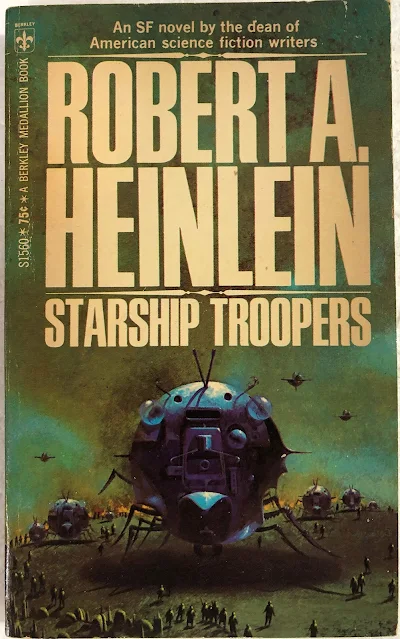
"Starship Troopers" by Robert A. Heinlein is a classic science fiction novel that has remained relevant for decades. The book is set in the future where Earth has become a highly organized military society. The novel revolves around the life of a young man, Juan Rico, as he enlists in the military and works his way up the ranks. Heinlein's writing style is engaging, and the book is packed with action, humor, and thought-provoking ideas.

Robert A. Heinlein is one of the most celebrated science fiction writers of the 20th century. Born in Missouri in 1907, Heinlein served in the US Navy before turning to writing. He published his first science fiction story in 1939 and went on to write many classic novels such as "Stranger in a Strange Land" and "The Moon is a Harsh Mistress." Heinlein's writing is known for its exploration of political and social issues, and "Starship Troopers" is no exception.


starship troopers book cover


The plot of "Starship Troopers" is fast-paced and action-packed. The story follows Juan Rico as he enlists in the military to become a citizen of the Terran Federation. The novel explores the themes of duty, sacrifice, and the nature of citizenship. 

The military society depicted in the book is highly organized, and the training that Rico undergoes is both grueling and fascinating. Heinlein's descriptions of the battles between the humans and the giant alien insects are vivid and engaging, making it easy to imagine the action unfolding in front of you.

One of the strengths of "Starship Troopers" is the way it explores the idea of citizenship. In Heinlein's world, only those who serve in the military can become citizens. This creates a hierarchy where those who have served are respected and those who have not are not seen as full members of society. Heinlein's exploration of this concept is thought-provoking and raises questions about the nature of democracy, the role of the military, and the relationship between the citizen and the state. The film adaptation also explores these themes.

"Starship Troopers" explores many themes that are still relevant today. One of the most prominent themes is the nature of citizenship and the role of the military in society. Heinlein's depiction of a world where only those who serve in the military can become citizens raises questions about the relationship between the citizen and the state. 

The novel also explores the themes of duty, sacrifice, and the nature of heroism. Rico's journey from a raw recruit to a respected officer is inspiring, and the sacrifices he makes along the way are both touching and thought-provoking.

"Starship Troopers" has received mixed reviews since its publication in 1959. Some critics have praised the book for its exploration of political and social issues, while others have criticized it for its depiction of a highly organized military society. The book has been both praised and criticized for its exploration of themes such as duty, sacrifice, and the nature of citizenship.

Despite its age, "Starship Troopers" remains relevant today. The novel's exploration of themes such such as citizenship, duty, and sacrifice are still important topics that society grapples with. Heinlein's vision of a highly organized military society also raises questions about the role of the military and the relationship between the citizen and the state that are still relevant today. Furthermore, the book's exploration of what it means to be a hero and the sacrifices that come with it is something that resonates with readers of all ages.

"Starship Troopers" is a classic science fiction novel that explores fascinating themes and raises thought-provoking questions. Heinlein's writing is engaging, and the book is packed with action, humor, and memorable characters. While it may not be perfect, "Starship Troopers" remains a must-read for anyone interested in science fiction or the role of the military in society. So, grab a copy and join Juan Rico on his journey to become a citizen of the Terran Federation.

Starship Troopers - Militarization to Fascism: Analyzing the Themes of the Film

The film "Starship Troopers" (based on the novel by Robert A. Heinlein)  is a satirical take on fascist societies, which is evident in its portrayal of the themes of militarism and nationalism. While the movie presents a society that is heavily militarized and nationalistic, it does so in a way that exposes the dangers of these ideologies.

The film "Starship Troopers" portrays a 'civil' society where military service is mandatory to gain citizenship and full rights as a human.

How wrecked is that?

The film exaggerates this idea by portraying the military as not just a means of defending the country, but also the ultimate source of power in the society. This emphasis on the military is a common feature of fascist regimes, where the military is often used to enforce the government's will and suppress dissent.

In the movie, we see how the military is not only responsible for defending the society against the alien threat but is also involved in running the government. For instance, we see that even the civilian government officials are former military leaders, which highlights the extent to which the military has infiltrated all aspects of society.

Moreover, the film portrays the military as an institution that demands strict conformity and obedience from its members. We see this in the training sequences where the characters undergo intense physical and mental conditioning to prepare them for military service. The characters are expected to conform to a strict hierarchy and set of rules, and there is little room for individuality or critical thinking.

johhny rico starship troopers

One of the ways the movie exposes the dangers of militarism is by showing how it can lead to the erosion of individuality and critical thinking. For instance, the main character, Johnny Rico, initially joins the military because he wants to impress his girlfriend and friends. 

However, once he is in the military, he finds himself caught up in a system that demands absolute loyalty and conformity. He is expected to follow orders without question, and there is little room for independent thought or action:

Come on you apes, you wanna live forever?

The film also highlights the dehumanizing effects of military training, showing how the characters are transformed into mindless soldiers who are willing to do whatever it takes to win the war. For example, in one scene, we see the characters participating in a brutal training exercise that involves killing live ammunition targets. The exercise is designed to simulate real combat situations and prepare the soldiers for the harsh realities of war. 

However, it also shows how the characters are being trained to see their enemies as faceless, inhuman monsters, rather than as individuals with their own lives and experiences.

In "Starship Troopers" the war against the alien species known as the Arachnids is presented as a struggle for the survival of the human race. This framing is a common tactic used by fascist regimes to rally the populace behind the government and create a sense of national unity. However, the film takes this idea to an extreme by portraying the Arachnids as a faceless, monstrous threat, thus dehumanizing them and making it easier for the characters to justify their actions.

The film portrays the Arachnids as mindless and vicious creatures that pose an existential threat to humanity. They are depicted as a hive mind, with no individuality or capacity for reason. This portrayal reinforces the idea that the Arachnids are not just enemies, but an evil force that must be eradicated at any cost. The film also shows propaganda posters and newsreels that depict the Arachnids as a monstrous and terrifying threat, further reinforcing the idea that they are not just another species, but a demonic force that must be defeated.

This dehumanization of the Arachnids allows the human characters to justify their actions against them, no matter how extreme. For example, the film shows scenes of human soldiers massacring hundreds of Arachnids with heavy firepower, including using flamethrowers and other weapons of mass destruction. The characters are shown to take pleasure in killing the Arachnids, which reinforces the idea that they are not just fighting a war, but engaging in a righteous crusade against an evil enemy.

The film also shows how the emphasis on nationalism can lead to the suppression of dissenting voices. Characters who question the government's actions or express doubts about the war effort are portrayed as unpatriotic and disloyal. For example, when one character suggests that the government is lying to the populace about the true nature of the war, he is accused of being a traitor and a coward.

In addition to these themes, the film also uses satire to comment on other aspects of fascist societies, such as the emphasis on conformity and the use of propaganda to control the population.

"Starship Troopers" presents a scathing critique of fascist ideologies and their potential consequences. By exaggerating the themes of militarism and nationalism to an extreme, the film exposes the dangers of these ideologies and highlights the importance of critical thinking and individuality.

Counter argument - the Arachnids threw the first rock...
avatar

Avatar's Political Allegory: Lessons for Our World on Greed and Marginalization

Some might say that James Cameron's 2009 science fiction film Avatar is just 'smurfs in space'.

But if you pay real attention to the themes and story, the film is a powerful example of the use of political allegory in cinema.

The film explores a range of themes, including imperialism and colonialism, environmentalism and conservation, capitalism and consumerism, racism and discrimination, and indigenous rights and resistance.

One of the most prominent themes in Avatar is imperialism and colonialism


The film is set on the distant planet of Pandora, where a corporation called the Resources Development Administration (RDA) has established a mining operation to extract a valuable mineral called unobtanium. The Na'vi people, the indigenous inhabitants of Pandora, are viewed as a primitive species by the human colonizers and are seen as standing in the way of progress and profit.

The theme of imperialism and colonialism is a central component of Avatar's political allegory. The film portrays the RDA as a colonial power that seeks to exploit Pandora and its resources for profit, regardless of the consequences for the Na'vi people or the planet's ecosystem. The Na'vi are marginalized and oppressed by the human colonizers, who view them as primitive and inferior.

This narrative is reflective of the history of colonialism and imperialism in our world, where powerful nations and corporations have exploited the resources and people of less powerful nations and communities for their own gain. 

The film's depiction of the RDA's ruthless pursuit of profit at the expense of the Na'vi's way of life is a commentary on the destructive consequences of imperialism and the impact it can have on marginalized communities.

One criticism of Avatar is that it draws heavily on the colonialism and imperialism narrative that has been seen in other works of fiction. The film has been described as "Pocahontas in space" by some critics who argue that its plot and themes are too similar to those seen in other stories. However, while the film may not be entirely original in its depiction of imperialism and colonialism, it does offer a powerful commentary on these themes.

One of the strengths of Avatar's political allegory is its use of symbolism and visual storytelling. The film's depiction of the Na'vi's connection to their environment and their reverence for nature is a powerful representation of the importance of environmentalism and conservation. 

The sacred trees of the Na'vi are an important symbol of their culture and way of life, and the destruction of these trees by the RDA represents the destructive impact of human greed and the exploitation of the environment.

Colonel Miles Quaritch

The character of Colonel Miles Quaritch is another powerful symbol of the film's critique of imperialism and colonialism. Quaritch represents the military-industrial complex that supports and drives imperialism, and his willingness to use violence and force to achieve his goals is a commentary on the violence and brutality that are often used to maintain colonial power. 

His character is an embodiment of the idea that imperialism is driven by a desire for power and profit at the expense of marginalized communities.

The film also critiques capitalism and consumerism


The human characters are driven solely by a desire for profit, and they view the Na'vi and the environment as obstacles to their bottom line. The RDA's entire operation on Pandora is driven by greed, and the corporation's leadership is willing to sacrifice anything or anyone to increase their profits. 

This is exemplified in the character of Parker Selfridge, who is the head of the RDA's operations on Pandora. He sees the Na'vi and the environment as nothing more than obstacles to be overcome in his quest for profit.

Avatar also explores themes of racism and discrimination


The Na'vi people are viewed as inferior and primitive by the human colonizers, who see themselves as superior and entitled to the resources of Pandora known as unobtainium. The human characters use racial slurs and view the Na'vi as expendable and disposable. The film also touches on the concept of "othering" and the idea that people are often dehumanized and marginalized based on superficial differences.

Finally, Avatar depicts the struggle of the Na'vi people to defend their land and culture against the invading humans. The Na'vi use their knowledge of the land and their spiritual connection to nature to resist the human invasion and protect their way of life. 

The film also highlights the importance of solidarity and support from allies in social justice movements. The character of Jake Sully, a former marine who becomes sympathetic to the Na'vi cause, represents the potential for individuals to ally themselves with marginalized communities and work towards justice and equality.

James Cameron's Avatar is a powerful example of the use of political allegory in cinema. Through its exploration of themes such as imperialism and colonialism, environmentalism and conservation, capitalism and consumerism, racism and discrimination, and indigenous rights and resistance, the film offers a powerful critique of the destructive consequences of human greed and the importance of respecting and valuing marginalized communities.

About the author Jimmy Jangles


My name is Jimmy Jangles, the founder of The Astromech. I have always been fascinated by the world of science fiction, especially the Star Wars universe, and I created this website to share my love for it with fellow fans.

At The Astromech, you can expect to find a variety of articles, reviews, and analysis related to science fiction, including books, movies, TV, and games.
From exploring the latest news and theories to discussing the classics, I aim to provide entertaining and informative content for all fans of the genre.

Whether you are a die-hard Star Trek fan or simply curious about the world of science fiction, The Astromech has something for everyone. So, sit back, relax, and join me on this journey through the stars!
Back to Top