11 April 2023

Starship Troopers - Militarization to Fascism: Analyzing the Themes of the Film

The film "Starship Troopers" (based on the novel by Robert A. Heinlein)  is a satirical take on fascist societies, which is evident in its portrayal of the themes of militarism and nationalism. While the movie presents a society that is heavily militarized and nationalistic, it does so in a way that exposes the dangers of these ideologies.

The film "Starship Troopers" portrays a 'civil' society where military service is mandatory to gain citizenship and full rights as a human.

How wrecked is that?

The film exaggerates this idea by portraying the military as not just a means of defending the country, but also the ultimate source of power in the society. This emphasis on the military is a common feature of fascist regimes, where the military is often used to enforce the government's will and suppress dissent.

In the movie, we see how the military is not only responsible for defending the society against the alien threat but is also involved in running the government. For instance, we see that even the civilian government officials are former military leaders, which highlights the extent to which the military has infiltrated all aspects of society.

Moreover, the film portrays the military as an institution that demands strict conformity and obedience from its members. We see this in the training sequences where the characters undergo intense physical and mental conditioning to prepare them for military service. The characters are expected to conform to a strict hierarchy and set of rules, and there is little room for individuality or critical thinking.

johhny rico starship troopers

One of the ways the movie exposes the dangers of militarism is by showing how it can lead to the erosion of individuality and critical thinking. For instance, the main character, Johnny Rico, initially joins the military because he wants to impress his girlfriend and friends. 

However, once he is in the military, he finds himself caught up in a system that demands absolute loyalty and conformity. He is expected to follow orders without question, and there is little room for independent thought or action:

Come on you apes, you wanna live forever?

The film also highlights the dehumanizing effects of military training, showing how the characters are transformed into mindless soldiers who are willing to do whatever it takes to win the war. For example, in one scene, we see the characters participating in a brutal training exercise that involves killing live ammunition targets. The exercise is designed to simulate real combat situations and prepare the soldiers for the harsh realities of war. 

However, it also shows how the characters are being trained to see their enemies as faceless, inhuman monsters, rather than as individuals with their own lives and experiences.

In "Starship Troopers" the war against the alien species known as the Arachnids is presented as a struggle for the survival of the human race. This framing is a common tactic used by fascist regimes to rally the populace behind the government and create a sense of national unity. However, the film takes this idea to an extreme by portraying the Arachnids as a faceless, monstrous threat, thus dehumanizing them and making it easier for the characters to justify their actions.

The film portrays the Arachnids as mindless and vicious creatures that pose an existential threat to humanity. They are depicted as a hive mind, with no individuality or capacity for reason. This portrayal reinforces the idea that the Arachnids are not just enemies, but an evil force that must be eradicated at any cost. The film also shows propaganda posters and newsreels that depict the Arachnids as a monstrous and terrifying threat, further reinforcing the idea that they are not just another species, but a demonic force that must be defeated.

This dehumanization of the Arachnids allows the human characters to justify their actions against them, no matter how extreme. For example, the film shows scenes of human soldiers massacring hundreds of Arachnids with heavy firepower, including using flamethrowers and other weapons of mass destruction. The characters are shown to take pleasure in killing the Arachnids, which reinforces the idea that they are not just fighting a war, but engaging in a righteous crusade against an evil enemy.

The film also shows how the emphasis on nationalism can lead to the suppression of dissenting voices. Characters who question the government's actions or express doubts about the war effort are portrayed as unpatriotic and disloyal. For example, when one character suggests that the government is lying to the populace about the true nature of the war, he is accused of being a traitor and a coward.

In addition to these themes, the film also uses satire to comment on other aspects of fascist societies, such as the emphasis on conformity and the use of propaganda to control the population.

"Starship Troopers" presents a scathing critique of fascist ideologies and their potential consequences. By exaggerating the themes of militarism and nationalism to an extreme, the film exposes the dangers of these ideologies and highlights the importance of critical thinking and individuality.

Counter argument - the Arachnids threw the first rock...
avatar

Avatar's Political Allegory: Lessons for Our World on Greed and Marginalization

Some might say that James Cameron's 2009 science fiction film Avatar is just 'smurfs in space'.

But if you pay real attention to the themes and story, the film is a powerful example of the use of political allegory in cinema.

The film explores a range of themes, including imperialism and colonialism, environmentalism and conservation, capitalism and consumerism, racism and discrimination, and indigenous rights and resistance.

One of the most prominent themes in Avatar is imperialism and colonialism


The film is set on the distant planet of Pandora, where a corporation called the Resources Development Administration (RDA) has established a mining operation to extract a valuable mineral called unobtanium. The Na'vi people, the indigenous inhabitants of Pandora, are viewed as a primitive species by the human colonizers and are seen as standing in the way of progress and profit.

The theme of imperialism and colonialism is a central component of Avatar's political allegory. The film portrays the RDA as a colonial power that seeks to exploit Pandora and its resources for profit, regardless of the consequences for the Na'vi people or the planet's ecosystem. The Na'vi are marginalized and oppressed by the human colonizers, who view them as primitive and inferior.

This narrative is reflective of the history of colonialism and imperialism in our world, where powerful nations and corporations have exploited the resources and people of less powerful nations and communities for their own gain. 

The film's depiction of the RDA's ruthless pursuit of profit at the expense of the Na'vi's way of life is a commentary on the destructive consequences of imperialism and the impact it can have on marginalized communities.

One criticism of Avatar is that it draws heavily on the colonialism and imperialism narrative that has been seen in other works of fiction. The film has been described as "Pocahontas in space" by some critics who argue that its plot and themes are too similar to those seen in other stories. However, while the film may not be entirely original in its depiction of imperialism and colonialism, it does offer a powerful commentary on these themes.

One of the strengths of Avatar's political allegory is its use of symbolism and visual storytelling. The film's depiction of the Na'vi's connection to their environment and their reverence for nature is a powerful representation of the importance of environmentalism and conservation. 

The sacred trees of the Na'vi are an important symbol of their culture and way of life, and the destruction of these trees by the RDA represents the destructive impact of human greed and the exploitation of the environment.

Colonel Miles Quaritch

The character of Colonel Miles Quaritch is another powerful symbol of the film's critique of imperialism and colonialism. Quaritch represents the military-industrial complex that supports and drives imperialism, and his willingness to use violence and force to achieve his goals is a commentary on the violence and brutality that are often used to maintain colonial power. 

His character is an embodiment of the idea that imperialism is driven by a desire for power and profit at the expense of marginalized communities.

The film also critiques capitalism and consumerism


The human characters are driven solely by a desire for profit, and they view the Na'vi and the environment as obstacles to their bottom line. The RDA's entire operation on Pandora is driven by greed, and the corporation's leadership is willing to sacrifice anything or anyone to increase their profits. 

This is exemplified in the character of Parker Selfridge, who is the head of the RDA's operations on Pandora. He sees the Na'vi and the environment as nothing more than obstacles to be overcome in his quest for profit.

Avatar also explores themes of racism and discrimination


The Na'vi people are viewed as inferior and primitive by the human colonizers, who see themselves as superior and entitled to the resources of Pandora known as unobtainium. The human characters use racial slurs and view the Na'vi as expendable and disposable. The film also touches on the concept of "othering" and the idea that people are often dehumanized and marginalized based on superficial differences.

Finally, Avatar depicts the struggle of the Na'vi people to defend their land and culture against the invading humans. The Na'vi use their knowledge of the land and their spiritual connection to nature to resist the human invasion and protect their way of life. 

The film also highlights the importance of solidarity and support from allies in social justice movements. The character of Jake Sully, a former marine who becomes sympathetic to the Na'vi cause, represents the potential for individuals to ally themselves with marginalized communities and work towards justice and equality.

James Cameron's Avatar is a powerful example of the use of political allegory in cinema. Through its exploration of themes such as imperialism and colonialism, environmentalism and conservation, capitalism and consumerism, racism and discrimination, and indigenous rights and resistance, the film offers a powerful critique of the destructive consequences of human greed and the importance of respecting and valuing marginalized communities.

Star Trek's 'Yesterday's Enterprise - A Masterpiece of Science-Fiction Storytelling

Review: "Yesterday's Enterprise"

In the pantheon of great science fiction television, certain episodes transcend their series to become touchstones of the genre. "Yesterday's Enterprise" is one such installment. A masterpiece from the third season of *Star Trek: The Next Generation*, it is a complex and emotionally resonant exploration of sacrifice, destiny, and the fragile nature of peace. More than just a thrilling time-travel adventure, it is the story that defined the show's maturity and cemented its place in television history.

The Genesis of a Classic

The episode's own origin is a piece of Trek lore. It began as a spec script that was heavily rewritten by the legendary writing team of Ronald D. Moore and Michael Piller, who transformed the core concept into a taut, character-driven drama. The episode also marked the return of Denise Crosby, who had left the show in its first season, dissatisfied with the development of her character, Tasha Yar. "Yesterday's Enterprise" offered her a unique opportunity: to give Tasha the heroic, meaningful exit she had been denied, a chance Crosby embraced, delivering a powerful and memorable performance.

A Ship Out of Time and a Peace Undone

The story is set in motion by the sudden appearance of the USS Enterprise-C, a ship lost with all hands twenty-two years prior. The moment the Ambassador-class starship emerges from a temporal rift, reality fractures. The familiar, optimistic world of the Enterprise-D vanishes, replaced by a dark, militaristic timeline. The Federation is on the brink of collapse, losing a devastating, decades-long war with the Klingon Empire.

The in-universe lore is crucial here. The Enterprise-C, under the command of Captain Rachel Garrett, was destroyed at the **Battle of Narendra III** while answering a Klingon distress call. It was a hopeless battle against Romulan warbirds, but the Enterprise-C fought to the last. For the Klingons, a culture that reveres dying well, this act of selfless honor from an enemy was so profound that it shamed them into seeking peace. That single act of sacrifice became the cornerstone of the Federation-Klingon alliance. By traveling forward in time, the Enterprise-C never made that sacrifice, and the butterfly effect was a generation of unending war.

A Mirror, Darkly: Life on a Warship

The episode masterfully portrays this alternate reality. The Enterprise-D is no longer a vessel of exploration; it is a warship. The bridge is a dark, metallic command center, stripped of comforts. The crew's relationships are strained and purely professional; the warmth between Riker and Troi is gone, replaced by the grim focus of combat officers. Even Captain Picard's log entries are different, his usual thoughtful reflections replaced with stark, weary battle reports. It is a world without hope, where survival is the only mission.

Lt. Richard Castillo (Christopher McDonald) and Tasha Yar (Denise Crosby) on the alternate Enterprise bridge

The darker, militaristic reality of the alternate timeline.

The Oracle in Ten Forward

In this broken timeline, only the enigmatic bartender, Guinan, senses that reality is wrong. As an El-Aurian, her consciousness is not strictly linear, and she retains an "echo" of the true timeline. She becomes the episode's conscience, the keeper of a truth no one else can see. Her quiet but firm insistence that Picard must send the Enterprise-C back to its certain doom—to restore a peace he has never known—is one of the most compelling scenes in the series. She must convince a hardened warrior to have faith in a peaceful galaxy that, to him, is just a ghost story.

To Die Well: Tasha Yar's Redemption

The return of Tasha Yar provides the story's powerful emotional core. In the prime timeline, her death at the hands of the creature Armus was abrupt and meaningless. In this reality, she has lived a full life as a warrior. When Guinan tells her about her other fate, Tasha sees a profound choice. She can remain in a doomed timeline, or she can return with the Enterprise-C to Narendra III and face certain death. She chooses the latter, not as an act of suicide, but as an act of creation. She chooses to give her life meaning, to ensure that her death is not a random tragedy, but a noble sacrifice that will save billions. It is a powerful exploration of existentialism, where one finds purpose by choosing the meaning of one's end.

The Weight of Command and the Echoes of a Choice

Ultimately, Picard makes the impossible command decision. Trusting Guinan's intuition over military logic, he orders Captain Garrett and her crew back through the rift. The final battle, with the Enterprise-D fighting desperately to defend its ancestor, is a spectacular and poignant climax. The moment the timeline snaps back to normal, with a confused Geordi asking Picard for orders, is a masterclass in subtlety.

The episode's legacy is immense and tangible. Tasha Yar's choice had unforeseen consequences; she was not killed at Narendra III but was captured by a Romulan general, becoming his consort and giving birth to a daughter, **Sela**. This half-Romulan daughter would later return as a major antagonist, a living echo of the events of "Yesterday's Enterprise." This long-term narrative impact elevates the episode from a brilliant standalone story into a pivotal moment of franchise lore.

For its masterful writing, superb performances, and profound thematic depth, "Yesterday's Enterprise" is a masterpiece. It stands as a testament to what science fiction can achieve, holding its own against any classic in the Trek canon, from "The City on the Edge of Forever" to "Trials and Tribble-ations." Its themes are further explored in other exceptional *Next Generation* episodes like "Chain of Command" and "The Inner Light."

10 April 2023

Watchmen - Exploring American Imperialism and the Vietnam War

Alan Moore's Watchmen is a seminal work in the graphic novel genre that presents a dark and complex critique of American imperialism and the Vietnam War.

The graphic novel presents a world where superheroes exist and have played a role in shaping American history. However, the story challenges the idea of superheroes as unambiguous champions of justice, instead depicting them as flawed and conflicted individuals who are unable to solve the complex problems facing society.

One of the main ways in which the graphic novel critiques American imperialism is through its portrayal of the Vietnam War via nonlinear storytelling

In the world of Watchmen, America has won the Vietnam War with the help of the superhuman powers of Dr. Manhattan. However, the victory is depicted as hollow and meaningless, with the cost of the war being staggering loss of life and a nation left in ruins. The novel shows how the Vietnam War was not only a military defeat for America, but also a moral and political failure, with the country committing atrocities and engaging in torture and other human rights abuses.

However, the experience leaves him disillusioned with humanity and he ultimately withdraws from the world. Dr. Manhattan's detachment from humanity is a metaphor for the cost of American imperialism, with the country becoming increasingly isolated and disconnected from the rest of the world as a result of its actions.

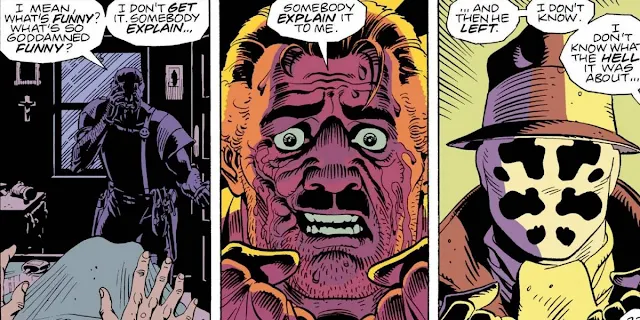
character of the Comedian is one of the key figures in the graphic novel's critique of American imperialism


The character of the Comedian is one of the key figures in the graphic novel's critique of American imperialism. The Comedian is depicted as a ruthless and amoral individual who sees the world as a nihilistic and violent place. He is responsible for numerous atrocities committed in Vietnam, including the murder of a pregnant woman. The Comedian represents the dark side of American imperialism, the willingness to commit unspeakable acts of violence in the pursuit of power and control.

Alan Moore's Watchmen is a searing critique of American imperialism, especially the Vietnam War. The graphic novel shows the consequences of the country's actions in Vietnam, including the staggering loss of life and the moral and political failure.

Beyond the Cape: Watchmen's Subversion of Superhero Tropes

Alan Moore's "Watchmen" is often credited with deconstructing the superhero genre because it takes a critical and realistic approach to the idea of superheroes. Rather than presenting superheroes as purely heroic figures with superhuman abilities, "Watchmen" portrays them as flawed and complex individuals with human weaknesses and failings

Via non linear story telling, the story also examines the social and political implications of having superheroes in the real world, questioning the morality of vigilantism and exploring the idea of power and corruption.

One way in which "Watchmen" subverts superhero mythology is by questioning the idea of heroism itself. The main characters, known as the "Watchmen," are not the traditional archetypal heroes of comic books. 

comedian killer vietnam watchmen

They are morally ambiguous, often committing violent and questionable acts in the name of justice. For example, Rorschach, one of the main characters, is a vigilante who wears a mask with constantly shifting patterns and sees the world in black and white. He is willing to resort to extreme violence to achieve his goals, and ultimately becomes a villain in the eyes of the other characters.

Another way in which "Watchmen" subverts superhero mythology is by exploring the darker side of superpowers. The character of Dr. Manhattan, a former physicist who gains god-like powers after a laboratory accident, is initially portrayed as a benevolent and omnipotent figure. However, as the story progresses, it becomes clear that his god-like abilities have left him disconnected from humanity, and he becomes increasingly distant and dispassionate.

The use of graphic violence in "Watchmen" is also a departure from traditional superhero comics, where violence is often sanitized or depicted in a cartoonish manner. The violence in "Watchmen" is often brutal and realistic, with characters being depicted as bloodied and wounded after fights.

In addition, "Watchmen" is notable for its metafictional elements, with the narrative itself reflecting on the nature of storytelling and the comic book medium. The story includes a comic-within-a-comic called "Tales of the Black Freighter," which is read by one of the characters and serves as a parallel to the main story. This self-reflexivity adds another layer of complexity to the story and contributes to the overall deconstruction of the superhero genre.

Overall, the deconstruction of superhero mythology in "Watchmen" has had a significant impact on the comic book genre as a whole. The story's exploration of complex characters, realistic violence, and metafictional elements has influenced subsequent comic book works, and has helped to establish a new approach to superhero storytelling that is more grounded and nuanced.

watchmen

Here are some additional points to consider in the deconstruction of superhero mythology in "Watchmen":
  • Critique of American imperialism: "Watchmen" takes place in an alternate history where the United States won the Vietnam War, and explores the consequences of American imperialism. The character of the Comedian, a government-sanctioned superhero and war veteran, embodies the brutal and violent nature of American foreign policy. His actions in Vietnam, including the rape and murder of a civilian woman, highlight the destructive impact of American interventionism.
  • Examination of the superhero's relationship with society: Unlike traditional superhero comics where the public adores and idolizes superheroes, "Watchmen" portrays a world where superheroes are treated with suspicion and hostility. The government has outlawed vigilantism, and many of the characters struggle with their place in society. The character of Silk Spectre II, for example, questions whether she has any agency or is simply a pawn in the schemes of the male characters.
  • Subversion of the superhero's role in preserving law and order: While traditional superheroes uphold the law and protect the innocent, the superheroes in "Watchmen" are often the ones committing crimes and causing chaos. The villainous plan of the character Ozymandias to create a fake alien invasion to bring about world peace, for example, is a morally dubious solution that sacrifices innocent lives for the greater good.
  • Deconstruction of the hero/villain dichotomy: "Watchmen" blurs the lines between hero and villain, and even the characters themselves are unsure of their moral standing. Rorschach, for example, is initially presented as a hero but ultimately becomes a ruthless vigilante, while Ozymandias is revealed to be the mastermind behind the plot to destroy New York City but justifies his actions as necessary for the greater good.
  • Exploration of the psychological impact of being a superhero: "Watchmen" delves into the psychological toll that being a superhero can take on individuals. Many of the characters suffer from PTSD, addiction, and other mental health issues as a result of their experiences as superheroes. Nite Owl for example is jaded and cynical - questioning his place in the world. 

watchmen

The Power of Non-Linear Storytelling in Watchmen

Watchmen by Alan Moore is a celebrated graphic novel that tells a complex and multi-layered story that explores themes such as power, morality, and human nature.

One of the defining features of the novel is its non-linear narrative structure, which breaks from traditional storytelling techniques. The non-linear structure allows the story to unfold in a way that is both unconventional and highly effective in conveying its themes and messages.

The novel is divided into twelve chapters, each of which contains multiple storylines that interweave and overlap with each other. This structure is further complicated by the use of flashbacks, dream sequences, and other non-linear narrative devices that make it difficult to determine what is happening in the present moment. This complexity forces the reader to actively engage with the story, making it a highly immersive experience.

One way that the non-linear structure contributes to the themes of the novel is by highlighting the ways in which events in the past shape the present. The novel is set in an alternate version of 1985, where the United States won the Vietnam War and Richard Nixon is serving his fifth term as president. However, the story frequently flashes back to events that took place in the 1940s and 1950s, which are shown to have a profound impact on the characters and the world they live in.

watchmen complex characters

For example, the backstory of the character of Ozymandias, one of the main protagonists, is revealed in a series of flashbacks that show how he became a superhero and then a successful businessman. These flashbacks serve to emphasize the character's journey and how his past informs his actions in the present. By highlighting the ways in which the past shapes the present, the non-linear structure emphasizes the importance of history and how it can have far-reaching consequences.

Another way that the non-linear structure contributes to the themes of the novel is by challenging the traditional hero narrative.

 In traditional narratives, the hero is often portrayed as a noble and selfless figure who fights for justice and protects the innocent. However, the characters in Watchmen are far more complex and morally ambiguous. By using a non-linear structure that jumps between different perspectives and time periods, the novel forces the reader to question the motivations and actions of the characters.

For example, the character of Rorschach, a vigilante who is initially portrayed as a hero, is revealed to have a deeply disturbed and violent past. Through flashbacks and other non-linear narrative devices, the novel shows how Rorschach's traumatic childhood and his experiences as a vigilante have warped his sense of morality and made him a dangerous and unstable individual. By challenging the traditional hero narrative and showing the darker side of superheroism, the non-linear structure contributes to the novel's overall message about power and its corrupting influence.

In contrast to traditional narrative structures, which often follow a linear and predictable path, the non-linear structure of Watchmen keeps the reader engaged and forces them to actively participate in the story. The use of multiple perspectives and time periods also creates a sense of complexity and depth that is not often found in traditional narratives. By breaking from convention and using a non-linear structure, Watchmen creates a unique and unforgettable reading experience that leaves a lasting impact on the reader.


Dave Filoni - The Chosen One

Dave Filoni is an exceptional storyteller and a visionary director who has made an indelible mark on the Star Wars franchise. He is widely recognized as one of the most important creative forces behind the recent resurgence of Star Wars in popular culture.

He's a cowboy, baby!

david filoni star wars
Mr Filoni is known for his love of wolves...

Filoni's contributions to Star Wars are many and varied. 

He served as the supervising director of the beloved animated series Star Wars: The Clone Wars, which ran for six seasons from 2008 to 2014. 

Under his guidance, the show developed a huge following and became an integral part of the Star Wars canon. Filoni was also involved in the creation of the spin-off series Star Wars Rebels, which followed a new set of characters in the early days of the rebellion against the Empire.

Filoni's impact on the Star Wars universe goes beyond just animation. He has been heavily involved in the development of the live-action shows The Mandalorian and The Book of Boba Fett, both of which have been huge hits with fans and critics alike. He has also written and directed several episodes of The Mandalorian, including the season two finale, which featured the return of Luke Skywalker and was widely praised for its emotional impact.

One of the reasons that Filoni's work has resonated so deeply with Star Wars fans is his deep reverence for the original trilogy and his commitment to honoring its legacy. 

He has been vocal about his admiration for George Lucas and his desire to continue telling stories that feel true to the spirit of the original films. At the same time, Filoni has been unafraid to take risks and explore new corners of the Star Wars galaxy, introducing new characters and concepts that have enriched the franchise.

He is currently working on Ashoka as a series, having directed the episode 'The Jedi' in season 2 of The Mandalorian in which Ashoka was first introduced as part of a live action show. 

Here is a list of Dave Filoni's major contributions to Star Wars:

  • Star Wars: The Clone Wars (TV series, 2008-2020) - Supervising Director, Executive Producer, Writer, Voice Actor
  • Star Wars: The Clone Wars - The Lost Missions (TV series, 2014) - Supervising Director, Executive Producer, Writer
  • Star Wars Rebels (TV series, 2014-2018) - Executive Producer, Supervising Director, Writer, Voice Actor
  • Star Wars: Forces of Destiny (TV series, 2017-2018) - Executive Producer
  • Star Wars Resistance (TV series, 2018-2020) - Executive Producer, Writer, Creative Executive
  • The Mandalorian (TV series, 2019-present) - Executive Producer, Writer, Director
  • The Gallery: The Mandalorian (TV series documentary, 2020-present) - Executive Producer
  • Star Wars: The Bad Batch (TV series, 2021-present) - Executive Producer, Writer
  • Star Wars: Visions (TV series, 2021) - Executive Producer
  • The Book of Boba Fett (TV series, 2021-present) - Executive Producer, Writer, Director (upcoming)

About the author Jimmy Jangles


My name is Jimmy Jangles, the founder of The Astromech. I have always been fascinated by the world of science fiction, especially the Star Wars universe, and I created this website to share my love for it with fellow fans.

At The Astromech, you can expect to find a variety of articles, reviews, and analysis related to science fiction, including books, movies, TV, and games.
From exploring the latest news and theories to discussing the classics, I aim to provide entertaining and informative content for all fans of the genre.

Whether you are a die-hard Star Trek fan or simply curious about the world of science fiction, The Astromech has something for everyone. So, sit back, relax, and join me on this journey through the stars!
Back to Top