09 April 2025

Dare Devil: Born Again > Review > Episode 8 'Isle of Joy'

The thing about Daredevil: Born Again is that it’s never just about fists flying or capes in the wind. It’s about consequences. 

Repercussions. The slow, suffocating tension of lives entangled in moral rot and personal vendettas. 

And in Episode 8, titled Isle of Joy—a name that lands with more irony than elegance—we finally feel the full weight of everything this show has been trying to say since the very first minute.

If Episode 7 was the smoldering aftermath of Muse’s chaos, then Episode 8 is where those embers catch flame. This isn’t setup. It’s eruption. And it’s the best episode of the season.

Let’s get into it.

Dare Devil: Born Again > Review > Episode 8 'Isle of Joy'
  

Poindexter Unchained

There’s something poetic about Bullseye—sorry, Benjamin Poindexter—getting the spotlight here. We met him in the premiere, blood already on his hands. But the show shelved him for much of the season, letting us forget just how dangerous a caged animal can be. And now? Now he’s back in gen pop, courtesy of Mayor Fisk, who’s clearly hoping prison politics will do what assassins failed to.

Wilson Bethel plays Dex like a cracked mirror: polite, measured, and completely deranged. He’s not scared. He’s calculating. Which is why when Matt slams his face into a metal table (three times), Dex thanks him. 

That face-slam? That was an assist. A loose tooth becomes a bullet. A distraction becomes an escape. 

And just like that, Bullseye’s loose in the city again, dressed like a guard and heading straight for the Black and White Ball. 

You can practically hear the clock ticking.

Vanessa’s Red Dress and Redder Intentions

Let’s talk about Vanessa Fisk. 

She’s been something of a ghost this season—appearing here and there, grieving, simmering. But in Isle of Joy, she steps into the narrative with fire. Fisk brings her to his secret lair (because of course he has one), where her ex-lover Adam’s been locked away like a spare coat. 

Fisk offers her a key or a gun. 

She chooses the gun. Shoots Adam point blank. 

Doesn’t blink.

It’s brutal. And it changes the game.

The Fisks are back on the same page, and that should terrify everyone. They're no longer a fractured couple trying to reconcile. They’re a united front. A two-headed hydra of political manipulation and street-level violence, swaying donors in the ballroom while orchestrating assassinations in back rooms. 

Their arrival at the gala with Vanessa wearing a blood-red dress to a black-and-white event, isn’t just fashion. 

It’s a warning.

Matt’s Spiral and Return to the Source

Meanwhile, Matt Murdock is unraveling. 

He’s losing faith in the law, in himself, in the people around him. 

His relationship with Heather is strained. She sees Daredevil and Muse as two sides of the same coin - "underdeveloped boys hiding behind masks." She’s not wrong, and Matt knows it, which makes it worse.

But something shifts when Matt visits Josie’s bar—the first time since Foggy’s death. It’s there, over a drink, that he remembers who he is. That maybe Foggy was celebrating a legal win, not wallowing. That maybe his murder wasn’t random. That maybe, just maybe, it was ordered.

And that’s where it all clicks.

Vanessa Ordered the Hit

This was the twist that turned Isle of Joy from great television into near-perfect storytelling. All season, we’ve assumed Fisk gave the kill order on Foggy. He’s the obvious choice. But Matt, eavesdropping on a whisper between the Fisks, hears the truth. Vanessa wanted Foggy dead.

So he cuts in on their dance, sweeping her away in a move that had me nearly off the couch. “I know it was you,” he says. "I just don’t know why." The tension? Devastating. Vanessa confirms it without confirming it. 

Game. Set. Match.

Until Bullseye fires his shot.

Matt, hearing the gun cock, makes a split-second decision. He dives. Takes the bullet for Fisk. The ballroom erupts. Murdock bleeds out on the marble floor, Heather screaming, Wilson stunned. And we’re left in freefall.

Fisk and Murdock: Public Enemies, Private Codependents

This moment asMatt saves Fisk is seismic. It reframes everything. These two men have been circling each other all season, playing chess in the shadows. 

But now? 

Now Fisk owes Daredevil his life. The public face of law and order, saved by the very symbol of the chaos he’s vowed to crush.


Color, Cameras, and Creative Revival

There’s no ignoring the shift in tone and style since showrunner Dario Scardapane and directors Moorhead & Benson took the reins. Episode 8 looks different. It feels different. From the red and blue lighting motifs to the extended single take at the gala, there’s an intentionality to the craft that’s been missing from other MCU shows.

When Matt uses his enhanced hearing, the aspect ratio changes—just like in the premiere. The screen tightens. The sound distorts. We’re inside his head. These aren’t gimmicks. They’re callbacks to what made Daredevil so good in the first place: grounded stakes told through bold choices.

Loose Ends Tightening

Episode 8 also does some much-needed clean-up. It brings the Foggy storyline full circle. It deepens Heather’s role as more than just a love interest. And it finally gives BB Urich a solid arc, revealing that she’s been working behind the scenes under a pseudonym to take Fisk down. The scenes between her and Commissioner Gallo feel like the quiet storm building under the chaos. 

A reckoning is coming or if you're a DC fan, 'a storm is coming Master Wayne'.

There are still flaws - Adam’s subplot, for instance, feels undercooked. His death lands with more function than feeling. But that might be the point. Vanessa didn’t kill Adam because of love or hate. She did it to wipe the board clean. 

He was a smudge in her new life. Now he’s gone.

Final Verdict

Isle of Joy is Daredevil: Born Again finally becoming the show it wants to be. It’s pulpy and operatic, brutal and intimate. And it confirms something we already suspected back in Episode 7: this version of Daredevil might not always wear the suit, but it understands the man beneath it better than ever.

With Bullseye free, Vanessa unmasked, and Matt bleeding out on a ballroom floor, the only question left is: what kind of devil does Hell’s Kitchen need now?

Bring on the finale.
Read Article →
07 April 2025

The Last of Us: Season 2 Review - a strong front, needing to find its way home

We know what you did 5 winters ago, Joel...

Season 2 of The Last of Us opens not with a bang, but with the echo of choices made in blood. From the outset, it makes clear this isn’t about survival anymore—it’s about consequences. Joel’s decision at the end of Season 1 to rescue Ellie from the Firefly hospital, killing dozens in the process and lying to her about it, becomes the narrative engine for everything that follows. 

This season confronts the ripple effect of that moment. It doesn’t just ask whether Joel did the right thing—it asks what “right” even means in a world that’s already ended. The show trades the physical road trip of Season 1 for an emotional spiral, and while that shift is bold, it’s also disorienting. Viewers expecting more of the same will be thrown, because Season 2 doesn’t hold your hand.

 It shoves you into the dark and dares you to keep walking.

The Last of Us: Season 2 Review

Pedro Pascal’s Joel is quieter this time, more haunted. He’s living with the weight of a lie that both saved and doomed Ellie. You see it in his eyes—he’s afraid of her, afraid for her, and most of all, terrified that she’ll find out. Pascal’s performance is restrained but loaded with guilt, especially in early scenes set in Jackson, Wyoming, where Joel tries to find some version of peace. Bella Ramsey’s Ellie is still raw, still sharp, but something is broken now.

She's angrier, darker.

Her teenage sarcasm has curdled into something brittle. The show tries to sell the passage of five years between seasons, but Ramsey’s portrayal doesn’t quite bridge that emotional gap. Ellie looks older, fights harder, but too often still talks like the kid she was. This matters because the whole season rests on Ellie’s moral collapse. Ramsey is brilliant in grief and confusion, but when the story calls for rage, for real menace, there’s a sense that the performance is playing catch-up with the character.


Enter Abby, played by Kaitlyn Dever, and with her comes the most controversial turn in both the game and the show. Abby’s arrival is immediate and unrelenting. She has a purpose, and it's vengeance. But in adapting her character for TV, the show loses some of the ambiguity that made her compelling in the game. The mystery is gone. We’re given her backstory, her motivations, and even her inner monologue upfront. In The Last of Us Part II, players are forced to reckon with Abby only after hating her for hours.

That structure built empathy by design. Here, the show seems scared we might not “get it,” so it tells us everything. What’s lost is the moral discomfort. The themes—revenge, justice, cycles of violence—are still present, but the adaptation plays it safer, less willing to alienate viewers. As a result, Abby feels less like a person and more like a concept.

Vengeance given a face, but not a soul.

And that brings us to the core theme of Season 2: the cycle. Violence begets violence. Love mutates into obsession. Redemption slips through bloodied hands. These aren’t new ideas, but the show digs in with a bleak intensity. Seattle, where most of the season unfolds, is painted as a city ruled by tribalism and ideology.

The Washington Liberation Front and the Seraphites (also known as Scars) represent opposing ends of the same ruinous spectrum. Militant order versus religious zealotry. But the show doesn’t dive deep into their philosophies or histories. Instead, they become set dressing for Ellie’s descent. This is a missed opportunity, especially since the game used these factions to explore how people cling to meaning after the fall. Still, the setting provides some unforgettable imagery.

Overgrown cities, rotting skyscrapers, and streets littered with the remnants of forgotten wars. Nature is reclaiming the world, but humans keep trying to burn it down again.

Where Season 1 was about connection—how people find each other in ruin—Season 2 is about isolation. Every character is pulling away. Joel and Ellie drift apart under the weight of unspoken truths. Ellie’s relationship with Dina is sweet, believable, and quietly tragic. It’s built on moments of affection that always feel like they’re about to be swallowed by dread. Isabela Merced is luminous. Funny, grounded, emotionally rich. Jesse, played by Young Mazino, adds heart to the early episodes, but like many characters this season, he’s underused.

Catherine O’Hara brings unexpected pathos as Gail, Jackson’s lone therapist. She’s a dry, incisive counterpoint to the show’s otherwise relentless despair. These moments of human connection are fleeting but vital. They remind us what’s at stake, even as the plot pulls us toward more violence, more revenge, more loss.

The storytelling structure of this season is ambitious but uneven. The timeline jumps around. A choice inherited from the game. But here it often feels jarring. Flashbacks interrupt rather than enhance. One episode is almost entirely set in the past. Beautifully performed but placed so awkwardly that it kills the forward momentum. Important character shifts happen in silence, offscreen, or in montage. It’s not that the narrative is confusing. It’s that it’s diluted. With only seven episodes, the show has less time to breathe. Emotional climaxes come too fast or too blunt. A major death happens amid chaos, overshadowed by an epic battle sequence that, while technically dazzling, feels like a tonal mismatch. This isn’t a story about glory. It’s about grief. And that grief gets lost in the noise.

Still, The Last of Us remains an aesthetic powerhouse. The production design is impeccable. Fungal-infected tunnels. Hauntingly empty churches repurposed as military bases. The lighting is especially noteworthy. Tender moments glow with amber warmth. Horror is rendered in deep crimson or flickering firelight. The infected return in greater numbers this season. One jaw-dropping siege stands out as a true high point. But ironically, the more we see them, the less threatening they become. The real monsters, as always, are human.

And the show is clearest in its worldview when it strips away spectacle and lets its characters sit in the aftermath. One quiet scene of Ellie and Dina playing guitar says more about love, loss, and longing than any battle ever could.

Lore-wise, Season 2 expands the universe in smart, subtle ways. Jackson is given more texture. A functioning society with rules, politics, and its own moral rot. We meet characters like Isaac, who is given more depth here than in the game, though not enough to fully land. Religious factions, old world ideologies, and the echoes of FEDRA’s fall all hover at the edges.

The Fireflies are still a phantom presence, and their absence says as much about the world’s decline as their actions ever did. But while the show builds its setting with care, it often forgets to populate it with compelling, multi-dimensional lives. We get bits and pieces. Some stunning guest star turns. But we’re not allowed to linger long enough for these new faces to become more than background noise.

What truly separates The Last of Us from other post-apocalyptic dramas is its refusal to offer catharsis. There are no heroes here. Only people doing what they think is right and dealing with the wreckage. The game made you complicit in this.

The show, for better or worse, makes you a spectator. That distance can be frustrating, especially when the writing veers into over-explaining. Characters articulate their trauma rather than embody it. There’s a lack of trust in the audience’s ability to sit with ambiguity. Part II the game trusted that discomfort. The show tries to manage it. And in managing it, it loses some of its rawest power.

So where does this leave us? With a season that’s bold, brutal, and not entirely successful. A middle chapter with jagged edges and unresolved threads. That might frustrate some, but it also feels true to the spirit of the source material.

The world of The Last of Us was never about clean arcs or tidy conclusions. It was about surviving one more day. Physically. Emotionally. Morally.

And if Season 1 was about what we’ll do for love, Season 2 asks what happens when love turns to hate. When justice becomes vengeance. When the truth you cling to starts to rot. These aren’t questions the show answers yet.

But it knows how to ask them. Loud. Painful. Unforgettable.
Read Article →

Themes of Rogue One: A Star Wars Story (2016)

There’s a sharpness to Rogue One that doesn’t exist in any other Star Wars film. It’s stripped of myth, drained of prophecy, and mostly free of that generational, space-wizard baggage. What’s left is something more grounded—more human. This isn't about “chosen ones” or balancing the Force. It’s about the cost of resistance when no one is coming to save you.

Released in 2016 and directed by Gareth Edwards stomping on the heel of his Godzilla remake, Rogue One was the franchise’s first real gamble post-Disney acquisition (The Force Awakens was going to clean up no matter what). A standalone war film with a foregone conclusion. No Jedi. No Skywalkers (well, almost). But in place of iconography, it gave us something else: tension. Desperation. Characters scraping against moral edges just to claw out a fighting chance. 

The result? A Star Wars film that doesn’t just flirt with fatalism - it leans all the way in.

Edwards - alongside the uncredited script-shaping of Tony Gilroy - crafted a film that punches harder than it has any right to. It doesn't build a world so much as it weaponizes one. Every rusted panel and dusty bootprint reminds us this galaxy isn't magical. It's occupied. Rogue One gives us Star Wars by way of resistance cinema. Less space opera, more last stand.

Here, we break it down into five thematic cores. Not just what the film is about - but what it's saying, beneath the wreckage, beneath the triumphs. Because when the heroes don’t survive, the message has to.

themes of rogue one star wars

SACRIFICE & UNSUNG HEROISM

Sacrifice isn't romantic here. It’s not the noble self-detonation of a Jedi or the blaze-of-glory moment with swelling strings. In Rogue One, sacrifice is gritty, often silent, and sometimes unnoticed. It comes in fragments - a hand on a lever, a breath taken before storming a data vault, a decision made knowing no one will remember your name. The film argues that real rebellion requires real cost. Not just the loss of life, but the forfeiting of comfort, clarity, and sometimes, your own moral compass.

Jyn Erso’s journey hinges on this idea. She doesn’t start as a freedom fighter—she’s angry, aimless, just trying to stay out of view. But when she watches her father's hologram and realizes his entire life was a long con against the Empire, something shifts. The cause becomes personal. But more importantly, it becomes hers. 

Her sacrifice isn’t just in dying on Scarif - it’s in letting go of survival mode and finally choosing purpose over self-preservation.

Then there’s Cassian Andor. 

He’s already knee-deep in the muck by the time we meet him. His opening scene has him killing an informant not out of malice, but necessity. It's a jarring moment. We're used to our heroes being clean. But Cassian's arc shows that rebellion isn't neat. It's not righteous all the time. And when he decides to defy orders and join Jyn’s suicide mission, it’s not redemption. It’s conviction. He knows exactly how dirty this fight is. And he still chooses it.

The rest of the Rogue One crew follows suit. Chirrut, Baze, Bodhi, even K-2SO - each of them makes a choice that leads to certain death. And they make it without fanfare. That’s the power of this film. It shows us that heroism in Star Wars isn’t just blowing up Death Stars. Sometimes it’s dying so someone else can.

THE SHAPE OF REBELLION

The Rebellion we meet in Rogue One isn’t the tidy, morally assured outfit we remember from the original trilogy. It’s fractured. Messy. Tense with infighting and uncertainty. This isn’t the righteous underdog of Yavin IV. This is a collection of cells, ideals, and desperation, all arguing about how to fight a war they’ve already been losing. And that’s the point—Rogue One shows rebellion as something built in pieces, not born in full.

Mon Mothma and Bail Organa represent the old guard. Measured. Diplomatic. Willing to fight, but not at the cost of legitimacy. Then there’s Saw Gerrera - the radical. The outlier. Broken lungs, broken ideals. He’s what happens when resistance calcifies into extremism. He’s not wrong, exactly. But the way he fights? 

The other Rebels want nothing to do with it. That’s what makes his death so tragic. He never stops resisting, but he dies alone, untrusted by both sides.

The moment Jyn pleads for action in front of the Alliance council is where this theme burns brightest. She’s passionate. She’s telling the truth. She has the evidence. And still, the room hedges. They want consensus. 

They want safety. But rebellion doesn’t wait for permission. So when Jyn says, “Rebellions are built on hope,” what she’s really saying is:

 “Hope without action means nothing.”

The fact that Rogue One acts without orders is the beginning of the real Rebellion. It’s not that the Alliance suddenly gets brave - it’s that they finally see what sacrifice looks like and decide to follow it. The fleet over Scarif doesn’t launch because of orders. It launches because someone had to go first.

themes of hope rogue one

HOPE AS A WEAPON

Hope in Rogue One isn’t abstract. It’s tactical. Galen Erso doesn’t just die believing in hope—he builds it into the Death Star itself. A flaw, small but fatal, hidden in plain sight. It’s his final rebellion, encoded into the Empire’s ultimate symbol of control. And when Jyn discovers this? She realizes hope isn’t just a feeling - it’s a plan.

Every character clings to a version of hope. For Bodhi, it’s the hope that defecting will undo some of what he helped build. For Cassian, it’s the hope that everything he’s done might lead to something better. For Chirrut, hope is faith - quiet, stubborn, unshakable. Even K-2SO, the droid built for combat, shows flickers of belief that what they’re doing matters.

The title of A New Hope doesn’t feel metaphorical anymore. It becomes the literal payload of this film. The data disk. The baton passed in blood and breath. And Leia’s final line? “Hope.” It’s not just a nod to fans— - t’s the thesis. The entire film exists to justify that word.

What makes Rogue One’s take on hope resonate is how earned it feels. No one’s preaching it from a throne. It’s hope born of fear. Hope as resistance. Hope when the odds are unwinnable and the sky is falling. Not idealism. Just the refusal to quit.

baze rogue one

THE MUDDY TRUTH OF WAR

If the mainline Star Wars films deal in mythology, Rogue One deals in consequences. It drags the moral binaries of the franchise into the dirt and forces us to sit with them. 

There’s no Luke here. No Jedi code. Just people with blood on their hands trying to make sure the Empire doesn’t win.

Cassian’s character is the clearest expression of this. He’s not a white-hat rebel. He’s an assassin, a saboteur, someone who’s done “terrible things on behalf of the Rebellion.” And he doesn’t hide from it. 

The question the film keeps asking is: when does the end stop justifying the means? And who gets to decide?

Saw Gerrera takes that question and runs it off a cliff. He tortures. He bombs. He doesn’t care if his methods mirror the Empire’s - because in his eyes, anything less is surrender. The film doesn’t excuse him, but it also doesn’t fully condemn him. That’s the discomfort Rogue One traffics in. It forces us to ask: can you fight a monster without becoming one?

Even the Empire gets a bit of this treatment. Krennic’s ambitions. Tarkin’s politics. The bureaucracy and backstabbing. Evil here isn’t faceless—it’s human. Petty. Petulant. And that’s more terrifying than a Sith Lord. Because it reminds us that tyranny isn’t always grand - it’s often banal.


LEGACY IN THE SHADOW OF OBLIVION

Legacy in Rogue One isn’t about bloodlines. It’s about intent. About what you leave behind when no one remembers your name. None of these characters get statues. They don’t live to see what they changed. But they change everything.

Galen’s legacy lives through a data file. A flaw. A choice. Jyn’s legacy is believing it. Risking everything to make sure it reaches the right hands. Cassian’s legacy is standing beside her, even when his past might say otherwise. These aren’t icons. They’re ghosts. But their actions echo louder than any medal ceremony.

Memory plays a quiet role here too. The film remembers the ones the saga often forgets. 

The grunts. 

The pilots. 

The nameless rebels who die lighting the spark. 

Rogue One tells us that those people mattered.

That without them, there’s no trench run.

No redemption. No peace.

And by ending where A New Hope begins, Rogue One does something rare: it reframes the original trilogy. Suddenly, Luke isn’t just flying into danger - he’s carrying the burden of dead rebels who paved the way. Leia isn’t just a princess on a mission - she’s the final link in a chain of sacrifice.

It’s legacy not as lineage, but as debt. The future owes the past. And the galaxy keeps spinning because someone, somewhere, decided not to let it die in silence.


I’ve seen Rogue One more times than I can count, and every time, that ending still hits like a freight train. Not because they die - but because they choose to. It’s the only Star Wars film where you feel the weight of every loss, every win, every quiet moment in between. Writing this wasn’t just about analyzing themes. It was about honoring a story that dared to end in ashes and still call it hope.

This wasn’t made to slot neatly into the Skywalker saga. It was made to punch a hole through it. And that’s why it sticks. That’s why it lingers. Because sometimes, the story isn’t about the hero who saves the galaxy. Sometimes it’s about the ones who gave everything so someone else could.
Read Article →
06 April 2025

Themes of Identity and Duality in Denis Villeneuve’s Enemy

Something crawls under your skin while watching Enemy, and it is not just the spiders. Denis Villeneuve’s 2013 film is a slow-burning psychological maze, the kind that refuses to resolve into comfort or clarity. It does not explain itself. It watches you watching it. 

It lingers.

It loops.

It tightens.

There is a reason Enemy feels so invasive. 
 
Villeneuve is not chasing plot twists or genre payoff. He is dissecting identity as a lived condition, obsession as a coping mechanism, and control as a fantasy that collapses the moment you believe in it. Adapted from José Saramago’s The Double, the film places Jake Gyllenhaal, known for Donnie Darko and Nightcrawler, into a dual role that is less about doppelgängers and more about fracture. This is not two men who look alike. It is one psyche failing to stay whole.

If Prisoners exposed the mechanics of vengeance, and Incendies traced how trauma reverberates across generations, Enemy turns inward. It implodes. The city hums with dread, the palette of sickly yellows and exhausted grays drains individuality from every frame, and the narrative resists coherence on purpose. Villeneuve gives us a mirror, then removes the instructions.


The Fragility of Identity

Adam Bell exists in a state of sedation. He teaches history as if reading from a script he no longer believes in. He eats the same meals, returns to the same apartment, performs intimacy with Mary, played by Mélanie Laurent, with mechanical regularity. Nothing in Adam’s life suggests presence. 
 
He is functional, not alive.

So when he discovers Anthony Claire, a struggling actor who looks exactly like him, the reaction is not curiosity. It is terror. Seeing oneself from the outside is not flattering. It is annihilating. It exposes the self as replaceable, as something that can be performed by someone else just as convincingly.

As Adam searches for Anthony, something subtle begins to happen. He adopts Anthony’s posture. His cadence changes. His gaze hardens. There is a moment of attempted sexual confidence with Mary that feels rehearsed, as if Adam is borrowing masculinity from a template rather than generating it himself.

Gyllenhaal plays this slippage with restraint. The distinction between the two men is never exaggerated. That restraint matters. Enemy is not interested in spectacle. It is interested in erosion. Identity here is not a core truth waiting to be uncovered. 

Control, Power, and the Dictator Within

Enemy is saturated with the language of power. Adam’s lectures on totalitarianism are not background texture. 
 
They are confession. 
 
He describes dictatorships as systems obsessed with control, with censorship, with the management of desire and expression. 
 
He does not realize he is describing himself.

Anthony appears dominant. He is assertive, sexual, aggressive. But his control is theatrical. He bullies Adam into submission with ease because Adam is already trained to obey. Yet Anthony is just as trapped. His marriage to Helen, played by Sarah Gadon, terrifies him not because of love, but because of permanence. Fidelity feels like surveillance. Parenthood feels like a sentence.

The underground sex club sequences reduce this power struggle to pure symbol. Men in suits watch women crush spiders beneath their heels. Desire becomes ritualized violence. Control becomes spectacle. No one is free in these rooms. They are only cycling through roles.

Repression, Desire, and the Spider Motif

Sex in Enemy is joyless. Adam and Mary share space, not intimacy. Anthony’s sexuality is louder but emptier. Every sexual encounter feels transactional, driven by anxiety rather than pleasure.

The spiders that haunt the film are not simple metaphors. They are manifestations of fear, guilt, and the protagonist’s inability to reconcile desire with responsibility. They appear when repression peaks. 
 
They appear when control falters. 
 

Surrealism as Structure, Not Decoration

One of the most persistent debates around Enemy is whether it is truly surreal or merely symbolic. That debate misses the point. Villeneuve is not interested in choosing between logic and abstraction. 
 
For most of the film, Enemy presents itself as controlled magical realism. A man finds his exact double. The rules seem stable. Then the final image detonates that assumption. The spider is not a twist explaining the plot. It is a rupture that reframes the entire experience. 

The Car Crash and the Anxiety of Meaning

The car crash remains one of the film’s most contested moments. Is it literal. Is it psychological. Does it matter. The film deliberately refuses to clarify. What matters is that the crash functions as sacrifice. One persona is destroyed so the other can continue. Whether it happened in the physical world or only within the mind is irrelevant to its effect.

Enemy is not concerned with realism. It is concerned with repetition.

Cycles and the Illusion of Escape

Everything in Enemy loops. Behavior. Desire. Fear. Even transformation is temporary. When Adam finds the key again, when he prepares to step back into the underground, the spider waits. Not attacking. Watching. Afraid. Knowing what comes next.

Villeneuve does not offer redemption. He offers recognition. Identity is not a journey forward. It is a pattern we repeat until we learn to see it. Enemy ends where it begins because that is the point. 

Read Article →
02 April 2025

Dare Devil: Born Again > Review > Episode 7 - Art for Art's Sake

We're back in Hell's Kitchen, and Daredevil: Born Again is firing on all cylinders with Episode 7, "Art for Art's Sake." This isn't just about costumed heroes trading blows; it's a deep dive into the broken psyches of these characters, the way their histories haunt them, and the delicate balance between order and anarchy. This episode serves as a critical examination of the season's overarching themes, rather than simply a bridge to the finale.

We've been watching these pieces get set up, right? Murdock's dual life, that tightrope walk between lawyer and vigilante, Fisk's calculated ascent through the political ranks, and this...Muse. This episode, those pieces start to tumble, and the fallout is spectacular. It's a study in contrasts: the righteous rage of Daredevil versus the cold, calculating ambition of Kingpin, and the way their conflict shapes the very soul of New York City.

Dare Devil: Born Again > Review > Episode 7 - Art for Art's Sake


Murdock starts this episode feeling, dare I say, good. He's back in the suit, the devil's in him, and there's a kinetic energy to him we haven't seen in a while. After the events of the previous episodes, where he grappled with his identity and the loss of his old life, there's a sense of catharsis in seeing him embrace his role as Daredevil once more. But it doesn't last. That feeling of renewed purpose is quickly undercut by the complications of his personal life.

Heather Glenn, played with a sharp edge by Margarita Levieva, isn't buying his "I'm fine" act.

She sees the cracks, the self-destructive streak that's always been lurking beneath the surface. It's a raw, uncomfortable honesty, a therapist's eye cutting through the bravado, and it's some of the best acting we've seen from her this season. She's not just a love interest here; she's a mirror, reflecting Matt's own internal battle back at him. She's a grounded counterpoint to his heightened existence, constantly reminding him of the human cost of his choices.

"Is this some kind of self-harm?" she asks.

Ouch. 

hat line, delivered with Levieva's quiet intensity, hangs in the air, a stark reminder of the pain that fuels Daredevil's crusade. It's a question that gets to the heart of Matt's motivations: Is he fighting for justice, or is he simply trying to punish himself?

Meanwhile, Detective Cherry (Clark Johnson) is still mad. Mad at Murdock for going back to the Daredevil life. He's seen what that life does to a man, the toll it takes, and he's not afraid to call Matt out on it. There's a weariness to Cherry, a sense of "I've seen this all before," that adds a compelling layer to his character. He represents the perspective of the everyday cop, the one who has to clean up the mess left behind by the vigilantes and the criminals, and he's tired of it.

We need more Cherry!

His frustration isn't just about the law; it's about watching a friend walk a dangerous path again, a path that Cherry knows can only lead to more pain and suffering.

Fisk, though. Fisk is in his element. Muse, the serial killer artist with a flair for the dramatic and the macabre, throws a wrench in his plans, disrupting the carefully constructed order he's trying to impose on the city. But Fisk, ever the opportunist, doesn't just react; he spins it. He takes credit for Daredevil's actions, demonizes masks, and uses the chaos to further his own agenda. He's a master of manipulation, turning tragedy into an opportunity to consolidate his power.

Vincent D'Onofrio plays this man with such a terrifying, believable power.

It's not just about physical presence; it's about the way he commands a room, the way he manipulates the narrative, the way he makes you believe that this kind of darkness could thrive in the real world. Fisk's rise to power is a chilling reflection of contemporary politics, a stark reminder of how easily demagoguery can take root. It's like watching a dark mirror of our own world, a chilling reflection of the seductive nature of power.

And then there's Vanessa. The subplot with Luca wraps up, but it feels...empty. It always felt like Fisk's past would come back in some bigger, more consequential way, that his sins would find a way to catch up with him. This episode tests Vanessa's loyalty and reveals the complex dynamics of her relationship with Fisk. Still, the mafia movie vibes are there, with the hushed conversations, the veiled threats, and the inevitable bloodshed. It's a reminder: Fisk can't escape who he is, no matter how high he climbs. He's forever bound to the criminal underworld, and that connection threatens to drag him down.

The Daredevil/Muse fight is the episode's centerpiece, a brutal ballet of violence and desperation. I'm not sure I entirely buy Muse going toe-to-toe with Daredevil; the disparity in experience should be significant. But the show sells it with sheer ferocity. It's not about fancy choreography; it's about the raw, animalistic struggle for survival. It's a clash of ideologies as much as it is a physical confrontation: Daredevil's controlled rage versus Muse's chaotic, unhinged violence.

The hook-through-the-shoulder? Chef's kiss.

That moment, that visceral, shocking image, is a reminder that this isn't your average superhero show. There are consequences here, real pain, and a willingness to push the boundaries of what we expect. It's a moment that lingers in the mind, a testament to the show's unflinching portrayal of violence.

Some other thoughts:

  • Is Glenn also Muse's therapist? It would be a very Marvel-y coincidence, a twist of fate that underscores the interconnectedness of these characters' lives. It would add another layer to the thematic exploration of identity and the masks we wear, both literally and figuratively.
  • How much blood did Muse have in his nose? That's a question that lingers, a testament to the episode's commitment to the grotesque. It's a visual that's both disturbing and unforgettable, highlighting the character's descent into madness.

Verdict:

This episode is a turning point. The two worlds are now firm colliding, the carefully constructed facades are crumbling, and there's no going back. We're hurtling towards the finale, and it's exciting, if a little heartbreaking. There's a sense of inevitability here, a feeling that these characters are trapped in a tragic dance, and we're just waiting to see who gets caught in the crossfire.

Muse is gone too soon. He had potential to be a truly memorable villain, a twisted reflection of the city's underbelly. But I guess that's the nature of this universe. There are too many villains, too little time, and sometimes, the story demands a sacrifice. His death serves a purpose, though: it acts as a catalyst for the other characters, forcing them to confront their own demons and make crucial choices.

Glenn gets some much-needed focus, but I'm still not entirely sold on her as Matt's equal. She's good with him, she challenges him, but there's a distance, a sense that she doesn't fully understand the darkness that he carries. Their relationship, while compelling, lacks the deep-seated connection that Matt shared with previous love interest such as Claire.

Matt's back as Daredevil, and it feels right. It feels like a return to form, a reclaiming of his identity. But it's causing problems. His return to vigilantism has immediate repercussions on his relationships and his professional life.

Cherry's pissed, his old friend and ally now sees him as a liability. Glenn's worried, fearing that he's sacrificing his hard-won stability for the thrill of the fight. He's got to figure out if he can be both Matt and Daredevil, or if he even wants to. That internal conflict, that push and pull between the light and the dark, is at the heart of this show. It's a struggle that resonates with the audience, as we all grapple with the different sides of ourselves.

Fisk, of course, is loving this. He's got his enemies right where he wants them, playing them against each other, manipulating events to his advantage. He's a master strategist, a puppet master pulling the strings from the shadows. His political power, combined with his underworld connections, makes him a formidable threat, and he's not afraid to use either to achieve his goals. 

And Vanessa? 

She's becoming more dangerous, more involved in her husband's machinations. She's not just Fisk's wife anymore; she's a player in her own right, with her own ambitions and her own agenda. Her transformation this season has been subtle but significant, hinting at a ruthlessness that rivals her husband's.

We've got two episodes left. And it's going to be a bloodbath.


Read Article →
01 April 2025

Why Theodosia appears to Valya as her brother Griffin in Dune: Prophecy - Twice Born

Theo’s revelation as a Face Dancer in Dune: Prophecy Episode 4, Twice Born, intertwines deeply with the broader mythology of the Dune universe.

Face Dancers, the shapeshifting operatives of the Bene Tleilax, represent one of the most enigmatic and feared creations within Herbert’s world. Their origins lie in Tleilaxu genetic engineering, designed to serve as assassins, infiltrators, and manipulators in service of the Tleilaxu’s long-term agendas. Theo, however, represents a deviation from the norm—an exile from her creators, now sheltered by the Bene Gesserit.

Why Theodosia appears to Valya as her brother Griffin in Dune: Prophecy - Twice Born

Origins: Theo's Tleilaxu Ties and Escape

The Bene Tleilax are known for their brutal control over their creations, using them as tools for subterfuge within the Imperium. Theo’s aversion to using her abilities and the pain involved in her transformations suggests a traumatic history, possibly rooted in the extreme conditioning the Tleilaxu impose on their Face Dancers.

Her statement about hoping never to use her powers again points to a desire to escape not only the physical agony but also the psychological trauma of being seen as a mere instrument of manipulation.

It’s likely that Theo's “creators,” alluded to in earlier episodes, are a rogue Tleilaxu faction seeking her return—either to reclaim their lost asset or to prevent her from exposing their secrets as a shape shifter.

Why Theo Appears to Valya Harkonnen

Theodoisa's choice to reveal herself as Griffin to Valya stems from layers of emotional and strategic reasoning. Valya, as the Sisterhood’s formidable and calculating leader, views Theo’s abilities as a critical asset in their struggle against external threats like Desmond. 

Valya’s earlier admission that Theo was brought to Salusa Secundus for her “gifts” underscores a utilitarian relationship, but there’s a subtler undercurrent: Valya, who herself has endured immense personal sacrifice for the Sisterhood, sees Theo as a mirror of her own struggles.

The transformation into Griffin, Valya’s deceased brother, is an act of profound emotional significance.

Theo uses her abilities not only to comfort Valya but also to demonstrate her loyalty and empathy. By embodying Griffin, Theo validates Valya’s sacrifices and silently pledges her own to the Sisterhood’s cause. This act is deeply personal, as it bridges the gap between Theo’s fear of her nature and Valya’s unrelenting drive for the Sisterhood’s survival.

Thematic Resonance and Sacrifice

Theo’s arc reflects Herbert’s recurring themes of identity, power, and sacrifice. 

Face Dancing, with its capacity to erase individuality, aligns metaphorically with the Bene Gesserit’s own practices of subsuming personal desires for collective goals. Yet Theo’s transformation is also an act of agency: she chooses to use her powers in a moment of vulnerability, making her not just a tool of manipulation but a willing participant in the Sisterhood’s vision.

The physical pain of Face Dancing, dramatized visually and through Theo’s cries of anguish, reinforces the idea of personal sacrifice as central to loyalty within the Dune mythos. Just as Reverend Mothers endure the Agony to gain prescient insight, Theo endures the torment of transformation to solidify her place in the Sisterhood and affirm her commitment to Valya’s mission.

Theo’s presence among the Bene Gesserit raises questions about the order’s ethical boundaries and the lengths they are willing to go to ensure their survival. If the rest of the Sisterhood were to discover her Tleilaxu origins, it could provoke distrust and challenge their unity. Simultaneously, Theo’s inclusion hints at a broader conflict between the Sisterhood and the Tleilaxu, potentially foreshadowing future power struggles.

Theo’s decision to reveal her true self in Twice Born enriches the narrative tapestry of Dune: Prophecy. It exemplifies how personal histories and larger political schemes intersect in Herbert’s universe, underscoring the cost of loyalty and the delicate balance between agency and servitude. 
Read Article →

The best X-Files 'Monster of the Week' episodes

The Best 'Monster of the Week' Episodes from The X-Files

The X-Files redefined episodic television with its iconic "Monster of the Week" format, offering fans a dazzling array of self-contained narratives that showcased the show’s imaginative scope. These episodes stood apart from the mythology-driven conspiracy arcs, delving into standalone tales that explored the strange, macabre, and sometimes absurd. They embodied the series' fearless genre-blending, veering seamlessly between horror, science fiction, dark comedy, and the outright surreal.

From grotesque mutants to supernatural enigmas, the “Monster of the Week” episodes pushed creative boundaries, delivering gripping stories rooted in urban legends, folklore, and cultural fears. These episodes often doubled as incisive commentaries on societal anxieties, tapping into a zeitgeist shaped by distrust of authority, fear of the unknown, and fascination with the paranormal.

Despite their standalone nature, they offered sharp character insights, deepening the dynamic between Mulder’s zealous belief in the extraordinary and Scully’s skeptical empiricism. Whether terrifying, whimsical, or darkly satirical, these episodes remain essential viewing for fans of inventive storytelling. Here’s a dive into some of the most memorable and celebrated “Monster of the Week” episodes from The X-Files, each a testament to the series’ legacy as a masterclass in suspense and creativity.

The Essential Episodes

A curated selection of the most memorable standalone monster episodes.

"Squeeze"Season 1, Episode 3 | Written by Glen Morgan & James Wong


"Squeeze" marks The X-Files' first true foray into the "Monster of the Week" format, setting a high bar for the episodes that followed. It introduces Eugene Victor Tooms, a mutant killer with the grotesque ability to stretch and contort his body to slip through impossibly tight spaces. Tooms preys on victims to harvest their livers, which he consumes to hibernate for decades. The dark, claustrophobic tone is palpable, as Mulder and Scully chase a predator who embodies primal fears of invasion and violation. What makes "Squeeze" enduring is how it establishes The X-Files' knack for making the extraordinary eerily believable. A key moment sees Tooms’ yellow eyes glowing in the dark—a haunting image that cemented him as one of the series’ most iconic villains.

"The Host"Season 2, Episode 2 | Written by Chris Carter


This is the quintessential X-Files “Monster of the Week” installment that melds body horror with ecological dread. The episode introduces the unforgettable Flukeman, a grotesque, humanoid parasite born from radioactive contamination in the sewers of Newark, New Jersey. Its origin as an unintended byproduct of industrial waste reflects the show’s recurring theme of humanity’s reckless relationship with nature. The episode is notable for its unrelenting atmosphere of decay and unease, from its nauseatingly claustrophobic sewer scenes to the disturbing visual of the Flukeman’s sucker-like maw. A standout moment sees the creature disgorged into a sewer pipe, alive and ready to haunt the deep—a haunting metaphor for humanity’s inability to fully contain the fallout of its actions.
the host x-files episode

"Humbug"Season 2, Episode 20 | Written by Darin Morgan


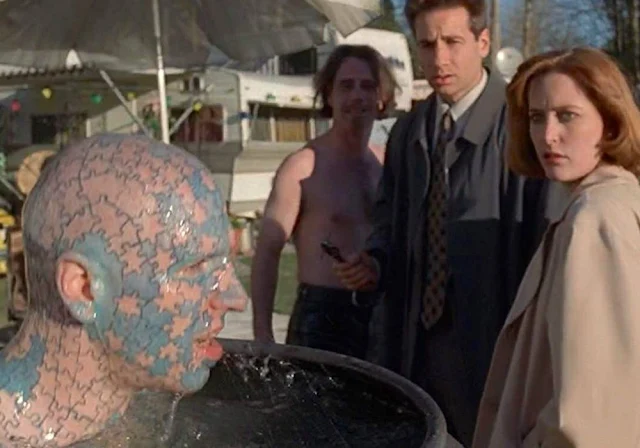
"Humbug" is a daring and deeply satirical episode that flips The X-Files formula on its head. Mulder and Scully travel to a Florida town populated by retired circus performers to investigate bizarre murders. Darkly humorous and oddly tender, the episode interrogates societal definitions of normalcy, turning the investigative spotlight on Mulder and Scully as outsiders. Morgan’s razor-sharp script is packed with biting wit and poignant commentary on prejudice. "Humbug" broke ground as the first X-Files episode to embrace overt comedy, showcasing a unique ability to balance levity and horror. Its lasting legacy is its challenge to viewers: who are the real monsters—those who look different or those who judge them?
humbug xfiles tattoo man

"Die Hand Die Verletzt"Season 2, Episode 14 | Written by Glen Morgan & James Wong


One of the darkest and most unnerving episodes, blending supernatural horror with biting social commentary. The story unfolds in the seemingly sleepy town of Milford Haven, where Mulder and Scully investigate a grisly death linked to a Satanic ritual. They uncover a group of hypocritical parents who practice occult rituals for selfish gain. When their rituals go wrong, they awaken a malevolent force embodied by Mrs. Paddock, a substitute teacher. The episode dissects themes of moral panic and hypocrisy, drawing from the “Satanic Panic” of the 1980s and 90s. The chilling final message on the chalkboard, “Goodbye. It’s been nice working with you,” is an iconic series moment.

"War of the Coprophages"Season 3, Episode 12 | Written by Darin Morgan


A masterclass in blending comedy, horror, and social commentary. Mulder investigates a bizarre outbreak of cockroach-related deaths, suspecting the involvement of extraterrestrial, robotic insects. Meanwhile, Scully offers grounded (and hilariously dismissive) commentary over the phone. Morgan’s script skewers humanity’s irrational fear of the unknown and the media’s role in amplifying panic. The episode’s title is a nod to *The War of the Worlds*, underscoring its theme of mass hysteria, complete with a fourth-wall-breaking visual gag that left many viewers swatting at their own TV screens.

"Chinga"Season 5, Episode 10 | Co-written by Stephen King & Chris Carter


A chilling blend of Stephen King’s signature small-town horror and The X-Files’ eerie style. Scully’s vacation in coastal Maine is interrupted by gruesome deaths linked to a sinister doll wielded by a young girl named Polly. The cursed toy drives townspeople to commit horrifying acts of self-harm. King’s influence is evident in the moody atmosphere and claustrophobic terror. The doll’s chilling refrain of "I want to play!" and its eerie, lifelike gaze are indelibly haunting.

"Sanguinarium"Season 4, Episode 6 | Written by Valerie & Vivian Mayhew


This episode plunges into the macabre world of vanity and greed in a high-end plastic surgery clinic. Mulder and Scully investigate bizarre deaths linked to cosmetic procedures gone horrifically wrong, revealing a surgeon using black magic to maintain youth and success by sacrificing patients. The episode excels in its visceral horror and its critique of society’s obsession with beauty, underscored by the title's Latin origin for “bloodthirsty.”

"Quagmire"Season 3, Episode 22 | Written by Kim Newton


This episode merges cryptozoological intrigue with a poignant exploration of Mulder and Scully’s dynamic. The agents investigate deaths linked to a possible lake monster named “Big Blue.” The heart of "Quagmire" lies in the now-iconic “conversation on the rock,” where the stranded agents engage in a deeply philosophical dialogue about life, loss, and obsession. This quiet, intimate moment is a fan favorite for its deft balancing of monster-hunting suspense and profound emotional resonance.
quagmire xfiles loch ness monster episode

"Badlaa"Season 8, Episode 10 | Written by John Shiban


A grotesque tale of vengeance and exploitation. A mysterious Indian mystic, portrayed by Deep Roy, uses supernatural abilities to infiltrate the bodies of his victims, smuggling himself into the U.S. inside another person’s stomach. The episode’s horror hinges on visceral, body-focused dread, but beneath the gore lies a layered exploration of cultural dislocation and post-colonial exploitation. Scully takes center stage here, grappling with her own evolving beliefs about the inexplicable.

"Familiar"Season 11, Episode 8 | Written by Benjamin Van Allen


A haunting return to The X-Files’ dark roots, combining supernatural horror with a dissection of small-town paranoia. A boy’s murder appears linked to “Mr. Chuckleteeth,” a nightmarish children’s character brought to life by witchcraft. The episode explores how fear can spiral into collective hysteria, reminiscent of the Salem witch trials. The title "Familiar" refers both to the witch’s familiar spirit and the eerie sense of déjà vu in the story’s themes of scapegoating and moral panic.

"Arcadia"Season 6, Episode 15 | Written by Daniel Arkin


A sharp, satirical take on suburban life. Mulder and Scully go undercover as a married couple ("Rob and Laura Petrie") in a gated community to investigate mysterious disappearances. They discover a tulpa—a thought-form monster—summoned by the residents’ obsessive adherence to rules, which viciously enforces the neighborhood’s oppressive regulations. The episode explores themes of repression and the cost of striving for perfection at the expense of individuality.

"X-Cops"Season 7, Episode 12 | Written by Vince Gilligan


An inventive crossover with the reality TV show *Cops*, blending vérité-style filmmaking with paranormal horror. The episode follows Mulder and Scully's investigation in Los Angeles, captured entirely by a *Cops* camera crew. The case involves a creature that manifests as its victims’ greatest fears, creating a surreal and chaotic ride through urban paranoia. The raw, handheld aesthetic heightens the episode’s tension and unpredictability.

"Roadrunners"Season 8, Episode 4 | Written by Vince Gilligan


A harrowing, claustrophobic horror story. Scully investigates a disappearance in a remote desert town, uncovering a cult that worships a parasitic slug-like creature they believe to be divine. When Scully becomes the cult’s next target, the episode becomes a visceral fight for survival. The stark, isolated setting and exploration of blind faith create a suffocating sense of dread. Doggett’s late arrival to rescue Scully marks a poignant beginning of mutual trust between them.

"Lord of the Flies"Season 9, Episode 5 | Written by Thomas Schnauz


A darkly comedic and grotesque installment that takes a satirical jab at reality television and teen culture. A bizarre death during the filming of a *Jackass*-style stunt show leads Doggett and Scully to a high school outcast who is part human, part insect. The episode balances humor and horror, with absurd stunts juxtaposed against the boy's chilling transformation. It features a guest role from a pre-*Breaking Bad* Aaron Paul and explores themes of freakishness, identity, and the search for belonging.

Read Article →

Hugh Howey’s Silo Series Explained: Dystopia, Deception, and Revolution

The Silo series by Hugh Howey (Wool, Shift, and Dust) stands as a towering achievement in modern dystopian fiction. 

Beneath its layers of claustrophobic tension and tightly wound intrigue lies a story that asks some of the most pressing questions of our time: 

What happens when humanity’s survival depends on oppressive control? 

And more hauntingly—what if the system designed to save us becomes our greatest threat?

the silo novels plot explained.

The Origins of the Silos: Fear and Survival

At the center of Silo’s mythos lies a chilling truth: the silos were never about salvation. They were about control. Constructed before a deliberately created global catastrophe the silos were sold to the remnants of humanity as lifeboats. 

But beneath that veneer of hope was a far grimmer agenda.

The creators, a shadowy cabal of politicians and technocrats, devised these underground habitats not just to protect humanity but to reshape it. The world outside was rendered uninhabitable—whether by radiation or engineered toxins—forcing survivors into these hermetically sealed environments. 

Yet the true genius, or cruelty, of the silos lay in their psychological design: the strict rules, the constant surveillance, the ever-present threat of “cleaning.” All were tools to keep humanity subdued and unquestioning.

Howey’s dystopia echoes with the fears of our age—ecological disaster, authoritarian regimes, and the technological leash tightening around us all. The silos were both a reaction to humanity’s mistakes and a cynical experiment in whether we could be better if stripped of freedom. 

But the question remains: who decides what “better” means?

The Intent of the Creators: A God Complex

At its core, the Silo series presents a twisted reflection of humanity’s god complex. The creators of the silos weren’t just engineers or politicians—they were puppet masters, pulling strings on a civilization they had remade in their image. In Shift, Howey peels back the curtain on this cabal, exposing their hubris and moral compromises. These weren’t saviors—they were master manipulators of humanity.

The stated goal was noble enough: preserve humanity in the face of extinction. 

But the execution was monstrous. By isolating populations in separate silos, cutting off communication, and fabricating a reality where even questioning the rules was lethal, the creators ensured absolute control. Each silo became a self-contained Petri dish for obedience, with its inhabitants molded by fear and ignorance.

But beneath their lofty intentions lurked darker motives. 

The creators weren’t merely preserving humanity—they were testing it. Could humanity thrive under conditions of extreme oppression? 

Would people rebel, or would they adapt, sacrificing freedom for survival? 


silo trilogy explanation ending


Inside Silo 51: The Fragile Illusion of Order

Among the sprawling network of silos, Silo 51 emerges as a microcosm of the entire system’s fragility. It operates much like the others: rigid hierarchies, strict resource management, and a culture of fear surrounding the idea of the outside world. But where other silos maintain their facade of order, Silo 51 cracks under the weight of its own design.

The leadership within Silo 51 represents the worst excesses of authoritarian rule. 

Greed, paranoia, and secrecy fester in its upper echelons, while the common people are left in the dark, both literally and metaphorically. Those who dare to question the system are branded heretics and exiled to “cleaning,” a brutal punishment in which they are forced to scrub the sensors outside before succumbing to the toxic environment. It’s a masterstroke of psychological manipulation: the doomed cleaner’s final act reinforces the lie that the world outside is uninhabitable.

Yet, Silo 51 also becomes a site of rebellion, hinting at the inherent flaw in the creators’ plan.

For all their control, they underestimated the human spirit’s capacity for defiance. The fractures in Silo 51’s society foreshadow the larger cracks that will ultimately bring the entire system to its knees.

The Nanotechnology Dilemma: Tools of Oppression

One of Howey’s most chilling innovations in the Silo series is his depiction of nanotechnology.

Presented as a marvel of progress, it becomes the perfect weapon in the hands of the silo’s overseers. Nanotechnology is everywhere—infused into the atmosphere, embedded in the systems that sustain life, and, most horrifyingly, inside the people themselves.

In Shift, the scope of this technology is fully revealed. 

It’s not just a tool for survival but a mechanism for absolute control. With the ability to manipulate thoughts, emotions, and even bodily functions, nanotechnology ensures that rebellion is almost impossible. The system can detect dissent before it even manifests, snuffing out resistance before it has a chance to grow.

Yet this same technology becomes a double-edged sword. When Juliette and others uncover the truth about its capabilities, they turn it against the system. The creators’ hubris—believing they could harness such power without consequences—becomes their undoing. The nanotechnology that once oppressed becomes a weapon of liberation, a reminder that even the most advanced tools are only as ethical as those who wield them.

Juliette’s Journey

Juliette Nichols is the unlikeliest of revolutionaries, yet her rise from mechanic to leader is the beating heart of the Silo series. In a world built on subservience, Juliette stands apart—not because she’s fearless but because she refuses to ignore what she sees. Her journey begins in the underbelly of the silo, toiling as an engineer in the mechanical depths, far removed from the political machinations above. Yet this position proves to be her greatest strength. 

Unlike the silo’s leaders, Juliette understands how its systems truly work—both the literal machines and the fragile social mechanisms holding everything together.

Her rebellion is sparked by tragedy. 

The unjust exile of her mentor, and later her lover, fuels her determination to uncover the silo’s secrets. As she digs deeper, she discovers truths that shatter the foundation of her world: the outside isn’t what they’ve been told, the creators of the silo are manipulating them, and the very fabric of their lives is engineered to ensure obedience. Juliette’s defiance becomes a lightning rod for others, transforming her from a lone voice in the wilderness to the leader of a full-fledged revolution.


The Escape: A Triumph of Will

Juliette’s escape from the silo is both a literal and symbolic act of defiance. While the creators believed their systems were airtight—both the physical containment of the silos and the psychological barriers to rebellion—Juliette proves them wrong. Her escape is meticulously planned, combining her deep mechanical knowledge with her unyielding determination. 

She understands that the silo’s greatest weapon isn’t its walls or nanotechnology but the fear it instills in its inhabitants. By confronting that fear, she shatters the illusion that the outside is unlivable.

The escape isn’t just about reaching the surface—it’s about dismantling the system from within. Juliette uncovers the truth about the world outside, revealing that the toxic atmosphere is, in part, an engineered lie. Her journey to freedom exposes the creators’ deceit and becomes a beacon for other silos, igniting a wave of rebellion that spreads like wildfire.

The escape’s success is also deeply human. Juliette doesn’t succeed alone—her allies, her community, and even the sacrifices of those who came before her all play a role. It’s a reminder that no revolution is the work of a single person. Her escape is the culmination of countless acts of courage and defiance, woven together into a tapestry of resistance.

Conclusion: Humanity’s Fight for Freedom

The Silo series culminates in a question that echoes far beyond its pages: 

What does it mean to be free? 

For Juliette and the people of the silos, freedom isn’t just the absence of walls—it’s the reclamation of their humanity. The silos were designed to strip people of choice, to reduce them to cogs in a machine. But Juliette’s rebellion proves that even in the most oppressive conditions, the human spirit cannot be extinguished.

Howey’s story is a meditation on the balance between survival and autonomy. The creators of the silos believed they were safeguarding humanity, yet their methods betrayed a fundamental lack of faith in the very people they sought to protect. Juliette’s triumph is a rejection of that cynicism, a declaration that survival without freedom is no survival at all.
Read Article →

Themes of 'Unforgiven' - Clint Eastward's masterpiece western film

Let's dissect Clint Eastwood's 1992 masterpiece, "Unforgiven," a film that's less a western and more a stark, brutal meditation on the nature of violence and redemption. Eastwood, a legend in his own right, delivers a film that peels back the romanticized veneer of the Old West, revealing the gnawing rot underneath.

This ain't your daddy's John Wayne flick (not counting The Searchers)

The film's journey to the screen was as deliberate and measured as Eastwood's own persona. David Webb Peoples (12 Monkeys, Bladerunner) penned the script in the late '70s, but Eastwood, recognizing its power and gravity, held onto it, waiting until he felt he was old enough to properly convey its themes. He wanted to be the weathered, world-weary figure at its core, and by the early '90s, he was.

The result?

A deconstruction of the western myth, a film that earned four Oscars, including Best Picture and Best Director, a testament to its profound impact.

Clint Eastwood's own performance is a masterclass in restraint, a slow burn that erupts in a final, devastating act of violence.

At the heart of "Unforgiven" lies the theme of violence and its corrosive effects. Eastwood's William Munny, a reformed killer, is dragged back into his past by poverty and a desperate need to provide for his children. His journey is a reluctant one, a stark contrast to the swaggering, gunslinging heroes of yore.

Munny's old partner, Ned Logan, played with quiet dignity by Morgan Freeman, serves as a moral counterpoint, a reminder of the toll violence takes on the soul. The brutalization of Delilah Fitzgerald, a prostitute, sets the plot in motion, highlighting the casual misogyny and brutality that permeated the West.

Gene Hackman's Sheriff "Little Bill" Daggett, a character that earned Hackman an Oscar for Best Supporting Actor, is a terrifying embodiment of unchecked power and the arbitrary nature of justice. Gene Hackman's performance is chilling, a portrait of a man who uses the law as a tool of oppression, his own violent tendencies thinly veiled beneath a veneer of order.

Little Bill's house, built from the wood of those who have been punished, is a physical manifestation of his tyranny. The clash between Munny and Little Bill is not a simple showdown; it's a confrontation between two men haunted by their pasts, a brutal reckoning with the legacy of violence.

The film also grapples with the concept of redemption, or the lack thereof. Munny's attempts to escape his violent past are constantly thwarted, forcing him to confront the darkness within him. The question isn't whether he can be redeemed, but whether such redemption is even possible in a world so steeped in blood. The film avoids easy answers, presenting a complex and morally ambiguous landscape where the lines between good and evil are blurred.

"English Bob," played with flamboyant relish by Richard Harris, is a caricature of the romanticized gunslinger, a man who peddles tall tales and lives by a code of violence. His eventual humiliation at the hands of Little Bill serves as a harsh rebuke to the mythologized image of the western hero. The Schofield Kid, played by Jamey Sheridan, represents the naive allure of violence, a young man eager to prove himself, only to be confronted with the horrifying reality of taking a life.

themes of unforgiven film 1992

The theme of redemption, or the lack thereof, is another crucial element of "Unforgiven." Munny's attempts to escape his past are constantly thwarted, forcing him to confront the darkness within him.

The film raises the question: can a man truly change?

Can he escape the sins of his past?

The answer, it seems, is a resounding "maybe," with a heavy emphasis on the "maybe."

Munny's final act of violence, while seemingly justified, leaves a lingering sense of unease, suggesting that the past can never be fully erased.Munny's journey is a reluctant one, a stark contrast to the swaggering, gunslinging heroes of yore. He is a man haunted by his past, a past that he desperately wants to escape. However, the world around him is not willing to let him go.


The violence that he has committed in the past continues to haunt him, and it ultimately leads him to commit one final act of violence.


william munny character themes unforgiven

Sam Peckinpah's "The Wild Bunch," released in 1969, arrived at a tumultuous time in American history, mirroring the nation's own disillusionment with violence and its romanticized past. Both films confront the inherent brutality of the West, but their approaches diverge significantly.

"The Wild Bunch" is a visceral, almost operatic depiction of violence, a ballet of bullets and blood that, while undeniably shocking, carries a certain aestheticized quality. Peckinpah's slow-motion sequences and graphic depictions of carnage, although intended as a critique, also possess a strange, almost seductive allure. The characters, a band of aging outlaws, are trapped in a dying era, clinging to a code of violence that's rapidly becoming obsolete. Their final, bloody stand is a nihilistic swan song, a desperate act of defiance against a changing world.

"Unforgiven," in contrast, presents violence as a corrosive force, a burden that weighs heavily on the soul. Eastwood's film strips away the romanticism, revealing the grim reality of killing. Munny's reluctant return to violence is not a celebration, but a lament.

Each gunshot is a stark reminder of the lives lost, the souls tarnished.

The film's muted palette and deliberate pacing amplify this sense of unease. The violence is sudden, brutal, and devoid of any sense of glory. It's a stark, unblinking look at the consequences of action, a reminder that the past, like a physical wound, never truly heals.

Where "The Wild Bunch" revels in the spectacle of violence, "Unforgiven" forces us to confront its moral and psychological cost.

"McCabe & Mrs. Miller," directed by Robert Altman, shares "Unforgiven's" revisionist approach, but with a different focus. Altman's film, released in 1971, portrays the West as a muddy, chaotic, and ultimately tragic place. The characters, like John McCabe and Constance Miller, are not larger-than-life heroes, but flawed, vulnerable individuals struggling to survive in a harsh and unforgiving environment. The film's slow, melancholic pace and Leonard Cohen's haunting soundtrack create a sense of quiet desperation, a feeling that the romanticized West is a myth, a lie. 

Like "Unforgiven", it shows the west to be a place of exploitation and the death of the romantic hero, but in a more subtle way. The ending of McCabe & Mrs. Miller shows the titular character dying alone in the snow, a very different ending to the "hero rides off into the sunset" trope.

All three films, in their own unique ways, contribute to a broader deconstruction of the Western myth. They challenge the simplistic narratives of good versus evil, the glorification of violence, and the romanticized image of the rugged individualist. They portray the West as a place of moral ambiguity, where the lines between hero and villain are blurred, and where the consequences of violence are devastating and long-lasting. They all show a dying west, and the death of the romantic hero that existed in earlier westerns.

"Unforgiven," however, stands out for its profound meditation on the nature of redemption and the enduring power of the past. It's a film that lingers in the mind, a haunting reminder that the ghosts of our past actions can never be fully exorcised. Eastwood's film, in its quiet, deliberate way, dismantles the very foundation of the Western genre, forcing us to confront the uncomfortable truths about ourselves and the stories we tell.

Read Article →
31 March 2025

The Conversation - the lingering echo of its themes

In 1974, sandwiched between The Godfather and its sequel, Francis Ford Coppola dropped a quieter bomb on the American psyche.

The Conversation didn’t have the operatic bloodlines or Sicilian vendettas of his Corleone saga, but its power lies in its whisper, not its roar. A film made during the golden age of American paranoia, its legacy feels eerily prophetic today. Shot with a minimalist pulse, anchored by a haunted, career-best performance from Gene Hackman, and penned by Coppola himself, the film crawls under the skin with a question that only becomes more urgent with each passing decade: 

What happens to the soul when all it does is listen?

the conversation film themes

The Nixon years set the stage. 

America in the early '70s was soaked in distrust. 

Vietnam had revealed the fault lines in the government's moral compass, and Watergate was exposing them in real time. The Conversation, released just months before Nixon resigned, tapped directly into the bloodstream of the era. Though Coppola has insisted the script was written before the Watergate scandal broke wide, its timing felt like psychic precision. 

It’s a film that doesn’t just mirror its age—it dissects it.

Gene Hackman's Harry Caul is the kind of man who exists in the peripheries, not just professionally but existentially. A surveillance expert with a saxophone and a soul in disrepair, Caul lives in the echo chamber of his own detachment. He’s a craftsman, not a voyeur, he insists. 

But the lie he tells the world is one he tries, and fails, to believe himself. Hackman, fresh off his Oscar-winning turn in The French Connection, plays Caul as a man dissolving slowly from the inside out. It’s all slouched shoulders, muttered responses, and a face that looks like it hasn’t met daylight in years.

The script—sparse, precise, and uncomfortably intimate—is pure Coppola. And while the film stands a world apart from the baroque richness of The Godfather, it carries the same moral rot at its center. Just as Michael Corleone succumbs to power under the illusion of control, Harry Caul becomes a prisoner of information he can't unhear. In both films, control is a myth. 

Surveillance doesn’t protect; it poisons. 

In The Conversation, that poison is slow, insidious, and deeply personal.

Caul’s moral erosion is rooted in a simple recording: a snippet of dialogue between a young couple in a crowded park. He plays it back, over and over, obsessed with the inflection of one line, convinced it holds the key to a potential murder. That repetition becomes ritualistic, even religious. In a world mediated by tape recorders and directional mics, language becomes unstable. 

Meaning slips..

And Caul, once confident in the clarity of his audio feeds, begins to question not just the words, but their intent—and his own culpability in the violence that may follow.

This is where The Conversation leaps past its moment and into prophecy. Its analog equipment feels ancient now, quaint even, but the questions it raises are ageless. What’s the ethical limit of observation? Where does accountability land when you're just "doing your job"? In the decades since its release, we’ve traded Caul’s reel-to-reel tapes for metadata, facial recognition, and algorithmic surveillance. Yet the disquiet remains the same. 

In the age of Edward Snowden, Cambridge Analytica, and predictive policing, Caul’s paranoia reads less like a character flaw and more like grim wisdom.

Isolation seeps into every frame of The Conversation. Caul’s life is a vacuum. He avoids intimacy, fences off emotion, and lives in a self-imposed exile of mistrust. The one time he opens up, he’s burned for it. This isn't just psychological realism—it's a cultural commentary. In a society obsessed with transparency, the most protected man becomes the most vulnerable. 

The film’s final sequence—Caul alone in his wrecked apartment, stripped bare, saxophone in hand—is among the bleakest endings in American cinema. 

It's not just the physical space he's torn apart; it's the illusion of safety itself.

final saxophone scene the conversation

Walter Murch, who co-wrote the sound design and edited the film, deserves mention here. 

Murch doesn't just mix sound; he sculpts it. Audio in The Conversation is a character, an unreliable narrator of sorts. Dialogue is fractured, layered, unclear. Reality becomes a matter of interpretation. It’s a subtle trick, but a devastating one: you start to hear the world as Caul does, and it’s terrifying.

In the fifty years since its release, The Conversation has only grown in stature. It’s less a relic of the '70s than a prelude to the 21st century’s ethical freefall. Its influence is clear in everything from Enemy of the State (which cast Hackman in a Caul-like role) to the techno-dread of Black Mirror. But unlike those inheritors, Coppola’s film resists spectacle. It remains interior, intimate, claustrophobic.

Coppola’s legacy may be forever tied to the Corleone family, but The Conversation is his most philosophical work. It's about guilt, not crime. About listening, not speaking. And in a world that’s never stopped talking, that silence is deafening.
Read Article →
Back to Top