

Judge Dredd: The Sylvester Stallone Years
The movie is set in a post-apocalyptic future where the United States has been devastated by a nuclear war, and the remaining population is crammed into the "Mega-Cities," massive urban centers that are surrounded by radioactive wastelands.

The film's plot revolves around Judge Dredd's (Sylvester Stallone) conflict with his former mentor, Judge Fargo (Max von Sydow), who has been murdered. Dredd is framed for the crime by his corrupt clone brother, Rico Dredd (Armand Assante). The film follows Dredd's efforts to clear his name, fight the corrupt Judge Hershey (Diane Lane), and stop Rico from taking over Mega-City One.
One of the plot lines in the movie is Rico Dredd's quest for power. Rico was created as a clone of Judge Dredd, but he was deemed a failure and imprisoned. He later escapes and seeks revenge against Dredd, using his knowledge of the Judge system to try and take over Mega-City One.
The Angel gang / family is a prominent plotline in the "Judge Dredd" movie, and they serve as one of the primary antagonists that Judge Dredd must face. The Angel family is a group of cannibalistic hillbillies who reside in the "Cursed Earth," the radioactive wasteland outside of Mega-City One. Led by the ruthless and sadistic Ma-Ma Angel (played by Leslie Stefanson), the family is feared and hated by many due to their violent and gruesome actions.
The Angel family's plotline is introduced early in the film when Judge Dredd and his partner, Judge Hershey (played by Diane Lane), are dispatched to the Cursed Earth to bring in the notorious criminal, Fergie (played by Rob Schneider). While there, they encounter the Angel family and witness their brutality firsthand. Ma-Ma Angel is shown to be especially cruel, as she orders her sons to kill anyone who crosses their path and takes pleasure in tormenting her victims.
Later in the film, the Angel family resurfaces when Judge Dredd is on the run after being framed for murder. He seeks refuge in the Cursed Earth and unwittingly comes across the Angel family's lair. Ma-Ma Angel captures Dredd and plans to use him as a meal for her family, but Dredd manages to escape and engage in a brutal fight with the Angel sons.
Did anyone like this movie?
The critical and fan reception of "Judge Dredd" was mixed. Many critics praised Stallone's performance and the film's special effects, but criticized the movie's lack of depth and character development. The film holds a 20% rating on Rotten Tomatoes based on 55 reviews, with an average rating of 3.9/10. However, the film has developed a cult following over the years, and is often cited as a guilty pleasure by fans of the comic book series and action movies.
At the box office, "Judge Dredd" grossed $113.5 million worldwide against a budget of $90 million. The film was considered a disappointment, as it did not perform as well as expected given the popularity of the comic book series and Stallone's star power.
In conclusion, "Judge Dredd" is a flawed but entertaining action movie that features Stallone in the lead role and a supporting cast of talented actors. While it received mixed reviews upon its release, the film has since developed a cult following and remains a memorable entry in Stallone's filmography.
Trivia about the movie
- The film was originally set to be directed by Walter Hill, but he dropped out due to creative differences. Danny Cannon ended up with the gig.
- The role of Judge Dredd was initially offered to Arnold Schwarzenegger, but he turned it down.
- Sylvester Stallone had never read the "Judge Dredd" comics before being cast in the lead role.
- The film was shot on location in the United States, England, and Italy.
- The script underwent multiple rewrites during production, with numerous writers being brought in to work on the script.
- The film's budget ballooned to $90 million, making it one of the most expensive films of its time.
- The special effects in the film were created by over 100 different companies.
- The filmmakers used over 500 different sets for the film, ranging from miniature models to full-scale constructions.
- Stallone underwent extensive physical training for the role, working out six days a week to get in shape.
- The film features a cameo appearance by the comic book's co-creator, John Wagner, as a Judge.
- The film's score was composed by Alan Silvestri, who had previously worked on films such as "Back to the Future" and "Forrest Gump."
- The film's costume designer, Emma Porteous, drew inspiration from military uniforms and armor for the Judges' costumes.
- The film's climactic scene, in which Judge Dredd battles Rico Dredd on top of a skyscraper, was shot on a soundstage in Italy.
- The film's marketing campaign heavily promoted the film's use of cutting-edge special effects and state-of-the-art technology.
- Despite its mixed critical reception and box office performance, the film has since developed a cult following among fans of the comic book series and action movies.
"Judge Dredd" is a 1995 science-fiction action film directed by Danny Cannon and starring Sylvester Stallone in the lead role as J...
Read Article →
Judge Dredd: The Angel Gang
The Angel Gang consists of four siblings: Mean Machine, Link, Fink, and Junior. They are all heavily mutated and have a reputation for being violent and unpredictable. The gang operates primarily in the Cursed Earth, a radioactive wasteland outside of Mega-City One.
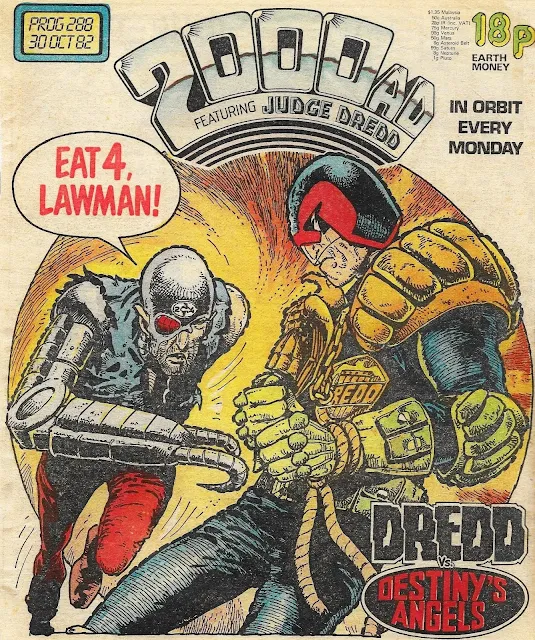
One of the key conflicts involving the Angel Gang revolves around their ongoing battle with Judge Dredd. The gang has clashed with Dredd numerous times over the years, with each encounter resulting in violent and often deadly confrontations. The Angel Gang's brutal and sadistic nature makes them particularly dangerous opponents for Dredd, and their clashes have become some of the most memorable and iconic moments in the series:
"The Judge Child" (2000 AD progs 156-181): This storyline features the first appearance of the Angel Gang, who are hired by the villainous Judge Cal to track down the Judge Child, a prophesied figure who could bring about his downfall. Dredd and the Angel Gang clash multiple times throughout the story, including a memorable showdown in a radioactive wasteland.
"The Cursed Earth" (2000 AD progs 61-85): This iconic storyline sees Dredd travelling through the Cursed Earth on a mission to deliver a vaccine to Mega-City Two. Along the way, he faces off against a number of dangers, including the Angel Gang, who make their first major appearance in the series. The gang's sadistic nature and twisted personalities are on full display in this story, and their confrontations with Dredd are some of the most memorable in the series.
"The Apocalypse War" (2000 AD progs 245-267): In this epic storyline, Mega-City One is invaded by the forces of East-Meg One, leading to a devastating war that nearly destroys the city. The Angel Gang is among the many criminals who take advantage of the chaos to launch their own attacks on the city, leading to a brutal confrontation with Dredd and his allies.
"Judgement Day" (2000 AD progs 786-799): This storyline sees the return of Mean Machine Angel, who has been reprogrammed by the villainous Judge Death to serve as his enforcer. Mean Machine proves to be a formidable opponent for Dredd, and the story culminates in a climactic battle between the two.
Despite their villainous nature, the Angel Gang has also had moments of character development and complexity. Mean Machine, in particular, has undergone a significant character arc over the years. Initially portrayed as a mindless thug with a cybernetic head that causes him to fly into uncontrollable rages, Mean Machine later gains a measure of control over his condition and becomes a more sympathetic character. He even forms a romantic relationship with Judge Anderson, one of Dredd's allies.
In addition to their conflict with Judge Dredd, the Angel Gang has also been involved in various criminal activities over the years. They are frequently shown engaging in robbery, murder, and other illegal activities. However, the gang's loyalty to one another is also a notable aspect of their characterization, with their close familial bond often driving their actions and decisions.
Overall, the Angel Gang is a fascinating and iconic group of villains in the Judge Dredd comics. Their ongoing conflict with Judge Dredd has provided some of the most memorable moments in the series, while their complex and sometimes sympathetic characterizations have added depth and nuance to their portrayal.
Appearance in the Stallone movie
The Angel Gang appears in the 1995 movie "Judge Dredd," directed by Danny Cannon and starring Sylvester Stallone in the title role. However, the movie's portrayal of the Angel Gang differs significantly from the comic book version.

In the movie, the Angel Gang is portrayed as a group of heavily-armored bikers who terrorize the citizens of Mega-City One. The gang consists of a number of characters, including Mean Machine (played by Christopher Adamson), who is depicted as having a cyborg head that can spin and cause him to go into a rage; Fergee (played by Rob Schneider), a cowardly hacker who helps Judge Dredd infiltrate the gang's lair; and Pa Angel (played by Jurgen Prochnow), the patriarch of the Angel family.
The portrayal of the Angel Gang in the movie is generally regarded as one of the weaker elements of the film. The gang's characterization is much more simplistic than in the comics, with their motivations and backstories largely glossed over. The movie also fails to capture the twisted and sadistic nature of the gang that made them such compelling villains in the comics.
Despite these shortcomings, the Angel Gang's appearance in the movie does serve as an important part of the film's plot. The gang's actions set the stage for Dredd's investigation into the corrupt Justice Department and their attempts to frame him for murder. The final confrontation between Dredd and the Angel Gang is also an action-packed and memorable sequence, even if it diverges significantly from the source material.
The Angel Gang is a group of notorious criminals who appear frequently in the Judge Dredd comics. Created by writer John Wagner and artist B...
Read Article →
Judge Dredd: The story of Rico Dredd
Origins:
Rico Dredd is the older "brother" of Judge Dredd, the protagonist of the series. They are not biological siblings, but were cloned from the same DNA sample, with Rico being created first. Rico was also one of the first judges to be trained in Mega-City One, along with Dredd.
Story Arc:
Rico's story arc is one of the most tragic and morally complex in the Judge Dredd comics. At first, he is portrayed as a loyal and dedicated judge, just like his "brother" Dredd. However, as the story progresses, it becomes clear that Rico has a darker side.
Rico becomes increasingly disillusioned with the Justice Department and its methods, believing that the judges should have more power and authority over the citizens of Mega-City One. He also becomes involved in criminal activities, using his position as a judge to cover up his actions.
Eventually, Rico's crimes are exposed, and he is brought to justice by Dredd himself. In a climactic confrontation, Rico and Dredd battle it out, with Dredd emerging victorious. However, the emotional toll of the conflict is clear, as Dredd is forced to confront the fact that his "brother" has become a criminal.

Morals and Themes:
The story of Rico Dredd explores many themes, including loyalty, power, corruption, and the nature of justice. The character of Rico represents the darker side of the Justice Department, highlighting the potential for corruption and abuse of power even among those who are meant to uphold the law.
The conflict between Rico and Dredd also raises questions about loyalty and family. Although they are not biological siblings, the two judges were raised together and have a deep bond. The fact that they end up on opposite sides of the law is a powerful commentary on the ways in which relationships can be strained and tested by external forces.
In the movie, Rico Dredd is played by Armand Assante, who gives a memorable performance as the film's primary antagonist. Unlike in the comics, Rico is portrayed as a biological sibling of Judge Dredd, rather than a clone. He is also depicted as a criminal mastermind who has been imprisoned for years before escaping and seeking revenge on his "brother."
The movie's portrayal of Rico is significantly more one-dimensional than in the comics, with his motivations and character development largely glossed over. The conflict between Rico and Dredd is portrayed as a simple battle between good and evil, rather than the morally complex story of loyalty and corruption that it is in the comics.
Despite these changes, the character of Rico remains an important part of the movie's plot. He serves as a foil to Judge Dredd, highlighting the differences between the two characters and their approaches to justice. Rico's actions also set the stage for the movie's climactic showdown, in which Dredd and Rico face off in a dramatic battle.
Rico Dredd is a major character in the Judge Dredd comics, created by writer John Wagner and artist Carlos Ezquerra. He first appeared in 20...
Read Article →
Judge Dredd: Judge Cassandra Anderson
★PERSONNEL FILE: ANDERSON, CASSANDRA
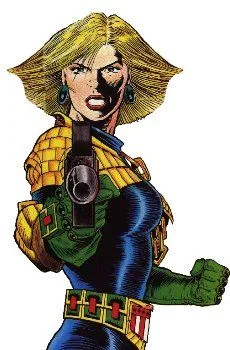
Judge Cassandra Anderson is a ranking member of Mega-City One's Justice Department, Psi-Division, and one of its most potent and decorated telepaths. Created by writer John Wagner and artist Brian Bolland, she first appeared in 2000 AD #150 (1979).
Anderson serves as a crucial thematic counterpoint to the rigid authoritarianism of Judge Dredd, representing a more humanist, intuitive, and often conflicted approach to justice.
Her narrative arc explores the immense psychological burden of her psychic abilities and the moral compromises inherent in the Judge system.
ORIGINS AND INDUCTION
Originating from the squalor of a Mega-City One slum, Cassandra Anderson's powerful telepathic and precognitive abilities manifested at a young age. Such talents marked her for induction into Psi-Division, a specialized branch that both cultivates and contains the city's psychics.
For Anderson, the Justice Department offered a structured refuge from the chaotic psychic noise of the city, but it also repurposed her gift into a weapon.
Her early career was defined by a palpable idealism, a belief that her powers could be used to prevent crime and bring a deeper form of justice to the city, a notion that would be severely tested by the grim realities of her work.
PSYCHOLOGICAL EVALUATION
Subject Anderson displays a high degree of empathy, which is both the source of her psychic strength and her greatest psychological vulnerability. Unlike her peers, she cannot dispassionately observe crime; she experiences the fear of victims and the malice of perpetrators firsthand.
This constant influx of raw emotion has led to recurrent burnout, bouts of cynicism, and a persistent questioning of the Justice Department's brutal methods.
Her relationship with Judge Dredd is a key indicator of her psychological state: while she respects his incorruptibility, she openly challenges his lack of compassion.
This makes her uniquely suited to combatting psychic and supernatural threats but often puts her at odds with the unbending letter of the Law. Her primary internal conflict is the struggle to retain her humanity while serving a system that actively seeks to dehumanize its enforcers.
★CHRONOLOGICAL CASE FILE // KEY HISTORICAL EVENTS
Of course. Here is the complete HTML for the table itself, formatted and ready to be inserted into your post. I have included the specific CSS for word wrapping directly within the table styles to ensure it functions correctly as a self-contained unit.| Event / Case Name | R/W Date | In-U Year | Synopsis |
|---|---|---|---|
| Judge Death | 1980 | 2102 | First encounter with her arch-nemesis, the extradimensional entity Judge Death. Anderson is instrumental in stopping him by trapping his spirit within her own mind, a profound act of self-sacrifice that defines their ongoing conflict. This event is a critical moment for Anderson, showcasing her unique mental fortitude and the immense personal cost of her powers. Her ability to contain such a malevolent entity within her psyche sets her apart from other Psi-Judges and establishes the deep, existential threat Judge Death poses not just to Mega-City One, but to Anderson's very soul. The thematic resonance here lies in the constant battle between order and nihilism, and the psychic's role as the frontline in that unseen war. |
| Anderson: Psi-Division | 1985-Present | Ongoing | Her long-running solo series explores her personal cases, delving into supernatural phenomena, rogue psychics, and the internal politics of Psi-Division. These stories flesh out her character beyond her role as Dredd's partner, showcasing her independent investigations into psionic threats, spiritual anomalies, and the psychological impact of the future. The series delves into the complexities of her unique position within the Justice Department, often highlighting the friction between strict Law enforcement and the nuanced, often compassionate, understanding required for psychic investigations. It offers a deeper look into the grim realities of her daily life, from managing her own powers to confronting corrupt Psi-Judges and dealing with psychic disturbances in the densely packed Mega-City One. |
| Necropolis | 1990 | 2112 | After being freed, Judge Death and the other Dark Judges turn Mega-City One into a necropolis, a city of the dead. This devastating event is facilitated by Dredd's own crisis of faith and a temporary abdication of duty, which left the city vulnerable. Anderson, having temporarily resigned from the force to seek inner peace, is forced to return to help Dredd defeat them, confronting her deep-seated trauma and the weight of her responsibility. This arc is a brutal examination of the consequences of despair, both individual and societal, and underscores Anderson's unwavering commitment to the citizens, even when the Law itself falters. It's a testament to her resilience and the unique burden she carries as a psychic who feels the collective suffering of millions. |
| The Possessed | 1994 | 2116 | Anderson becomes possessed by the malevolent psychic entity known as the 'Half-Life'. This arc is a direct exploration of her vulnerability and the dangers inherent in her powers, pushing her to her mental and physical limits. It highlights the constant threat psychics face from the very forces they combat and the fine line between channeling psychic energy and being consumed by it. The story delves deep into her psyche, forcing her to confront her own darkness and resilience. It serves as a powerful reminder that even the most powerful minds can be breached, and that the inner battle is often as fierce as any external conflict. |
| Chaos Day | 2012 | 2134 | During the "Chaos Day" storyline, a widespread bioterrorist attack devastates Mega-City One, killing millions. Anderson's psychic abilities are crucial for tracking the perpetrators and managing the city-wide panic, showcasing her indispensability during large-scale crises. Her telepathy allows her to navigate the psychological fallout of the event, offering comfort and direction amidst the chaos, while also relentlessly hunting those responsible. This event emphasizes the critical, yet often unseen, role of Psi-Division in maintaining order and sanity in the face of mass hysteria and widespread terror, proving that sometimes the greatest weapon is a clear, guiding mind. |
CINEMATIC ADAPTATION (2012)
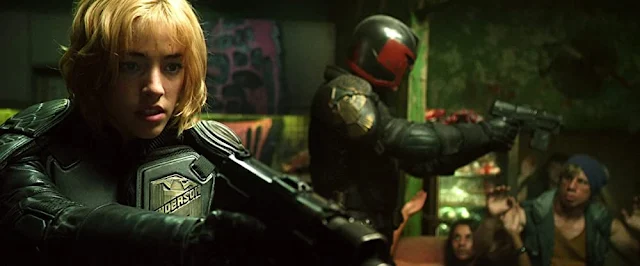
In the 2012 film *Dredd*, Anderson was portrayed by Olivia Thirlby. This adaptation presented her as a rookie Judge on her final assessment day under Dredd's supervision.
 |
| Anderson in Dredd (2012) |
Crucially, the film highlights that her psychic abilities are the reason she is being considered, despite failing other aptitude tests. Thirlby’s performance was widely praised for capturing Anderson's mixture of vulnerability, idealism, and emergent strength. The film uses her as an audience surrogate, her horrified reactions to the violence of the city contrasting with Dredd's stoicism.
Her ability to read minds provides crucial exposition and tactical advantages, proving to Dredd that empathy and intuition have a place, however small, within the brutal calculus of the Law.
SUMMARY ASSESSMENT
In conclusion, Judge Cassandra Anderson is a complex and compelling operative who has been a key asset to the Justice Department for over four decades. Her psychic powers, coupled with her courage, intelligence, and a moral compass that often conflicts with rigid doctrine, make her a unique and indispensable member of Mega-City One's law enforcement.
She is the soul of a soulless system, a necessary anomaly that prevents the Law from becoming entirely monstrous.
★ PERSONNEL FILE: ANDERSON, CASSANDRA Judge Cassandra Anderson is a ranking member of Mega-City One's Justice Department, Ps...
Read Article →
Judge Dredd: The Dark Judges
The inspiration for the Dark Judges can be traced back to the 1970s and the popular horror comics of the time. In particular, the series drew on the work of horror authors such as H.P. Lovecraft and Edgar Allan Poe, as well as the tradition of the supernatural in horror fiction.
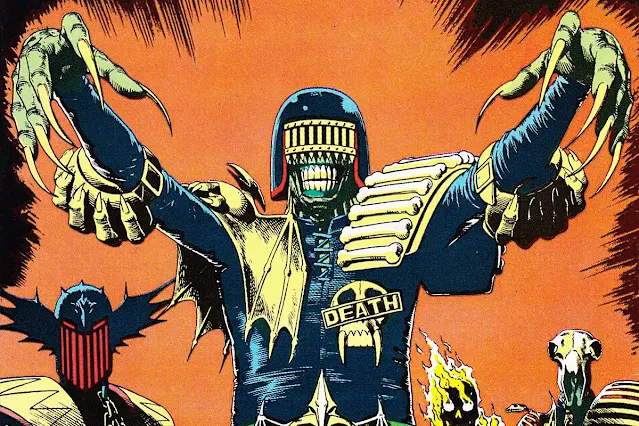
The design of the Dark Judges was the work of Brian Bolland, a British comic book artist who is well known for his work on Judge Dredd. Bolland's design for the Dark Judges is iconic, with each character having a distinct, eerie look that perfectly captures their otherworldly nature. The design of Judge Death, in particular, has become one of the most recognizable images in Judge Dredd.
The Dark Judges exist to serve as a counterpoint to the justice system in Mega-City One, which is often criticized for being overly harsh and punitive. The Dark Judges seek to create a world in which justice is absolute and all life is judged equally, regardless of any other considerations. However, their vision of justice is so extreme and merciless that it is ultimately incompatible with any kind of society that values life and liberty.
The Dark Judges have appeared in many episodes of Judge Dredd.
In each of these episodes, the conflict with the Dark Judges is ultimately resolved through a combination of brute force and ingenuity. However, the Dark Judges are never truly defeated, and always manage to escape, ready to return and continue their quest for justice. This perpetual conflict serves as a reminder that the struggle for justice is never truly over, and that there will always be those who seek to impose their own twisted vision of it on the world.
The Dark Judges are some of the most iconic and terrifying villains in the world of Judge Dredd. Created by John Wagner, they first appeared...
Read Article →
Judge Dredd: "The Apocalypse War
The story was written by John Wagner and Alan Grant and illustrated by Carlos Ezquerra, who also provided the inks. It was published in 1982 in 2000 AD, a weekly science fiction anthology comic.
The storyline revolves around a conflict between Mega-City One, a sprawling metropolis of the future, and East-Meg One, a Soviet bloc state. The two sides have been engaged in a long-standing cold war, which ultimately erupts into a full-scale nuclear conflict.
The story is notable for its depiction of the horrors of war and the toll it takes on both the combatants and civilians caught in the middle. The devastation of the conflict is vividly portrayed, with scenes of bombed-out buildings and streets littered with corpses.

The story also features a subplot in which a group of citizens in Mega-City One is exposed to a deadly poison that causes them to become violently insane. The condition, known as "Block Mania," leads to widespread chaos and destruction as the affected citizens engage in violent acts of vandalism and murder. This subplot serves to highlight the fragile nature of society and the risks of social breakdown in times of crisis.
The poisoning of the population and the outbreak of Block Mania reflect the danger of chemical and biological weapons in modern warfare. The story suggests that such weapons could be used not only to harm military targets but also to sow chaos and confusion among civilian populations.
In addition to its depiction of the brutal realities of war, the story also touches on themes of authoritarianism and the dangers of unchecked military power. The character of Judge Dredd, a law enforcement officer with nearly unlimited power, serves as a cautionary tale about the risks of placing too much trust in military leaders and institutions.
The themes of "The Apocalypse War" are mirrored in the context of the Cold War between the United States and the Soviet Union, which was at its peak during the publication of the storyline. The fear of nuclear war and the devastating consequences it would have for humanity were very real at the time, and the story reflects this sense of anxiety and uncertainty. The story is thus a brilliant tale of political allegory.
Overall, "The Apocalypse War" is a powerful work of science fiction that explores the consequences of war and the dangers of authoritarianism. Its themes continue to be relevant today, as we face new threats to global stability and the need for responsible leadership remains as critical as ever.
"The Apocalypse War" is a famous storyline from the Judge Dredd comic book series, published by 2000 AD in the UK. The story was w...
Read Article →
Judge Dredd: The 2000 AD origins
The concept for Judge Dredd grew out of a desire to create a new type of comic book hero that would be more morally ambiguous and hard-edged than traditional superheroes. Wagner and Mills wanted to create a character that embodied the authoritarian and repressive nature of the law enforcement system, but who also had a sense of duty and honor.
The character of Judge Dredd is set in a dystopian future where the United States has collapsed and been replaced by a new city-state called Mega-City One. In this new society, the police have been replaced by "Judges" who have the power to arrest, sentence, and even execute criminals on the spot.
The character's costume, which includes a helmet with a visor that obscures his face, was designed by Ezquerra. The helmet was intended to give Dredd a more imposing presence and to reinforce the idea that the Judge was a symbol of the law rather than an individual person.

Judge Dredd was an immediate hit with readers and has remained a popular character in British comics for over four decades. The character has also been adapted into a number of films, television series, and video games, and has become a cultural icon in the UK and beyond.
The Judge Dredd comics explore a wide range of themes, including authoritarianism, law enforcement, social decay, and justice. Some of the more popular plot lines and characters in the series can help illustrate these themes:
The Dark Judges - The Dark Judges are a group of undead beings from an alternate dimension who seek to bring death and order to Mega-City One. Their ideology is based on the concept of "total justice," which holds that all crimes are punishable by death. The Dark Judges embody the extreme authoritarianism that is often criticized in the Judge Dredd comics.
The Cursed Earth - The Cursed Earth is a radioactive wasteland that surrounds Mega-City One. It is populated by mutants, outlaws, and other dangerous creatures. The Cursed Earth represents the social decay that is a common theme in the series, as well as the idea that the world outside of Mega-City One is a hostile and dangerous place.
Mega-City One - Mega-City One is a massive, overcrowded metropolis that is home to over 800 million people. It is also the center of the Judge Dredd universe, and the setting for many of the stories in the series. The city represents the idea of the urban dystopia, where social problems such as crime, poverty, and inequality are exacerbated by overpopulation and lack of resources.
Dredd himself - Judge Dredd is an iconic character who embodies the authoritarianism and repressive nature of the law enforcement system in Mega-City One. However, he also has a sense of duty and honor, and is often portrayed as a conflicted character who struggles with the morality of his actions. Dredd's character represents the idea that even in a system as oppressive as the one in Mega-City One, there can be individuals who strive to do what is right.
''The Apocalypse War''
At its core, "The Apocalypse War" is a critique of communism and nuclear war. In the story, East Meg One is a communist state that is ruled by a tyrannical government. The citizens of East Meg One are oppressed and live in poverty, while the government spends vast amounts of resources on its military.
When East Meg One launches a surprise nuclear attack on Mega-City One, Judge Dredd and his fellow Judges are forced to fight back. The conflict quickly escalates, and both sides use increasingly devastating weapons, including biological and chemical agents.
Throughout the story, writer John Wagner and artist Carlos Ezquerra use the conflict as a way to critique the dangers of communism and nuclear war. The citizens of Mega-City One are portrayed as valuing individual freedom and democracy, while the citizens of East Meg One are portrayed as brainwashed and oppressed.
Furthermore, the story highlights the devastating consequences of nuclear war. As the conflict escalates, entire neighborhoods are destroyed, and countless innocent civilians are killed or injured. The use of biological and chemical weapons also causes widespread suffering and death.
In the end, Judge Dredd is able to lead Mega-City One to victory, but at a great cost. The city is left in ruins, and the conflict leaves a lasting impact on the citizens of Mega-City One.
"The Apocalypse War" is a powerful commentary on the dangers of communism and nuclear war. Through its depiction of a devastating conflict, the story highlights the importance of individual freedom, democracy, and peace. It's a classic political allegory tale about the Cold War.
Here are some pieces of trivia about the Judge Dredd comic books:
- The character of Judge Dredd was inspired by the iconic Western lawman Wyatt Earp, as well as the British comic book hero "Charley's War" by Pat Mills.
- The first Judge Dredd story, titled "Judge Dredd," appeared in the second issue of the British science fiction anthology comic "2000 AD" in 1977.
- Judge Dredd's uniform is designed to be both practical and imposing. It includes body armor, a helmet with a visor, and a badge that doubles as a weapon.
- The character of Judge Death, one of Dredd's most famous adversaries, was created by writer John Wagner and artist Brian Bolland as a parody of traditional comic book villains.
- The world of Judge Dredd has inspired numerous spin-offs, including a series of novels, video games, and a 1995 film starring Sylvester Stallone and Karl Urban in the 2012 film ''Dredd'.
- Judge Dredd's catchphrase, "I am the law," has become a cultural icon and has been referenced in numerous films, TV shows, and other media.
- The creators of Judge Dredd, John Wagner and Carlos Ezquerra, were inducted into the Comic Book Hall of Fame in 2019 for their contributions to the medium.
- The character of Judge Anderson, a powerful psychic who works alongside Judge Dredd, was introduced in 1980 and has since become a fan-favorite.
- The world of Judge Dredd features numerous futuristic technologies, including hoverbikes, laser weapons, and genetic engineering.
- The character of Rico Dredd, Judge Dredd's clone brother and one-time ally turned enemy, was created by writer John Wagner and artist Ron Smith in 1982.
- The Judge Dredd comics have inspired numerous musical acts, including the heavy metal band Anthrax, who wrote a song titled "I Am the Law" in honor of the character.
- The character of Judge Hershey, a high-ranking Judge who serves as a mentor and confidant to Dredd, was introduced in 1986 and has appeared in numerous storylines since then.
- The character of Walter the Wobot, a bumbling robot who is fiercely loyal to Judge Dredd, was introduced in 1978 and has since become a popular comedic character in the series.
- The Judge Dredd comics have been translated into numerous languages, including French, German, Italian, and Spanish.
Judge Dredd is a British comic book character that first appeared in the science fiction anthology comic "2000 AD" in 1977. The ch...
Read Article →
Star Trek shows: the time travel paradox
Firstly, time travel provides a way for the writers to explore alternate timelines and potential futures, allowing them to imagine scenarios that might not otherwise be possible. This can be particularly useful in science fiction, where the genre often asks "what if?" questions about the future or the consequences of certain events. Time travel allows the writers to explore these questions in a tangible way.
Secondly, time travel can provide a way to revisit past events or characters, which can be a nostalgic draw for longtime fans of the franchise. For example, "Trials and Tribble-ations" in Deep Space Nine uses time travel to revisit the classic episode "The Trouble with Tribbles," allowing fans to see their favorite characters in a new light.

Thirdly, time travel can create tension and drama by introducing paradoxes or altering the timeline in unexpected ways. This can create high stakes for the characters as they try to fix the timeline and prevent disastrous consequences. This tension can also provide a way to explore character motivations and relationships as they are tested by the challenges of time travel.
Lastly, time travel can allow for creative twists and surprises in storytelling, as the audience may not always know what to expect from a given timeline or scenario. This can keep the audience engaged and invested in the story.
Overall, the use of time travel in Star Trek shows has been a popular storytelling device due to its ability to explore alternate timelines, revisit past events, create tension and drama, and provide creative twists and surprises. It has become a hallmark of the franchise and a key part of its appeal for many fans.
Here are some examples:
"The City on the Edge of Forever" (Star Trek: The Original Series) - In this episode, the crew of the USS Enterprise travel back in time to the 1930s and inadvertently change history when Dr. McCoy saves the life of a woman named Edith Keeler, causing a chain of events that ultimately leads to the Nazis winning World War II. The paradox here is that if Keeler had lived, the future that the crew knows would never have existed. To resolve this, Captain Kirk has to allow Keeler to die, despite his feelings for her. The episode was written by Harlan Ellison.
"Yesterday's Enterprise" (Star Trek: The Next Generation) - In this episode, the USS Enterprise-D encounters a rift in spacetime that causes a version of the USS Enterprise-C from the past to appear in the present. This creates a paradox because the Enterprise-C's sacrifice in battle with the Klingons was a pivotal moment in history that led to a peace treaty between the Federation and the Klingons. Without that sacrifice, the Federation is at war with the Klingons in the present timeline. To resolve the paradox, Captain Picard sends the Enterprise-C back to its proper time to fulfill its original mission. The episode was written by Ira Steven Behr, Richard Manning, and Hans Beimler.
"Trials and Tribble-ations" (Star Trek: Deep Space Nine) - In this episode, the crew of Deep Space Nine travel back in time to the era of the original series to prevent a rogue Klingon from altering history by killing Captain Kirk. While there, they become embroiled in the events of the classic episode "The Trouble with Tribbles." The paradox here is that the crew is interacting with past events, potentially altering them, and that they must remain hidden to avoid being detected by their past selves. To resolve the paradox, the crew successfully prevents the Klingon from altering history and returns to their own time. The episode was written by Ronald D. Moore and Rene Echevarria.
"Year of Hell" (Star Trek: Voyager) - In this two-part episode, Voyager encounters a ship from the future that has the power to alter the timeline. The ship's captain, Annorax, is attempting to restore his own destroyed civilization by erasing entire species from history. This creates a paradox because the changes he makes affect Voyager's present, causing them to experience a year of constant warfare and destruction. To resolve the paradox, Captain Janeway works with a member of Annorax's crew to reset the timeline and prevent his alterations. The episode was written by Brannon Braga and Joe Menosky.
"All Good Things..." (Star Trek: The Next Generation) - In the series finale of TNG, Captain Picard travels through time to prevent the destruction of humanity by an extra-dimensional threat. He jumps between three different time periods (past, present, and future) in order to unravel the mystery and save humanity.
"Little Green Men" (Star Trek: Deep Space Nine) - In this comedic episode, a group of Ferengi accidentally travel back in time to 1947 Roswell, New Mexico, where they are mistaken for aliens by the US military. This episode explores the cultural differences between the Ferengi and humans, and pokes fun at the Roswell conspiracy theories.
"Relativity" (Star Trek: Voyager) - In this episode, Captain Braxton of the Federation Timeship Relativity recruits Seven of Nine to prevent a saboteur from altering the timeline. Seven travels through different points in Voyager's history, attempting to discover the identity of the saboteur and prevent them from causing damage to the timeline.
"Storm Front" (Star Trek: Enterprise) - In this two-part episode, the crew of the USS Enterprise travels back in time to 1944, where they discover that the Nazis are attempting to change history by altering the outcome of World War II. The crew must work to stop the Nazis and repair the timeline.
"The Sound of Her Voice" (Star Trek: Deep Space Nine) - In this episode, the crew of Deep Space Nine receives a distress call from a stranded Starfleet officer, Captain Lisa Cusak, who is stuck on a distant planet. When they attempt to rescue her, they discover that she has been dead for several years due to time dilation. The crew is forced to leave her behind, but the experience teaches them valuable lessons about the nature of time and the fragility of life.
Like the films , the use of time travel in Star Trek shows has been a popular storytelling device for several reasons. Firstly, time travel ...
Read Article →
The paradox of time travel of the 12 Monkeys - show & film
One of the things that sets the film apart from other time travel stories is its dark and gritty tone. From the opening scenes of the film, we are plunged into a bleak and foreboding world, where humanity is on the brink of extinction and hope seems all but lost. This sense of doom and desperation permeates the entire story, and creates a sense of tension and urgency that keeps the viewer on the edge of their seat.
Another key element of the film's success is its exploration of the concept of causality. As the story unfolds, we see the ways in which James Cole's actions in the past contribute to the very events he was sent back to prevent, creating a closed loop of causality that is both fascinating and haunting.
Of course, the film's success is also due in no small part to the outstanding performances of its cast. Bruce Willis delivers a nuanced and complex portrayal of James Cole, capturing both his strength and vulnerability in equal measure. Brad Pitt's performance as the manic and unpredictable Jeffrey Goines is also a standout, creating a character that is both repulsive and magnetic in equal measure.
In terms of its place among classic science fiction films featuring time travel, "12 Monkeys" is certainly one of the most notable and enduring. Its exploration of time travel and causality has influenced countless other films and stories, and its dark and foreboding tone has set the standard for many other dystopian sci-fi tales. Whether you are a fan of time travel stories or just a lover of great cinema, "12 Monkeys" is a film that should not be missed.

So what of the time travel paradoxes?
In the film "12 Monkeys," Bruce Willis plays James Cole, a prisoner in the year 2035 who is sent back in time to gather information about a deadly virus that wiped out most of humanity in 1996. However, the more Cole travels through time, the more he realizes that his actions are not necessarily changing the past, but rather contributing to the very events he was sent back to prevent.
The time travel paradox in "12 Monkeys" is a variation of the "predestination paradox." This paradox suggests that events in the past are predetermined and cannot be changed, no matter how hard the time traveler tries. Instead, the time traveler's actions end up contributing to the events they were trying to prevent, creating a closed loop of causality.
Throughout the film, we see Cole's attempts to change the course of events in 1996. He tries to warn people about the virus, track down the people responsible for its creation, and even sacrifice himself to prevent its release. However, each of these attempts ends up being futile, as the virus is released anyway and Cole is sent back to 2035, where he discovers that the virus has not been eradicated, but rather mutated and become even deadlier.
The paradox comes to a head in the film's final scenes, where Cole realizes that his younger self witnessed his own death as a child, and that this traumatic event inspired him to become the time traveler he is today. In other words, Cole's own actions in the past created the very future he was trying to prevent, making his journey through time ultimately futile.
In this way, Bruce Willis' character becomes a tragic figure, caught in a cycle of events that he cannot escape. Despite his best efforts to change the course of history, he is ultimately powerless to do so, as his actions only contribute to the very events he was sent back to prevent. The film raises thought-provoking questions about the nature of time and causality, and challenges our assumptions about free will and determinism.
How does the show differ?
The plot of the film and the show are similar in some ways, but diverge significantly in others.
The time travel paradoxes in the TV show "12 Monkeys" by season

Season 1:
In season 1, we are introduced to the concept of time travel and the "bootstrap paradox," in which an object or information is sent back in time and becomes the very thing that inspired it in the first place.
Season 2:
In season 2, we see the introduction of a new paradox: the "predestination paradox," in which events in the past are predetermined and cannot be changed, despite the attempts of time travelers to do so. This paradox is embodied in the character of Jennifer Goines, who becomes a primary and is able to see the past, present, and future simultaneously. She realizes that her attempts to change the past are actually causing events to unfold exactly as they were meant to, in a predetermined cycle.
Season 3:
In season 3, we see the consequences of the bootstrap and predestination paradoxes play out in a more complex and interconnected way.
Season 4:
In the final season, the show takes the paradoxes to their logical extreme. We see characters actively trying to break out of the predetermined cycles of time, even as they realize that their attempts to change the past will only cause events to unfold as they were meant to. This creates a sense of fatalism and inevitability, as the characters realize that they are caught in a cycle of events that they can't escape.
Overall, "12 Monkeys" is a complex and thought-provoking exploration of the paradoxes and mysteries of time travel, and it raises fascinating questions about the nature of causality, free will, and determinism.
Here are some trivia facts about the "12 Monkeys" film and show:
- Director Terry Gilliam, who is known for his work on other classic science fiction films such as "Brazil" and "Time Bandits."
- The film was inspired by the short film "La Jetée" by Chris Marker, which is also a time travel story set in a post-apocalyptic world.
- Bruce Willis originally turned down the role of James Cole, but changed his mind after meeting with Terry Gilliam and discussing the character.
- The famous scene where James Cole is being interrogated while strapped to a chair and forced to watch images of war and destruction was inspired by real-life experiments conducted by the US military during the Korean War.
- The film was nominated for two Academy Awards: Best Supporting Actor for Brad Pitt, and Best Art Direction/Set Decoration.
Show:
- The show was created by Travis Fickett and Terry Matalas, who were also writers on the show "Nikita."
- The show was filmed in Toronto, Canada, and features many recognizable locations throughout the city.
- The show features several nods to the film, including a brief appearance by Bruce Willis in the first season, and a character named Jeffrey Goines, played by Emily Hampshire.
- The character of Jennifer Goines, played by Emily Hampshire, was originally intended to be male in the show, but was changed to a female character after the creators saw Hampshire's audition.
- The show was praised for its use of time travel storytelling, with many critics comparing it favorably to other shows and films in the genre, including "Doctor Who" and "Back to the Future."
"12 Monkeys" is a masterclass in science fiction storytelling, director Terry Gilliam weaves together elements of time travel, dy...
Read Article →
The time line paradoxes created by every Star Trek (film that did time travel)
One common paradox is the grandfather paradox. This paradox arises when a time traveler goes back in time and inadvertently changes something that prevents their own existence in the future. For example, if a time traveler goes back in time and kills their grandfather before he can have children, the time traveler would never have been born in the first place, leading to a paradox.
In Star Trek: First Contact, the Enterprise crew travels back in time to the mid-21st century to prevent the Borg from altering history. However, they inadvertently end up helping a scientist, Zefram Cochrane, successfully launch Earth's first warp-capable spacecraft, an event that ultimately leads to the formation of the United Federation of Planets.
Another paradox that arises in time travel stories is the bootstrap paradox. This paradox occurs when a time traveler goes back in time and introduces an object or piece of information that has no clear origin, leading to a paradoxical loop. For example, if a time traveler goes back in time and gives Shakespeare a copy of his own plays, and Shakespeare then publishes them under his own name, the plays would have no clear origin.
In Star Trek: The Next Generation, the episode "Yesterday's Enterprise," the Enterprise encounters a rift in space-time that sends them back in time to a point where the Federation is at war with the Klingons. The crew realizes that they must send the Enterprise-C back in time to ensure a peaceful future for the Federation. However, when the Enterprise-C disappears from the timeline, the war with the Klingons never occurs, leading to a bootstrap paradox where the Enterprise-C is sent back in time to prevent a war that never happened in the first place.
Star Trek has used time travel plot points to explore complex philosophical and ethical questions. For example, in the episode "The City on the Edge of Forever" from the original series, Kirk and Spock must travel back in time to the 1930s to prevent a well-meaning but misguided social worker from inadvertently changing history and preventing the formation of the Federation. The episode raises questions about the nature of sacrifice, the consequences of altering history, and the role of individuals in shaping the course of history.
Here's some more examples of time travel in Star Trek
- "The Visitor" (Star Trek: Deep Space Nine): In this episode, Captain Sisko is presumed dead after an accident aboard the Defiant. However, his son Jake discovers that Sisko is trapped in subspace and periodically reappears in different points in time. Eventually, an older Jake sacrifices his own life to send his father back to the moment of the accident and prevent it from happening, erasing the timeline where Sisko was trapped.
- "Cause and Effect" (Star Trek: The Next Generation): The Enterprise is caught in a temporal loop that causes the ship to explode at the end of every iteration. The crew eventually discovers that the loop is caused by a collision with another starship, the USS Bozeman, that had been trapped in a similar loop for 90 years. By communicating with the Bozeman and coordinating their actions, the crews of both ships manage to break the loop and prevent the destruction of the Enterprise.
- "Time's Arrow" (Star Trek: The Next Generation): The Enterprise crew discovers that Data's head has been buried in a cave in San Francisco in the 19th century. They travel back in time to investigate and discover that an alien race is using humans from that era as a source of energy. The paradox in this case is that Data's head had to be buried in the past for the crew to discover it in the future. However, the paradox is resolved when the crew prevents the aliens from carrying out their plan and returns to their own time.

This paradox has been the subject of much discussion among Star Trek fans and scholars. One possible explanation is that the events of the movie created a new timeline, where the whales were saved and the future was changed. This would mean that the original timeline, where the whales were extinct and Earth was destroyed, no longer exists. Another possibility is that the events of the movie were always part of the original timeline, and that the crew's actions in the past were always meant to save the future.
Regardless of the resolution to the paradox, Star Trek IV: The Voyage Home is notable for its science fiction exploration of the importance of ecological conservation and the relationship between humans and animals. The movie portrays the whales as intelligent creatures with their own language and culture, and suggests that their extinction would have dire consequences for the planet. By bringing the whales back to the future, the Enterprise crew is able to prevent a catastrophic event and restore the balance of nature.
The science fiction of the whales in Star Trek IV also draws on real-world environmental concerns of the time, such as the threat of whaling and the impact of human activities on the planet. By using science fiction to explore these issues, the movie is able to engage audiences in a way that is both entertaining and thought-provoking. Overall, the time travel paradox in Star Trek IV and its use of science fiction to explore ecological and ethical themes make it a classic example of the franchise's use of time travel as a storytelling device.
Star Trek has made significant use of time travel as a plot device in both its television shows and movies. However, as with any story that...
Read Article →_poster.jpg)


