
Frank is the image that most people remember from Donnie Darko: a towering rabbit with grey fur, a metallic skull and a voice that speaks as though the future has already happened. He looks like the monster of the film, yet he repeatedly saves Donnie and guides him towards the act that prevents reality from collapsing.
That contradiction is the point. Frank is a dead man appearing before his own death, a frightening figure performing the work of a guardian, and an apparent villain whose violence helps expose the respectable monsters hiding inside suburban Middlesex. The rabbit costume carries all of those ideas at once.
Why is Frank a rabbit? The literal answer is that the living Frank wears the rabbit costume to Elizabeth Darko’s Halloween party. After Donnie kills him inside the Tangent Universe, Frank becomes one of the Manipulated Dead and appears to Donnie in the form associated with his death. The deeper answer is that the rabbit turns Frank into a guide, a sacrificial victim, a corrupted symbol of innocence and the living face of Donnie’s approaching deadline.

Frank is one person at two points in time
Frank the rabbit and the young man driving the red Pontiac are the same person. The film is not presenting a supernatural rabbit and a separate human character who happen to share a name.
The living Frank is connected to Elizabeth Darko and arrives at the Halloween party dressed in the rabbit costume. Later that night, he drives towards Roberta Sparrow’s house. Gretchen is lying in the road after being attacked by Seth and thrown from Donnie’s bicycle. Frank swerves to avoid Sparrow, runs over Gretchen and stops the car. Donnie responds by shooting him through the right eye.
The Frank who has been speaking to Donnie throughout the previous 28 days is the dead version of that young man. Because Frank dies inside the Tangent Universe, he can communicate through what Roberta Sparrow’s The Philosophy of Time Travel calls the Fourth Dimensional Construct. His death occurs near the end of the story, but his influence reaches backwards through the entire Tangent timeline.
This is why Frank can remove his rabbit mask in the cinema and show Donnie the wound in his eye before Donnie has fired the shot. The injury is evidence arriving before its cause. Frank is effectively displaying Donnie’s future action back to him.
The rabbit belongs to the Ensurance Trap
The jet engine does not simply crash into Donnie’s bedroom and create the Tangent Universe. Sparrow’s lore treats the engine as the Artifact, a metal object that has appeared inside an already unstable offshoot of reality. Donnie, designated the Living Receiver, must send that Artifact through a temporal portal and back into the Primary Universe before the Tangent Universe collapses.
Frank’s job is to get him there.
How Frank closes the causal loop
- Frank summons Donnie out of bed, preventing the Artifact from killing the one person capable of returning it.
- He orders Donnie to flood the school. The closure gives Donnie the opportunity to walk Gretchen home and begin the relationship that changes him.
- He tells Donnie to burn Jim Cunningham’s house, exposing Cunningham’s child abuse material.
- Cunningham’s arrest causes Kitty Farmer to remain in Middlesex, so Rose Darko accompanies Sparkle Motion to Los Angeles.
- Rose and Samantha return on the aircraft whose engine becomes the Artifact.
- Gretchen dies and Donnie kills the living Frank, creating two Manipulated Dead figures with the power to guide him.
- Donnie sends the engine through the portal, erases the Tangent Universe and allows the Artifact to fall into his bedroom in the restored timeline.
This chain is the Ensurance Trap. Frank’s destructive instructions are pieces of cosmic stage management. Flooding the school, burning Cunningham’s house, meeting Gretchen, placing Rose on the aircraft and killing Frank all converge on the same result.
The trap also makes Frank morally disturbing. He saves existence, but he does so by manipulating Donnie through love, grief and violence. The universe does not gently explain Donnie’s duty. It engineers a situation in which sacrifice becomes the only choice he can live with.
A monster who exposes the respectable monsters
Frank’s appearance establishes one of the film’s sharpest reversals. The character who looks demonic is helping to save the world. Jim Cunningham, the smiling motivational speaker welcomed by the school and admired by its adults, conceals predatory abuse beneath the language of confidence and moral certainty.
Frank has the face of a monster and performs a necessary good. Cunningham has the face of a saviour and commits genuine evil. One wears his horror openly. The other hides his behind pastel clothes, television appearances and the approval of the community.
This is why Frank cannot be comfortably placed on Cunningham’s absurd “fear and love” lifeline. His methods inspire fear, but they lead Donnie towards love and sacrifice. He is threatening and protective, cruel and necessary. Donnie’s rejection of Cunningham’s binary thinking prepares him to understand a universe in which moral truth is far more complicated than the adults around him will admit.
Frank also gives Donnie permission to attack the false order of Middlesex. The flooded school reveals the fragility of its institutions. The fire tears open Cunningham’s public identity. Each act appears antisocial on the surface, yet each exposes something rotten underneath.
The mask, the wounded eye and the “man suit”
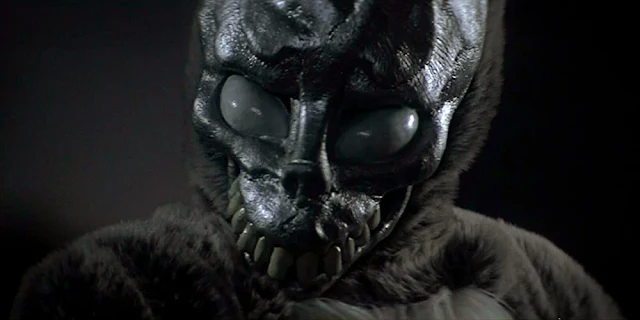
When Donnie asks why Frank is wearing a rabbit suit, Frank responds by asking why Donnie is wearing a “man suit.” The exchange turns a simple costume into a question about identity.
Donnie is already performing versions of himself. He is the difficult son, the medicated patient, the disruptive student, the frightened teenager and the possible saviour of reality. None of those roles fully contains him. Frank’s answer suggests that the ordinary human identity Donnie presents to the world may be another costume worn over something stranger.
Halloween makes that uncertainty visible. Donnie wears a skeleton costume, dressing as the dead man he will soon become. Frank dresses as an animal, then returns as a supernatural version of that animal after his death. Their costumes do more than conceal identity. They reveal destiny.
The wound beneath Frank’s mask completes the inversion. Masks normally hide the truth. Frank removes his and shows Donnie the most impossible truth in the film: an effect whose cause has not happened yet. His destroyed eye becomes a temporal signature, proof that the figure in the cinema has already experienced the ending.
The eye also belongs to the film’s larger concern with perception. Donnie sees liquid paths emerging from people’s bodies, glimpses the machinery of predestination and recognizes the emptiness in Cunningham’s philosophy. Frank loses an eye but gains a perspective outside ordinary time. Physical sight is damaged at the precise moment metaphysical sight becomes possible.
The White Rabbit, Watership Down and the countdown
Frank resembles a corrupted White Rabbit. Like the rabbit followed by Alice, he draws the protagonist out of familiar reality and into a world governed by unfamiliar rules. Both figures are associated with time and urgency. Frank makes that association apocalyptic by giving Donnie an exact countdown to the end of the world.
The connection with Richard Adams’ Watership Down is even stronger. Richard Kelly has discussed the novel as an influence on Frank’s conception, and the Director’s Cut restores a classroom sequence devoted to the book. Watership Down begins with a prophetic vision of catastrophe that others struggle to believe. Its rabbits must trust frightening knowledge, leave the apparent safety of home and move towards a future they cannot fully understand.
That structure closely resembles Donnie’s predicament. He receives knowledge no one else can verify, recognizes that his comfortable suburb is already threatened and must act before the disaster visible only to him arrives.
Frank also recalls the Black Rabbit of Inlé, the death figure within the mythology of Watership Down. The Black Rabbit is frightening because it represents the inevitability of death, yet it is part of the natural order rather than an embodiment of simple evil. Frank performs a similar function. He comes to Donnie as a figure of death, but also escorts him towards understanding and acceptance.
Kelly wanted the costume to look disturbing and animalistic rather than resemble a cheerful Easter mascot. Production designer Alex Hammond developed the design from Kelly’s sketches, costume designer April Ferry built the suit, and James Duval gave Frank his unnervingly still physical presence. The finished mask resembles a rabbit skull fused with a machine, making Frank appear dead, organic and artificial at the same time. The story behind that design is explored in this account of Frank’s creation.
The cinema scene turns Frank into a dark angel
Frank’s most revealing appearance occurs during a Halloween double feature of The Evil Dead and The Last Temptation of Christ. The choice of films places Donnie between demonic horror and sacred sacrifice.
The Evil Dead contributes portals, possession and bodily terror. The Last Temptation of Christ concerns a messianic figure tempted by the possibility of escaping sacrifice and living an ordinary life. Donnie faces his own version of that temptation. He has found love with Gretchen and briefly experienced a life with purpose, yet restoring the Primary Universe means surrendering that future.
Frank sits between those two meanings. He resembles a demon, functions like a prophetic messenger and guides Donnie towards a sacrifice that saves people who will never know what he did. Calling him either an angel or a monster captures only half of his role.
Is Frank real or a hallucination?
The theatrical cut preserves enough uncertainty for Frank to be read as a projection of Donnie’s mental illness. Donnie undergoes therapy, takes medication and experiences visions that other characters cannot see. Frank’s commands can resemble the external voice Donnie gives to impulses he already possesses.
That interpretation becomes strained once the entire plot is considered. Donnie could hallucinate Frank, but his illness cannot easily explain the unidentified jet engine, the temporal vortex, the future eye wound, the liquid paths emerging from other people or the emotional aftershocks experienced by several characters after the timeline resets.
The Director’s Cut reduces the ambiguity further by placing pages from The Philosophy of Time Travel directly into the film. Those passages identify the Artifact, the Living Receiver, the Manipulated Living, the Manipulated Dead and the Ensurance Trap. Within that expanded version, Frank has a defined metaphysical function.
The strongest reading allows the psychological and cosmic explanations to coexist. Frank is a real entity within the film’s science fiction mythology, but Donnie experiences him through the language of his fear, alienation and unstable perception. His mental condition makes his testimony easy for everyone else to dismiss. It also leaves the audience sharing his uncertainty until the temporal design becomes visible.
For a closer map of those mechanics, the full Donnie Darko Tangent Universe and time travel explanation follows the Artifact from the aircraft to Donnie’s bedroom and back through the portal.
Fate gives Donnie a script, but he still has to choose
Frank appears to prove that every event is predetermined. He knows the deadline, carries a wound from the future and directs Donnie along a path that has already been completed from his perspective. The liquid trails extending from people’s bodies make human movement look prewritten.
Yet Donnie’s final act still depends upon choice. The Ensurance Trap can place the pieces around him, teach him what the Tangent Universe means and make the cost of failure unbearable. It cannot make his sacrifice emotionally meaningless.
During the Tangent timeline, Donnie learns that Gretchen can be saved only if the life they shared is erased. He can preserve his own existence and lose everyone when the unstable universe collapses, or restore reality and accept the death that Frank initially helped him escape.
His freedom therefore exists inside necessity. Donnie cannot choose the structure of the crisis, but he can decide how to answer it. His laughter in bed suggests recognition rather than defeat. He remembers enough to understand what the falling engine will do, and he remains where he is.
The final montage implies that the erased world leaves emotional residue. Frank touches his eye. Gretchen senses a connection to the grieving Darko family despite never having met Donnie in the restored timeline. The characters appear to retain fragments of the Tangent Universe as dreams, grief or instinct. The events have been erased from history without being completely erased from the people who lived through them.
The rabbit is the face of an impossible mercy
Frank is a rabbit because the costume must work on several levels at once. It identifies the human being who will die on Halloween. It gives the Manipulated Dead a recognizable form. It evokes a guide leading Donnie into another reality, a prophetic animal fleeing catastrophe and a death figure arriving to escort someone out of the world.
Most importantly, the costume embodies the film’s moral reversal. Frank looks evil but leads Donnie towards salvation. Cunningham looks virtuous but conceals abuse. Donnie looks like a disturbed and destructive teenager but becomes the only person capable of saving reality.
The rabbit is frightening because it knows the ending. It is tragic because its human wearer has not reached that ending yet. Every time Frank appears, Donnie is speaking to a victim of an act he has not committed, following instructions made possible by a death still waiting for both of them.
Frank is therefore more than the mascot of Donnie Darko. He is the film’s temporal paradox given a face: killed by Donnie, created by that killing, and sent backwards to guide his killer towards the choice that erases the world in which the murder occurred.
That circular causality is also why Donnie Darko remains such an unusual time travel film. Donnie does not travel through history in a machine. He lives inside a dying version of reality and sends one impossible object out of it. The distinction, and the paradox it creates, is examined further in Donnie Darko: the time travel movie that features no time travel.


_poster.jpg)


