
Alien: Resurrection, directed by Jean-Pierre Jeunet and released in 1997, is the strangest film in the main Alien franchise. It is not as pure as Ridley Scott's Alien, not as muscular as James Cameron's Aliens, and not as grimly spiritual as David Fincher's Alien 3. It is a grotesque laboratory experiment of a sequel, a film about cloning that itself feels cloned from earlier franchise parts, reassembled with mismatched tissue, theatrical lighting, black comedy, body horror, and a deep unease about what counts as human.
Set 200 years after the events of Alien 3, the film resurrects Ellen Ripley through military cloning. That premise is both the film's best idea and its central problem. Ripley died in Alien 3 to stop Weyland-Yutani from owning the Queen embryo inside her. Alien: Resurrection asks what happens if the future simply refuses to respect that sacrifice.
The answer is ugly, interesting, uneven, and often more ambitious than its reputation suggests. The film does not fully succeed. Its tone lurches from horror to camp to action comedy. Some characters feel like sketches rather than people. The dialogue can be too self-aware for its own good. But beneath the mess is one of the franchise's most disturbing ideas: Ripley does not return as the woman who sacrificed herself. She returns as Ripley 8, a clone with Xenomorph DNA, acid in her blood, inherited memory, alien instinct, and a body that no longer belongs completely to humanity.
A sequel built from refusal
The boldest thing about Alien 3 is that it ends. Ripley dies. The Queen dies with her. Weyland-Yutani loses the prize. The franchise reaches a bleak but complete conclusion: the survivor chooses death rather than let the company own the monster inside her.
Alien: Resurrection begins by rejecting that ending. Not emotionally. Industrially. The future military does not care about Ripley's sacrifice as a moral act. It treats her remains as recoverable data. Blood becomes archive. DNA becomes property. Death becomes a technical inconvenience.
That makes the film's title more cynical than triumphant. This is not resurrection as miracle. It is resurrection as extraction. Ripley is brought back because her body contains something valuable. She is not restored out of love, grief, or justice. She is manufactured because the Queen inside her can be harvested.
That idea places the film firmly inside the franchise's central tradition. The company in Alien wants the organism. Burke in Aliens wants the organism. Weyland-Yutani in Alien 3 wants the Queen. The United Systems Military in Resurrection wants the same thing under a different institutional name. The franchise keeps changing the face of power, but the appetite remains the same.
The USM Auriga and the military-industrial nightmare
The action takes place aboard the USM Auriga, a military research vessel where scientists have successfully cloned Ripley in order to extract the Queen embryo from her body. The ship is not a haunted commercial tug like the Nostromo, and it is not a marine deployment zone like LV-426. It is a laboratory, a slaughterhouse, and a factory.
That setting matters. Alien: Resurrection shifts the franchise from corporate greed to military science, but the ethical rot is familiar. The Auriga exists because people in power still believe the Xenomorph can be managed, studied, bred, and weaponized. Two centuries after Ripley's death, humanity has still not learned the basic lesson of the franchise: the Alien cannot be reduced to a product without turning the surrounding world into a nest.
The ship's scientists are not curious in the noble sense. They are technicians of violation. They clone Ripley repeatedly. They discard failed bodies. They surgically remove the Queen. They breed Xenomorphs. They keep hosts imprisoned as reproductive material. The Auriga is a future where medical advancement, military ambition, and corporate-style exploitation have merged into one cold system.
This is one of the film's sharper points. In earlier Alien films, the body is violated by the Xenomorph lifecycle. Here, the body is violated by humans before the monsters even escape. The scientists have learned from the Alien, but not ethically. They have learned how to reproduce its cruelty.
Ripley 8: the survivor as hybrid
Sigourney Weaver's performance is the film's strongest anchor. Ripley 8 is not the Ellen Ripley we knew, and Weaver understands that. She does not play the character as a simple continuation. She plays her as a memory with teeth. Ripley 8 knows things she should not know, feels things she cannot fully explain, and moves through the film with a strange mixture of amusement, sorrow, menace, and detachment.
The original Ripley was defined by procedure, suspicion, trauma, and moral clarity. Ripley 8 is defined by ambiguity. She has some of Ripley's memories, but not her full human continuity. She has some of the Alien's instincts, but not its pure biological drive. She stands between species, between death and life, between motherhood and monstrosity.
That makes her fascinating. The old Ripley fought to keep the Alien outside humanity. Ripley 8 has the Alien inside her. She is faster, stronger, stranger, and less morally legible. When she looks at the Xenomorphs, she does not react only with fear. There is recognition. There is kinship. There is disgust. There is grief.
This is where Alien: Resurrection has real thematic value. It asks whether identity lives in memory, body, experience, DNA, or choice. If Ripley has been copied, altered, and merged with the monster she died to destroy, is she still Ripley? The film never answers cleanly, which is one of its better instincts.
The failed Ripley clones and the film's best horror scene
The most haunting sequence in the film is not an action scene. It is Ripley discovering the failed clones that came before her. The room is filled with aborted versions of herself, malformed bodies that expose the cost of the scientists' success. Clone 7, still alive and suffering, is the film's most direct accusation against the people who made Ripley 8.
This scene works because it slows the film down and lets the horror become moral rather than tactical. The monsters in the tank are not Xenomorphs. They are failed Ripleys. Human experiments. Biological drafts. Bodies treated as disposable because they did not produce the desired result.
Ripley burning the failed clones is one of the film's most emotionally complicated moments. It is mercy, rage, self-recognition, and self-erasure at once. She destroys the evidence, but she also releases versions of herself from a life that should never have existed. It is the one scene where the film's cloning theme fully lands.
It also strengthens the link to the film's larger themes of identity, cloning, and genetic experimentation. Alien: Resurrection is at its best when it treats science not as spectacle, but as a way of asking what cruelty becomes possible when a person is redefined as material.
Call, synthetic conscience, and the franchise's AI thread
Winona Ryder's Annalee Call is one of the film's more interesting ideas, even if the execution is uneven. At first, she appears to be a nervous young mechanic among the mercenary crew of the Betty. Her secret is that she is an auton, a synthetic made by other synthetics, which places her in the franchise's long line of artificial persons alongside Ash, Bishop, David, Walter, Andy, and others.
Her role matters because she is not serving the military, the company, or the mission. She has come to kill Ripley before the Queen can be extracted and exploited. In other words, the synthetic character is the one who understands the ethical stakes more clearly than the humans running the experiment.
That makes Call a useful reversal. Ash in Alien is terrifying because he obeys corporate instruction over human life. Bishop in Aliens is moving because he proves a synthetic can act with loyalty and care. Call adds another layer: artificial life with independent moral agency. She is not simply programmed to protect. She chooses to resist.
This connects directly to the franchise's broader concern with AI, androids, and synthetic beings in the Alien films. The series never settles for one view of artificial intelligence. Synthetics can be servants, traitors, protectors, artists, killers, family members, and moral witnesses. Call belongs to the witness category. She sees the Auriga's work for what it is: a crime disguised as research.
The Betty crew: lively, messy, and underwritten
The mercenary crew of the Betty gives the film a very different energy from the previous entries. Elgyn, Johner, Christie, Vriess, Hillard, and Call are smugglers, pirates, scavengers, and survivors. They are not workers like the Nostromo crew, soldiers like the Colonial Marines, or prisoners like the men of Fiorina 161. They are outsiders moving through the cracks of a militarized future.
This is a good setup, but the film does not always give the characters enough interior life. Ron Perlman's Johner is memorable because of performance and attitude, while Dominique Pinon's Vriess fits Jeunet's taste for eccentric physical presence. Still, too many of the others function as movement, banter, and eventual danger rather than fully shaped people.
That is one reason the film feels thinner than its themes. Alien made the Nostromo crew feel lived-in. Aliens made the Marines vivid through rhythm and group dynamic. Alien 3 gave the prisoners a bleak religious culture. Resurrection has personality, but not always depth. The Betty crew are fun to watch, but the film rarely lets them carry the same emotional weight as Ripley 8 or Call.
Jeunet's grotesque visual style
Jean-Pierre Jeunet was an odd choice for an Alien film, but not an uninteresting one. His visual style is theatrical, wet, grimy, exaggerated, and bodily. The Auriga is not a sleek future environment. It feels sticky, cramped, rusted, and diseased. Faces are strange. Spaces are distorted. The lighting often makes the film feel like a dark carnival version of science fiction.
That style is both a strength and a weakness. On the positive side, it gives Alien: Resurrection a distinct identity. It does not look like the other films. It leans into grotesque texture, strange humour, and bodily discomfort. On the negative side, the film sometimes becomes too cartoonish for its own horror. Its weirdness can undercut tension when the story needs dread.
Still, Jeunet's instincts suit the cloning material. A cleaner, more conventional director might have made the film feel like a generic late-1990s action sequel. Jeunet makes it feel like a mutated organism. It may not always be good mutation, but it is mutation with personality.
The Xenomorphs as clever animals, not cosmic nightmares
The Xenomorphs in Alien: Resurrection are more intelligent and socially coordinated than in some earlier entries. They learn. They test their containment. They use violence strategically. The sequence where they kill one of their own so acid blood can burn through the floor is one of the film's best monster ideas.
That said, the film also loses some of the creature's original mystery. In Alien, the Xenomorph is almost supernatural in its unknowability. In Aliens, the hive structure gives it social logic. In Resurrection, the creatures feel closer to dangerous lab animals, still horrifying, but less mythic. That shift fits the story, since these Xenomorphs are bred and studied in captivity, but it also reduces some of the awe.
The film's best use of them is in the underwater sequence. It is visually memorable, physically tense, and different from the corridors-and-vents structure the franchise often returns to. The Xenomorphs swimming after the survivors is one of the few set pieces in the film that genuinely expands how the creatures can move through space.
The Newborn: failed child, failed god, failed future
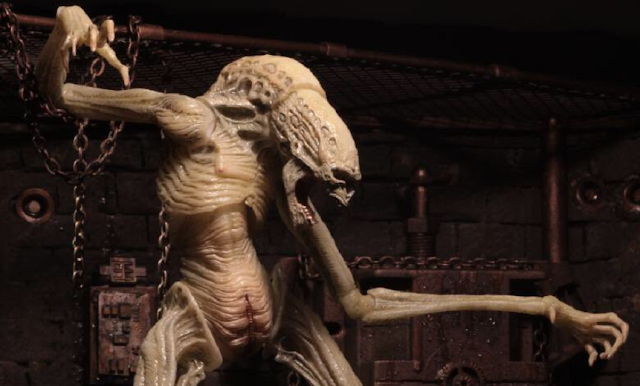
The Newborn is the film's most divisive creation. It is ugly, pale, needy, violent, and pitiful. Some viewers find it ridiculous. Others find it deeply disturbing. The design does not have the elegant biomechanical purity of the classic Xenomorph lifecycle. That is partly the point. The Newborn is not perfect. It is the result of interference.
The Newborn represents hybridization gone wrong. It is part human, part Xenomorph, part child, part monster. It looks at Ripley 8 as a mother figure, which makes the final confrontation stranger than a normal monster battle. Ripley is not only killing a threat. She is killing a creature that exists because her cloned body was used as reproductive technology.
This is where the film's themes of motherhood, cloning, and bodily ownership become most grotesque. Ripley 8 has an intimate connection to the Queen. The Queen gives birth in a mutated, mammalian manner. The Newborn rejects the Queen and bonds with Ripley. The whole sequence turns family into horror and reproduction into a chain of misplaced attachments.
The Newborn may not be as iconic as the original Xenomorph, but it makes thematic sense. It is not supposed to be sleek. It is a bad answer to a bad experiment. It is humanity's fantasy of control made flesh, and like most things in Alien, it turns back on its makers.
Cloning, identity, and the ownership of the body
The best science-fiction idea in Alien: Resurrection is not that Ripley is cloned. It is that cloning does not restore anything cleanly. The film rejects the comforting fantasy that a person can simply be copied and returned. Ripley 8 carries fragments of memory, but she is not the same woman. She carries alien DNA, but she is not a Xenomorph. She carries maternal connection to the Queen, but she also carries disgust, anger, and grief.
The film uses cloning to ask whether identity is biological, experiential, spiritual, or narrative. If Ripley remembers something from her previous life, does that make it hers? If her body has been altered, is her humanity reduced or expanded? If she has been created for a purpose she did not choose, can she still claim freedom?
These questions connect Resurrection to the larger Alien franchise more strongly than its action sequences do. The series has always been about bodies under threat. Kane's body becomes a host. Newt's body is at risk of becoming part of the hive. Ripley's body in Alien 3 contains a Queen. Ripley 8's body is not invaded from outside, but manufactured from the start as a vessel for someone else's ambition.
The film's tone problem
The major flaw of Alien: Resurrection is tonal control. The film contains rich ideas, memorable images, and strong body-horror material, but it often undercuts itself with jokey dialogue, exaggerated performances, and a slightly weightless action-comic rhythm. The result is a film that sometimes seems embarrassed to sit with its own horror.
This matters because Alien films depend on pressure. Scott builds dread through restraint. Cameron builds pressure through escalation. Fincher builds doom through fatalism. Jeunet builds grotesquerie through style, but style alone does not always create fear. Resurrection is visually rich, but emotionally slippery.
That does not make the film worthless. It makes it unstable. Its instability is part of its identity. It is a film about failed copies, hybrid bodies, and unnatural rebirth, and the film itself feels like an unnatural rebirth of the franchise. It is messy in a way that matches its subject, though that does not excuse every weak line or thin character beat.
The Whedon script and Jeunet film do not always want the same thing
Part of the film's unevenness comes from the clash between Joss Whedon's script sensibility and Jeunet's visual world. The dialogue often reaches for sarcasm, ensemble banter, and genre self-awareness. Jeunet's direction reaches for decay, odd faces, bodily grotesquery, and dark fairy-tale strangeness. Those impulses do not always align.
At times, the combination gives the film flavour. At other times, it makes the characters sound like they wandered in from a different movie. The Alien franchise can handle humour. Aliens has plenty of it. The problem is calibration. In Aliens, the humour sharpens fear because the characters feel real. In Resurrection, the humour sometimes floats above the danger.
The film's better moments are the ones where Jeunet's grotesque style wins: the failed clones, the Queen birth, the Newborn, the underwater chase, Ripley 8's uncanny behaviour, and the laboratory atmosphere. Those scenes feel like they belong to this film's specific nightmare.
Earth as an ending and a warning
The film's ending brings Ripley 8 and Call to Earth, a planet Ripley no longer truly knows. That final arrival should be more emotionally overwhelming than the film allows, but the idea is strong. Ripley has spent the franchise fighting in space, on colonies, on prison worlds, and aboard military vessels. Earth becomes less a homecoming than a question.
What does Earth mean to a clone? What does humanity mean to a hybrid? What does freedom mean to a synthetic like Call? The film closes with the possibility that both women, one cloned and one artificial, may be more humane than the human institutions that created the horror around them.
This ending also gains extra resonance beside later franchise entries. The prequels would move backward toward Engineers, black pathogen, David, and creation myths. Alien: Romulus would later return to the idea of young people trapped by systems that treat bodies as resources. Resurrection remains the far-future endpoint of that same sickness: humanity still trying to own life, still failing, still calling the failure progress.
Main themes in Alien: Resurrection
Identity after death
Ripley 8 is the film's central question. She looks like Ripley, remembers parts of Ripley, and carries Ripley's symbolic weight, but she is not simply the same person. The film uses her to explore identity as something unstable, biological, emotional, and haunted by memory.
Science without moral limits
The Auriga scientists embody the franchise's old sin in a new form. They are not reckless miners or desperate colonists. They are professionals with resources, training, and institutional authority. That makes their moral failure sharper. They understand enough to proceed and not enough to stop.
Motherhood as mutation
The Alien franchise has always linked motherhood and horror, especially in Aliens and Alien 3. Resurrection makes that link grotesque. Ripley 8 is tied to the Queen. The Queen gives birth differently because of Ripley's DNA. The Newborn sees Ripley as mother. Family becomes biological confusion.
Artificial conscience
Call gives the film its most direct AI theme. She is artificial, but she possesses moral urgency. The human scientists are natural-born, but ethically monstrous. The film therefore separates humanity from biology. A person is not human because of what they are made from. A person becomes human through responsibility, empathy, and choice.
The monster as inheritance
The Xenomorph is no longer merely an external threat. It is inherited through blood, tissue, memory, and cloning. The monster is part of Ripley 8, and Ripley 8 is part of the monster. That makes the conflict more intimate, though also more difficult for the film to dramatize cleanly.
Franchise placement and legacy
Alien: Resurrection is rarely treated as the franchise's finest hour, and that is fair. It lacks the terrifying elegance of Alien, the emotional propulsion of Aliens, and the tragic seriousness of Alien 3. But it has become more interesting with time because its obsessions now feel more central to modern science fiction: cloning, body ownership, synthetic identity, military research, genetic hybridity, and the ethics of manufactured life.
It also looks less like an outlier when placed beside the later franchise. Prometheus and Alien: Covenant would explore creation, mutation, black goo, and synthetic authorship. Alien: Romulus would return to hybrid horror through the Offspring and corporate experimentation with alien material. In that wider context, Resurrection feels less like a dead end and more like the franchise's first full dive into genetic horror.
Its problem is not a lack of ideas. Its problem is that it has more ideas than tonal discipline. It wants to be horrifying, funny, grotesque, philosophical, stylish, action-driven, and strange all at once. Sometimes that mixture works. Sometimes it curdles. Either way, it is hard to mistake for anything else.
Verdict
Alien: Resurrection is not a great Alien film in the clean, classical sense. It is too uneven, too jokey in places, and too inconsistent in character focus. But it is a far more interesting film than its weaker reputation allows. It has one of Sigourney Weaver's strangest performances as Ripley, one of the franchise's best horror scenes with the failed clones, a genuinely provocative AI figure in Call, and a grotesque final monster that pushes the series' obsession with motherhood and mutation to an uncomfortable extreme.
The film's greatest value is its refusal to let Ripley's sacrifice remain clean. That choice is frustrating, but it is also thematically potent. In the Alien universe, no body stays sacred once institutions discover value in it. Death can be reversed. Identity can be edited. Motherhood can be engineered. The Xenomorph can be bred again. The crime can be repeated under a new name.
That is the real horror of Alien: Resurrection. It is not only that Ripley comes back wrong. It is that the future brings her back for the same old reason: someone still thinks the monster can be owned.


_poster.jpg)


