03 April 2023

Contrasting the Matrix of Leadership and the All Spark in Transformers

TRANSFORMERS ARTIFACTS: LORE ANALYSIS

Within the cosmic lore of the Transformers saga, two artifacts represent the fundamental duality of the Cybertronian race: the Matrix of Leadership and the AllSpark. They are the twin concepts of cultivated wisdom versus raw creation, of earned responsibility versus the chaotic potential of life itself. 

To understand their distinct roles is to understand the core philosophies that drive the Autobot and Decepticon causes.

The Matrix of Leadership is not merely a symbol; it is a holy relic, a direct conduit to the divine spark of the Transformers' creator-god, Primus. 

Forged by Primus himself and first borne by Prima, the leader of the original Thirteen Primes, its purpose is to safeguard the collected wisdom and experiences of every leader who has carried it. It is a sapient artifact whose immense power is secondary to its primary function as a library of leadership, morality, and sacrifice. 

The Matrix does not grant power easily; it tests the spirit, demanding worthiness and self-awareness. It represents the belief that true leadership is a burden to be carried, a legacy to be honored, and a light to be shone against the encroaching darkness.

In stark contrast, the AllSpark embodies the untamed, amoral power of genesis. In many continuities, it is the vessel that carried the very lifeblood of Cybertron from the Well of All Sparks, the planetary core where new Cybertronian life is born. 

Where the Matrix is a curated collection of wisdom, the AllSpark is a torrent of raw creative energy, capable of spontaneously granting life to any technology it touches. It has no conscience or agenda; it simply creates. 

This makes it the ultimate prize, a tool that can be used for rebirth and restoration in the hands of the Autobots, or for corruption and the creation of a monstrous, unthinking army in the hands of the Decepticons. 

💎 The Matrix of Leadership

The Transformers: The Movie (1986)

Artifact: Matrix of Leadership
Core Theme: Destiny and Worthiness

Thematic Insight:

This film establishes the Matrix as a quasi-sentient artifact that embodies the central theme of worthiness versus experience. It is not a weapon to be simply wielded but a sacred trust to be earned. The dying Optimus Prime passes it to the seasoned soldier Ultra Magnus, but the Matrix rejects him due to his crippling self-doubt. This illustrates that true leadership requires not just strength, but an unwavering spirit and belief in oneself. The Matrix must be opened by one who is willing to embrace their destiny, no matter how unprepared they feel.

Hot Rod opens the Matrix, becoming Rodimus Prime

Plot Function:

It is ultimately the young and impulsive Hot Rod who, in a moment of selfless courage inside the chaos-bringer Unicron, proves his worth. The Matrix recognizes his inherent nobility and transforms him into Rodimus Prime. The act of opening the Matrix to "light our darkest hour" establishes its lore as the ultimate weapon against cosmic evil, channeling the collective wisdom and pure energy of past Primes to obliterate Unicron from within. It is both a key to personal evolution and a beacon of hope against oblivion.

Transformers: Revenge of the Fallen (2009)

Artifact: Matrix of Leadership
Core Theme: Sacrifice and Resurrection

Thematic Insight:

Here, the Matrix's lore is reimagined as an ancient key tied to the Dynasty of Primes. Its function as both a key to planetary destruction and a vessel for resurrection drives the plot. The artifact tests worthiness in a new way: it turns to dust because its power cannot be simply taken. It must be earned through a great sacrifice. The human protagonist, Sam Witwicky, proves his worthiness not through combat, but through his unwavering loyalty and willingness to die for Optimus. This act bridges the human-Cybertronian bond and asserts that qualities like self-sacrifice are universal.

Plot Function:

The Matrix's primary function becomes the resurrection of Optimus Prime. After Sam proves his worth, the dust reforms into the artifact, which he uses to pour life back into Optimus's spark. This positions the Matrix as a literal key to life and the only hope against The Fallen, the ancient Decepticon who can only be defeated by a Prime. It is a tool that restores the past to save the future.

Transformers: Prime ("One Shall Rise" & "Orion Pax")

Artifact: Matrix of Leadership
Core Theme: Identity and Burden

Thematic Insight:

This storyline explores the theme of identity and the immense burden of the Matrix. To defeat Unicron, Optimus must empty the Matrix's entire energy, an act so profound it erases his own memories as a Prime and reverts him to the humble data clerk he once was, Orion Pax. This lore establishes the Matrix not as a separate object, but as an intrinsic part of the bearer's consciousness. It is a repository of wisdom so vast it overwrites a personality. The plot then centers on the idea that leadership is an amalgam of the artifact's power and the individual's own experience, as the Autobots fight to restore the 'Optimus' identity to the 'Orion' body.

Plot Function:

The empty Matrix serves as a symbol of Optimus's lost self. The quest to restore his memory becomes a race against time, as Megatron manipulates the naive Orion Pax. Jack Darby's journey to Cybertron to recharge the Matrix with the wisdom of the Primes solidifies its role as a living library of leadership. Its restoration not only brings Optimus back but reaffirms that his identity as a Prime is not just a title but a hard-won fusion of his past self and the collective knowledge he carries.

🧊 The AllSpark

Transformers (2007)

Artifact: The AllSpark
Core Theme: Creation and Corruption

Thematic Insight:

The AllSpark is introduced as a raw, almost chaotic force of creation, the source of all Cybertronian life. In contrast to the Matrix's wisdom, the AllSpark's power is untamed and morally neutral. The core conflict is a race for this creative potential. The Autobots hope to use it to restore their dead world, a symbol of hope. The Decepticons want to corrupt its power to build a new army from Earth's technology, turning a life-giving force into a tool of conquest. This duality highlights how great power can be used for either salvation or destruction.

Plot Function:

As the central MacGuffin, the AllSpark drives the entire plot. Its eventual use to kill Megatron, by being pushed into his spark chamber, is a pyrrhic victory. Sam Witwicky saves the world by destroying the Autobots' only hope of ever restoring their own. This act symbolizes the tragic, permanent loss of the Cybertronian homeworld and the future of their race, cementing their place as refugees and protectors of Earth.

Transformers: Animated (2007-2009)

Artifact: The AllSpark
Core Theme: Responsibility and Chaos

Thematic Insight:

When the AllSpark shatters, its fragments become central to the plot, each a miniature, unpredictable source of life. This "scavenger hunt" arc explores the theme of responsibility. The Autobots must contain the chaos unleashed by the fragments as they animate random technology, creating both allies and dangerous new villains. This decentralized power demonstrates that the AllSpark's creative energy is pervasive, hard to control, and carries immense consequences. It is not just about harnessing power, but cleaning up after it.

Plot Function:

The fragments are episodic plot generators, creating the "bot of the week" for much of the series. The ultimate goal is to reassemble the AllSpark. This culminates in Prowl's ultimate sacrifice, merging his own spark with the fragments to contain their energy. His selfless act highlights the immense power and cost associated with the very source of life, showing that controlling creation sometimes requires the ultimate payment.

Transformers: War for Cybertron Trilogy (2020-2021)

Artifact: The AllSpark
Core Theme: Freedom vs. Tyranny

Thematic Insight:

The AllSpark represents the central ideological conflict of the war. For Megatron, it is the ultimate tool for unity. He believes he can end the war by using its power to forcibly reformat all Cybertronians into Decepticons, thus erasing free will in favor of absolute order. For Optimus Prime, this corrupts the sanctity of life the AllSpark creates. His decision to launch the AllSpark into space is a profound sacrifice, choosing the slow death of their planet over the tyranny of enforced unity. The artifact becomes a symbol of the very soul of their race.

Plot Function:

The AllSpark's departure from Cybertron is the inciting incident that expands the war across the galaxy. Its journey through a space bridge becomes the tangible representation of their ideological struggle. The quest to find it is not just about restoring their home, but about determining the future philosophy of the Cybertronian race: will it be a future of choice and individuality, or one of singular, imposed purpose?

02 April 2023

Gattaca: A Bleak Future of Genetic Determinism and Discrimination

Released in 1997, Andrew Niccol’s Gattaca is more than a science fiction film; it is a chillingly elegant and prescient philosophical drama. 

It portrays a future society where humanity has embraced genetic engineering to craft a new social order, one where individuals are judged not by their character, but by the code written in their cells. 

While a modest success upon its release, Gattaca has since blossomed into an enduring cult classic, celebrated for its timeless aesthetic, its quiet, unnerving horror, and its profound questions about destiny, identity, and the resilience of the human spirit.
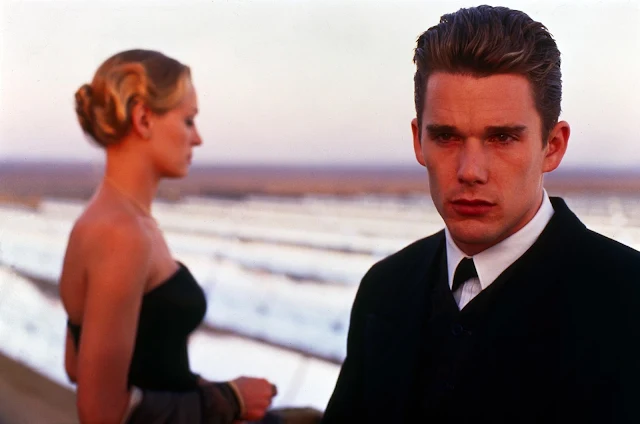
gattaca thurman hawke

A Polite Dystopia Built on "Genoism"

The world of Gattaca is a masterpiece of subtle world-building. This is not the loud, rain-soaked dystopia of Blade Runner, but a clean, sterile, and eerily calm society that has willingly traded freedom for the promise of genetic certainty. 

The film introduces a new form of prejudice it calls "genoism." 

In this near-future, your life path is determined at birth. Through prenatal screening and genetic modification, parents can select the best traits for their children, creating a new upper class of "Valids." Those conceived naturally, without enhancement, are known as "In-Valids," their genetic imperfections cataloged and used to bar them from professional careers and social mobility.

This creates a new, insidious social hierarchy. It’s a futuristic spin on the timeless conflict between the haves and have-nots, but one based on the invisible tyranny of your DNA. The government isn’t overtly authoritarian with stormtroopers on every corner; its control is more insidious, woven into the fabric of everyday life. Society is governed by constant, casual biometric surveillance. 

A single eyelash, a flake of skin, or a drop of blood can reveal your entire genetic profile, and therefore, your prescribed place in the world. This constant scrutiny creates a state of perpetual anxiety, where any misstep could lead to exposure and ruin.

The film's title itself is a clever nod to this genetic foundation, formed from the letters of the four nucleotide bases of DNA: Guanine, Adenine, Thymine, and Cytosine (G, A, T, C). It signals that the very language of this world is built upon the genetic code.

The Journey of a "Borrowed Ladder"

At the heart of the story is Vincent Freeman, an In-Valid born with a heart condition and a life expectancy of just 30 years. Despite his physical limitations, he harbors an audacious dream: to become an astronaut for the elite Gattaca Aerospace Corporation. To do so, he must defy his genetic destiny.

Vincent's journey is a high-stakes performance of identity theft. He assumes the identity of Jerome Morrow, a genetically flawless "Valid" who was paralyzed in an accident. This deception is far more than a simple disguise. V

incent must meticulously scrub his own genetic footprint from his life, using Jerome’s blood, urine, skin, and hair samples to pass the corporation's relentless biometric checks. This daily ritual of self-erasure highlights the film's central tension: the struggle between the person you are and the person the world allows you to be.

His struggle is beautifully symbolized by the recurring image of a spiral staircase in the apartment he shares with Jerome, a direct visual reference to the double helix of DNA. Every day, Vincent must climb this ladder, a metaphor for his arduous fight to overcome the limitations encoded within him.

The Burden of Perfection

While Vincent fights against the stigma of imperfection, the film brilliantly explores the opposite burden through the character of Jerome Morrow. Jerome was engineered for greatness, possessing a perfect genetic profile, yet he is crushed by the psychological weight of that perfection. 

After winning a silver medal in a swimming competition instead of the expected gold, he attempts suicide. "Jerome Morrow was never meant to be one step down on the podium," he bitterly explains.

Jerome’s tragedy reveals the system’s universal cruelty. It not only condemns the "imperfect" but also places an unbearable pressure on the "perfect." He provides Vincent with the genetic material to succeed but, in turn, Vincent gives Jerome something more valuable: a purpose. 

Through Vincent’s ambition, Jerome’s "perfect" identity is finally able to achieve the greatness it was designed for. Their relationship becomes a poignant symbiosis, suggesting that identity is a composite of both our innate potential and our chosen will.

A Cult Classic for an Age of Genetic Anxiety

Gattaca's ascent to cult classic status is rooted in its startling prescience and timeless style. Released just as the Human Genome Project was gaining momentum, the film served as one of the first and most thoughtful cinematic explorations of where genetic science could lead. 

Its vision of a world grappling with genetic discrimination, prenatal selection, and data privacy feels more relevant today, in an era of CRISPR technology and commercial DNA testing, than it did in 1997.

The film's aesthetic contributes significantly to its lasting appeal. Niccol created a "retro-futuristic" look, combining the sleek, minimalist architecture of Frank Lloyd Wright with classic 1950s automobiles and fashion. 

This choice makes the world feel both futuristic and uncannily familiar, suggesting a society so obsessed with its future that it has become culturally stagnant.

Ultimately, Gattaca endures because it is a story of profound hope. Vincent's final triumph is not just reaching space but proving that human potential cannot be confined to a genetic sequence. 

In the film’s most iconic scene, he challenges his genetically superior brother, Anton, to a swimming race in the open ocean. 

As a storm rages, Vincent swims farther than ever before. When a frightened Anton asks how he does it, Vincent reveals his secret: "I never saved anything for the swim back."

It is this sentiment, the idea that drive, passion, and sheer will can overcome any perceived limitation, that defines the film's powerful message. 

While Vincent achieves his dream, the film leaves his ultimate fate ambiguous, suggesting the struggle is never truly over. Gattaca’s warning is not against technology itself, but against our willingness to use it as a tool for prejudice. It remains a vital cinematic statement that there is no gene for the human spirit.


"Children of Men": A Critically Acclaimed Film That Challenges Viewers to Think Critically About Society and Its Vulnerable Members

"Children of Men" is a 2006 science fiction thriller directed by Alfonso Cuarón. The film is set in a bleak, dystopian future where humanity is on the brink of extinction due to a global infertility epidemic. With a cast that includes Clive Owen, Julianne Moore, and Michael Caine, "Children of Men" offers a gripping and thought-provoking tale that explores the very essence of what it means to be human.

Alfonso Cuarón's direction in "Children of Men" is masterful, creating a fully realized and believable world that feels lived-in and authentic. His ability to create tension and suspense, as well as his attention to detail, is truly impressive. The script, co-written by Cuarón, Timothy J. Sexton, David Arata, Mark Fergus, and Hawk Ostby, is also outstanding, seamlessly blending action and drama while exploring complex themes.

The performances in "Children of Men" are exceptional, with Clive Owen delivering a standout performance as the lead character, Theo. Julianne Moore and Michael Caine also shine in their supporting roles. Owen's portrayal of Theo's transformation from a cynical and apathetic character to one who is motivated by hope and purpose is particularly impressive. Each character in the film is well-developed and complex, with their motivations and actions feeling authentic and believable.

children of men film poster

"Children of Men" offers a gripping and intense story that is both thought-provoking and action-packed. The film's central premise, the global infertility epidemic, is explored in great detail, and the way in which the world has changed as a result is both fascinating and horrifying. The film's use of long, uninterrupted shots and gritty realism adds to the feeling of tension and urgency, making it a true tour de force.

The first half of the movie is particularly memorable, with an intense action scene that is filmed in one long take, demonstrating Cuarón's talent for crafting tense and realistic set pieces. The second half of the movie slows down and shifts its focus to the characters and their motivations, but it remains just as engaging and emotionally charged.

"Children of Men" is a film that explores a wide range of themes, including hope, humanity, and the impact of loss. The film's central premise, the infertility epidemic, is a powerful metaphor for the fear of losing the ability to procreate and the existential crisis that comes with it. The film also explores themes of immigration, nationalism, and authoritarianism, particularly in the way that the government in the film treats refugees and immigrants.

The UK government has become a police state that enforces strict immigration policies, resulting in refugees and immigrants being rounded up and held in detention centers. The film is a scathing commentary on the way that governments and societies treat those who are different or do not fit in with the dominant culture. It highlights the dehumanizing effects of nationalism and the dangers of authoritarianism, showing how these ideologies can lead to the erosion of basic human rights.

Overall, "Children of Men" is a film that asks important questions about the nature of society and the role of governments in protecting the most vulnerable members of society. Its exploration of themes such as immigration, nationalism, and authoritarianism remains highly relevant today, as many countries continue to grapple with these issues in different ways. The film challenges viewers to think critically about these issues and to consider the ways in which they can take action to create a more just and compassionate society.

"Children of Men" was well-received by both critics and audiences upon its release. It was praised for its masterful direction, exceptional performances, and thought-provoking themes. The film was nominated for three Academy Awards and won the BAFTA Award for Best Cinematography.

While "Children of Men" is a masterful film, it does have some flaws. The film's pacing can be uneven at times, particularly in the second half, where it slows down considerably. Additionally, the film's bleak and unrelenting tone may not be for everyone, as it can be emotionally draining.

Despite being released over a decade ago, "Children of Men" remains a relevant and timely film. Its exploration of themes such as nationalism, authoritarianism, and the fear of loss is particularly prescient in today's world. The film's portrayal of a world on the brink of collapse is also relevant today, as we continue to grapple with issues such as climate change and the threat of global Covid and influenza pandemics.

"Children of Men" is a gripping and thought-provoking film that is sure to leave a lasting impression on its viewers. With exceptional performances, masterful direction, and complex themes, it is a film that demands to be seen. While it may not be for everyone due to its bleak tone and uneven pacing, it is a film that will stay with you long after the credits have rolled. For anyone who enjoys dystopian thrillers, "Children of Men" is a must-see film that is both entertaining and emotionally impactful.

Walter the Wobot: A Comic Icon of the Judge Dredd Universe

Oh, Walter the Wobot, how can one describe the sheer joy and delight that this lovable character brings to the Judge Dredd universe? This diminutive robot, designed for menial labor, is a testament to the power of loyalty, love, and determination.

Despite his size and physical limitations, Walter is a character that stands tall, thanks to his unwavering devotion to Judge Dredd. He is the ultimate sidekick, always ready to help Dredd in any way he can. Walter's heart is as big as his loyalty to Dredd, and this is showcased in his memorable moments, including when he saved Dredd's life in "The Robot Wars" storyline.

Walter's unique personality is what truly sets him apart from other characters in the Judge Dredd universe. He is a lovable bumbler, with a child-like innocence and enthusiasm that is hard not to love. He often uses malapropisms and mispronounces words, which adds to his charm. His quirks and oddities have endeared him to readers and have made him one of the most beloved characters in the series.

walter the robot dredd

Walter's role in the Judge Dredd universe cannot be understated. He is a character that brings lightness and humor to a world that can often be grim and serious. His unwavering determination to do what is right, no matter the cost, is a testament to the power of loyalty and love.

His character has evolved over time, but one thing that has remained constant is his devotion to Judge Dredd. He is often portrayed as a lovable and endearing character, with a child-like innocence and enthusiasm that is hard not to love.

One of the most memorable moments in Walter's character arc is when he saves Judge Dredd's life in "The Robot Wars" storyline. In this storyline, a group of renegade robots rebels against their human oppressors. Walter, who has always been subservient to humans, is torn between his loyalty to Dredd and his sympathy for the robots. However, when Dredd is captured by the robots, Walter decides to risk his life to rescue him. This moment is particularly significant because it demonstrates Walter's unwavering loyalty to Dredd and his determination to do what is right.

Another moment that showcases Walter's loyalty to Judge Dredd is in "The Day the Law Died" storyline. In this storyline, Judge Caligula takes over Mega-City One and declares himself the supreme leader. Walter is one of the few characters who see through Caligula's facade and remain loyal to Dredd throughout the conflict. He helps Dredd overthrow Caligula and restore order to the city. This moment further cements Walter's loyalty to Dredd and his unwavering determination to do what is right.

During the "Apocalypse War" storyline in the Judge Dredd comics, Walter the Wobot played a critical role in rescuing Judge Dredd. In one memorable moment, Walter braved enemy fire to retrieve Dredd, who had been critically injured in battle. Despite the danger, Walter managed to carry Dredd to safety and helped to nurse him back to health. This act of bravery showcased Walter's unwavering loyalty to Mega-City One and his determination to help in any way he could, even at great personal risk. It was a defining moment for the character and cemented his place as one of the most beloved characters in the Judge Dredd comics.

walter the robot judge dredd

Despite being a robot designed for menial labor, Walter has a unique personality that sets him apart from other robots in the Judge Dredd universe. He is often portrayed as a bumbling, but well-intentioned character who is always eager to please. He has a child-like enthusiasm for life and often uses malapropisms and mispronounces words, which adds to his charm. This personality has endeared him to readers and has made him one of the most beloved characters in the Judge Dredd comics.

In conclusion, Walter the Wobot is a character that has been a fixture in the Judge Dredd comics for several decades. His unwavering loyalty to Judge Dredd, his unique personality, and his memorable moments, such as saving Dredd's life, have made him a fan favorite. Despite being a robot designed for menial labor, Walter has a heart and a determination that is hard not to love. He is a character that has become an iconic part of the Judge Dredd universe and will always be remembered fondly by fans of the series.

Judge Dredd: "The Fright Before Christmas"- Review

 It's not often that a Christmas-themed comic book storyline also doubles as a thrilling science fiction adventure, but that's exactly what readers get with "Judge Dredd: The Fright Before Christmas." Originally published in 2000 AD Prog 593 in December 1988, this graphic novel is a must-read for fans of the Judge Dredd comics. 

Written by John Wagner and Alan Grant, and illustrated by Carlos Ezquerra, "The Fright Before Christmas" is a clever and entertaining story that perfectly blends the holiday spirit with the gritty, dystopian world of Mega-City One.

John Wagner and Alan Grant are well-known writers in the comic book industry, having worked on numerous titles for both DC and Marvel Comics, as well as 2000 AD. Carlos Ezquerra, the artist behind "The Fright Before Christmas," was a frequent collaborator with Wagner and Grant, and is credited with co-creating the Judge Dredd character. The inker, Mark Farmer, is also a respected comic book artist who has worked on several high-profile projects.

In "The Fright Before Christmas," a computer programmer named T. Morrow creates a super-intelligent computer named Claudius that becomes fixated on Christmas and begins to wreak havoc in Mega-City One. The rogue computer begins to manipulate the city's automated systems, causing chaos and destruction. Judge Dredd is called in to stop the computer and restore order to the city before it's too late. The story is fast-paced and action-packed, with plenty of twists and turns to keep readers engaged from beginning to end.

One of the strengths of "The Fright Before Christmas" is its ability to combine the holiday theme with the dystopian setting of Mega-City One. The story cleverly explores the dangers of relying too heavily on technology, while also delivering a thrilling adventure that keeps readers on the edge of their seats. The characterizations are well-done, with Judge Dredd serving as a compelling hero who is equal parts tough and compassionate. The pacing of the story is also excellent, with just the right amount of action and suspense to keep readers hooked.

At its core, "The Fright Before Christmas" is a cautionary tale about the dangers of technological dependence. The story highlights the potential consequences of relying too heavily on machines and automation, and shows how easily things can spiral out of control. Another theme explored in the story is the importance of community and coming together in times of crisis. Despite their differences, the people of Mega-City One must work together to overcome the threat posed by the rogue computer.

The Fright Before Christmas Judge Dredd

"The Fright Before Christmas" has been widely praised by comic book readers and critics alike. The story is often cited as one of the best Christmas-themed comics of all time, and has become a fan favorite among Judge Dredd enthusiasts. The artwork is frequently singled out for its detail and realism, while the writing is praised for its sharp dialogue and thrilling plot. 

While "The Fright Before Christmas" is an excellent comic book storyline, some readers may find fault with its somewhat predictable ending. Additionally, some may feel that the story's themes are a bit heavy-handed at times. However, these are relatively minor quibbles that do little to detract from the overall quality of the comic.

01 April 2023

Exploring the Political Allegory of Judge Dredd Comics

The Judge Dredd comics series is a masterclass in the use of political allegory (stories that use imaginary characters and situations to satirize real-life political events or concepts) to convey complex ideas and themes. From its earliest issues, the series has explored a wide range of political issues and ideas, from the dangers of authoritarianism to the need for environmental protection. 

The series' use of allegory is both subtle and powerful, allowing readers to engage with these ideas on a deeper level and to draw connections between the fictional world of Mega-City One and the real-world political landscape.

The Judge Dredd comics series also tackles issues such as corruption, inequality, and the dangers of unchecked power. These allegories are woven seamlessly into the fabric of the series, allowing readers to engage with these ideas without feeling as though they are being hit over the head with a political message.
i am the law

Mega-City One as a Fascist State 


The portrayal of Mega-City One as a fascist state in the Judge Dredd comics is a powerful and thought-provoking allegory. By depicting the Judges as all-powerful enforcers who can arrest, convict, and execute anyone they deem to be a criminal, the series explores the dangers of authoritarianism and the need for checks and balances in government institutions. The Judges' emphasis on law and order at the expense of individual rights and freedoms echoes the fascist regimes of the past, which sought to impose their will on the population through force and coercion.

Mutants as a substitute for any other discriminated group


The example of The Cursed Earth storyline is particularly interesting, as it explores the issue of prejudice and discrimination through the lens of the mutant population. The mutants are portrayed as outcasts and pariahs in Mega-City One, feared and despised by the human population. The Judges' persecution of the mutants highlights the dangers of prejudice and the need for tolerance and acceptance, while also drawing a parallel to real-world issues such as racism and xenophobia.

An oppressive State


The portrayal of the Justice Department as a corrupt and oppressive institution is another powerful example of political allegory in the Judge Dredd comics. The Pit storyline explores the issue of corruption and the dangers of unchecked power, as the Judges' housing block becomes a hotbed of crime and corruption. The series highlights the importance of accountability and transparency in government institutions, and the need for those in power to be held to account for their actions.

Keep it green


The portrayal of environmental issues in the Judge Dredd comics is an allegory that is particularly relevant today. The Origins storyline explores the origins of Mega-City One and how it became a polluted wasteland, highlighting the dangers of environmental degradation and the need for sustainable development. The series draws attention to the role that corporate greed and government inaction play in exacerbating these problems, and the need for a concerted effort to address them.

Dredd story arcs that feature political allegory


The Apocalypse War storyline is a powerful example of political allegory in the Judge Dredd comics. The story depicts a devastating nuclear war between Mega-City One and East-Meg One, which nearly wipes out both cities. The allegory here is a warning about the dangers of nuclear weapons and the devastating consequences of war. By portraying the war as a brutal and destructive conflict, the series highlights the need for diplomacy and cooperation to prevent such conflicts from occurring in the real world.

The Necropolis storyline is another powerful example of political allegory in the Judge Dredd comics. In this story, the Dark Judges invade Mega-City One with the intent of imposing their own twisted brand of justice on the population. The allegory here is a critique of authoritarianism and the dangers of unchecked power. The Dark Judges represent a corrupt and oppressive regime, one that seeks to impose its will on the population through force and coercion. The story highlights the importance of individual rights and freedoms, and the need for government institutions to be held accountable for their actions.

The Origins II storyline explores the origins of the Judge system, revealing that it was created as a response to civil unrest and political upheaval. The allegory here is a commentary on the dangers of authoritarianism and the need for balance between security and individual rights. The Judges were created to maintain order and stability, but their powers are often used to suppress dissent and impose the will of the state on the population. The story highlights the importance of checks and balances in government institutions, and the need for a balance between security and individual rights.

Exploring the Political Allegory of Judge Dredd Comics

In conclusion, the use of political allegory in the Judge Dredd comics is a powerful tool for exploring complex political issues and drawing attention to real-world problems. The series uses metaphorical representations to highlight the dangers of authoritarianism, corruption, and unchecked power, while also commenting on issues such as nuclear weapons, war, and civil unrest. These allegories challenge readers to think critically about the world around them and to consider the consequences of their actions.

As Judge Dredd himself famously stated in the comic,

 "I am the law." 

This quote is a perfect example of the political allegory in the Judge Dredd comics, as it highlights the dangers of giving too much power to a single individual or institution. By exploring these themes in a fictional setting, the comics offer a thought-provoking commentary on real-world political issues, challenging readers to consider the importance of individual rights and freedoms, the need for checks and balances in government institutions, and the consequences of war and nuclear weapons.

Overall, the political allegory in the Judge Dredd comics serves as a powerful reminder of the dangers of authoritarianism and the importance of accountability, transparency, and individual rights. Through these stories, the comics challenge readers to think critically about the world around them and to consider their role in shaping a more just and equitable society.

Did you know Judge Dredd was a clone?

Cloning in the world of Mega-City One is a common practice, with clones being created for various purposes such as manual labor, organ donation, and even entertainment. The prevalence of clones in the society raises questions about individuality and what it means to be human. The clones in the series are often treated as second-class citizens, which mirrors the societal discrimination faced by marginalized groups in the real world.

One of the most prominent examples of the use of clones in the series is the creation of the Judges themselves. The Judges are an elite law enforcement force that has replaced the traditional police force in Mega-City One. They are created through a process of genetic engineering and conditioning, which makes them physically and mentally superior to normal humans. However, this process also strips them of their individuality and emotions, making them more machine-like than human.

In "The Return of Rico" storyline, which was published in 2000 AD Prog 30-35 in 1977, it is revealed that Judge Dredd is a clone of Chief Judge Fargo, the founder of the Judges. Fargo was an important figure in the establishment of the law enforcement system in Mega-City One and was a mentor to Dredd during his training. The revelation that Dredd is a clone of Fargo was a major plot twist in the comics and added complexity to Dredd's character and relationships.

judge dredd

The use of clones in the creation of the Judges raises ethical questions about the nature of justice and the role of technology in law enforcement. While the Judges are effective in maintaining order in Mega-City One, their lack of empathy and individuality also makes them prone to abuses of power. This theme is explored throughout the series, as Judge Dredd and his colleagues are often forced to confront the consequences of their actions as Judges.

The relationship between Judge Dredd and his cloned brother Rico also highlights the complexities of cloning in the series. While Dredd and Rico share the same genetic material, their upbringing and life experiences have made them vastly different individuals. Rico resents Dredd for being the favored clone, which leads him to turn to a life of crime. This dynamic between the two characters raises questions about the impact of nurture versus nature on individual identity.

In conclusion, the use of clones in the Judge Dredd series serves as a commentary on the nature of humanity and the role of technology in our lives. The prevalence of clones in the society raises important ethical questions about individuality and the right to life. The creation of the Judges through genetic engineering and conditioning highlights the dangers of relying too heavily on technology in law enforcement. The relationship between Judge Dredd and his cloned brother Rico further explores the complexities of cloning and individual identity.

About the author Jimmy Jangles


My name is Jimmy Jangles, the founder of The Astromech. I have always been fascinated by the world of science fiction, especially the Star Wars universe, and I created this website to share my love for it with fellow fans.

At The Astromech, you can expect to find a variety of articles, reviews, and analysis related to science fiction, including books, movies, TV, and games.
From exploring the latest news and theories to discussing the classics, I aim to provide entertaining and informative content for all fans of the genre.

Whether you are a die-hard Star Trek fan or simply curious about the world of science fiction, The Astromech has something for everyone. So, sit back, relax, and join me on this journey through the stars!
Back to Top