

The thematic meanings of the 'Sisterhood of Dune' novel
Sisterhood of Dune: The Origins of Power and Fanaticism
Eighty years after the Jihad, the Imperium is a fragile balance of emerging powers. Herbert and Anderson explore the collision between progress and regress in this foundational text.
In Sisterhood of Dune, Brian Herbert and Kevin J. Anderson take us back to a defining period in the Dune universe, one rich with emerging political and spiritual forces that will shape human destiny for millennia to come. Eighty years after the Butlerian Jihad, the Imperium is a tense balance of newly established power factions—the Bene Gesserit, Mentats, Suk doctors, and the Spacing Guild—struggling to establish identities and philosophies in a time marked by the deeply divisive shadow of the anti-technology Butlerian movement.
This novel, the first in the Great Schools of Dune trilogy, resonates with timeless themes of fanaticism, knowledge, and societal evolution. Herbert and Anderson brilliantly expand the Dune universe, creating a thought-provoking tapestry that examines humanity’s paradoxical desire for both order and autonomy.
I. Progress Versus Regress: Venport and Torondo
Central to the novel is the collision between progress and regress. This timeless battle is crystallized in the power struggle between Josef Venport and Manford Torondo. Venport, head of the galaxy’s monopolistic space-travel conglomerate, embodies the allure and utility of technology, emphasizing logic, advancement, and control over his enterprise and society. Torondo, on the other hand, represents humanity’s primal distrust of progress. He is an icon of fanaticism who rallies the Imperium’s vulnerable masses against any vestige of the thinking machines.
Here, Herbert and Anderson deftly illustrate how the lust for control, whether technological or ideological, can lead to disastrous polarization. The rivalry between Venport and Torondo underscores the tension between reason and faith, leaving readers questioning the true path to human advancement.
II. The Fragility of Governance
Yet this ideological conflict between Torondo and Venport is more than a binary clash of technocrat versus zealot. Through characters like Emperor Salvador Corrino, the novel illuminates the precarious nature of governance in a fractured universe. Salvador’s hold on power is continually threatened by populist pressures, technological monopolies, and rebellion. Here, the Corrino rule becomes a metaphor for fragile authority, as Salvador’s attempts to balance power reveal his vulnerability. The novel demonstrates that power is not absolute. It requires constant maintenance, adaptation, and, at times, compromise.
Salvador’s struggles exemplify how governance, in its purest form, must navigate a labyrinthine landscape of competing ideologies, illustrating that ruling over an empire is as much about containing its chaos as about providing order.

III. The Birth of the Sisterhood
Meanwhile, the origins of the Bene Gesserit Sisterhood bring a unique lens to Sisterhood of Dune, offering insight into the evolution of what will become one of the Dune universe's most powerful institutions. Unlike the cold, manipulative order of Frank Herbert’s original novels, here the Sisterhood emerges from necessity, camaraderie, and survival. Raquella Berto-Anirul, the Sisterhood’s leader, imbues the order with purpose and integrity, even as she engages in morally ambiguous practices, such as using forbidden computers to catalog family genetic information.
Raquella’s efforts are acts of rebellion against the Butlerian purists, setting the Bene Gesserit on a path of quiet defiance that will ultimately define their methods. Through Raquella’s character, Herbert and Anderson explore the theme of legacy and the moral cost of preserving it, showing that power often demands uncomfortable choices in the pursuit of higher goals.
IV. The Mentat Paradox
Another thematic cornerstone of the novel lies in the struggle for knowledge and identity, particularly within the Mentat School led by Gilbertus Albans. Gilbertus’s attempts to hide his robotic mentor, Erasmus, from the watchful eye of the Butlerians reveal a complex internal conflict. The Mentats’ pursuit of knowledge is marked by a paradox: they are the very embodiment of human potential, yet their existence is perilously close to violating the anti-machine principles of their society.
The Mentats’ struggle to thrive under Butlerian scrutiny underscores the theme of intellectual persecution. In Gilbertus, the authors create a character wrestling with his identity as both human and machine learner. His journey is one of navigating treacherous waters, questioning how much of humanity’s legacy can be retained without the technologies that once empowered it.
V. Generational Trauma and Populism
Equally compelling is the portrayal of the Harkonnen and Atreides families, whose blood feud exemplifies the theme of generational trauma. Vorian Atreides and the disgraced Harkonnens, exemplified by Valya Harkonnen’s determination to restore her family’s honor, represent two paths in the face of loss and disgrace. Their stories ask whether one’s destiny is determined by heritage or choice. Vorian’s exile and the Harkonnen’s humble existence on Lankiveil show that family legacy is both a burden and a motivator.
Through these familial arcs, Herbert and Anderson explore how individuals and families attempt to shape their identities while shackled to their pasts, a poignant exploration of heritage in a universe that prizes bloodline and legacy above all else.
The anti-technology fervor of the Butlerian movement, led by Torondo, touches on a theme that feels more relevant today than ever: the dangers of populism and zealotry. Torondo, a populist dictator in every sense, utilizes fear and charisma to incite the masses against any whisper of advanced technology. His rise highlights humanity’s susceptibility to charismatic leaders promising simple solutions to complex problems.
Torondo’s character reminds readers of the seductive nature of fanaticism, with promises that are ultimately empty yet devastatingly effective. This portrayal is both a caution and a reminder that humanity’s instinctual need for purpose can often blind it to reason, making it vulnerable to leaders who exploit rather than uplift.
VI. Religion, State, and Original Vision
Finally, Sisterhood of Dune explores the intersection of religious fervor and political power. The Emperor’s strategic use of the Orange Catholic Bible’s release to quell unrest reveals the complex relationship between religion and the state. The religious undertones and the reinterpretation of ancient texts for political gains emphasize the manipulation of faith as a means of control, asking readers to consider the ethics of institutionalizing belief for the sake of order.
Salvador’s eventual downfall illustrates that exploiting faith as a tool of authority is fraught with risks, especially when that faith becomes the only weapon left to both oppressors and the oppressed.
The themes in Sisterhood of Dune seamlessly connect to Frank Herbert's original Dune universe, weaving a deeper understanding of the ideological roots and institutions that will shape the future struggles on Arrakis. At its core, Sisterhood of Dune builds on Herbert's central examination of humanity’s relationship with power, technology, and ecological responsibility.
The Butlerian anti-technology fervor echoes Herbert's cautionary tales about humanity's dependency on machines and presages the technological puritanism and selective manipulation of genetics that the Bene Gesserit, Mentats, and Spacing Guild later employ. Similarly, the Sisterhood’s early ethical compromises and breeding program reflect Herbert’s complex portrayal of the Bene Gesserit’s role in human affairs, foreshadowing their pivotal influence over centuries.
This novel enriches Herbert’s theme of fanaticism as a double-edged sword, with Torondo’s zealotry mirroring later figures like Paul Atreides and the cult of Muad’Dib. By delving into these foundational conflicts, Sisterhood of Dune not only expands the lore but intensifies Herbert's original exploration of humanity’s unending battle between free will, the allure of messianic power, and the consequences of ideologically driven control over society and nature.
Connection to Dune: Prophecy
Sisterhood of Dune serves as the foundational narrative and inspiration for the television series Dune: Prophecy, which explores the origins of iconic institutions like the Bene Gesserit, Mentats, and the Spacing Guild. As a starting point, the novel delves into the turbulent post-Butlerian Jihad era, where anti-technology fervor and new power struggles begin to shape the Imperium's future. This background enriches the series, bringing to life the early ideological conflicts and ambitions that set the stage for the political and spiritual intrigues central to Frank Herbert’s original Dune saga.
Book Review Sisterhood of Dune: The Origins of Power and Fanaticism Eighty years after the Jihad, the Imperium is a ...
Read Article →
Silo: The final episode of season one explained
When Juliette Nichols, Rebecca Ferguson’s raw-boned, no-nonsense engineer-turned-sheriff, is cast outside, the series steps out of claustrophobic corridors and into the void, with a gasping intensity that recalls the post-apocalyptic dread of The Road or Children of Men.
What she encounters beyond the airlock is less a revelation of freedom than a plummet into existential bleakness, one that redefines Silo’s dystopian roots.
It’s not freedom; it’s a grimmer cage.
Juliette's final moments in the Silo are as disorienting as they are crucial. Bracing against her fate, she is forced to confront Bernard, the show’s sinisterly bureaucratic mayor (Tim Robbins, War of the Worlds), who turns her cleaning sentence into a moral riddle.

Bernard is part Orwellian authority, part pragmatist, wielding his control over the Silo with a menacingly gentle touch, promising her leniency for her loved ones if she accepts this public punishment. And by sending her out, Bernard preserves not only his control but also the facade of the Silo as a hermetic safehouse against a hellish outside.
But Juliette’s departure cracks that facade for herself and the viewers alike.
As she steps outside, Silo rips into its grand illusion—quite literally—in the form of an ocular trick designed to pacify. The helmet display conjures a luscious, habitable world: blue skies, greenery, even birds flitting across a pristine horizon.
This artificial projection lulls its victims into one last moment of obedience, compelling them to "clean" the sensor, reaffirming the illusion for everyone left behind. The repeated display pattern, the same hopeful, lush world, is a calculated cruelty meant to keep the Silo’s lie alive.
But Juliette, noticing the birds’ repeated, programmed movement (which keen viewers can observe themselves in prior episodes), unearths the truth in a moment of profound horror.
It’s the heat tape, ironically, that lets her see past this deception.
This seemingly innocuous material, a mechanic’s staple in the world below, turns from mundane supply to lifeline. Harriet Walter’s character Walker, Juliette’s mentor, recognizes that the standard-issue tape—designed to fail—is the true cause of death for the condemned.

Walker's homemade, industrial-grade tape is a quiet revolution wrapped around Juliette’s suit, allowing her to survive the trek up the hill and past the display’s lies. The decision to trust Juliette’s life to tape recalls the symbolic poignancy of a minor object taking on monumental meaning, a detail Silo hides in plain sight until its significance detonates in the finale.
Juliette’s survival goes beyond defiance; it sparks curiosity and rebellion in others.
By refusing to clean, by cresting the hill to see what lies beyond the display, she becomes the unwitting Flamekeeper that Gloria foreshadowed.
Meanwhile, Robert Sims (Common), Bernard’s enforcer, finds his own allegiance at a breaking point. While outwardly a believer in the Silo’s strict protocol, Sims reveals a subtle internal fracture. His confusion as Bernard mutters, “She knows,” at Juliette’s realization hints at an incomplete awareness of the true machinations within. Sims embodies a brutal paradox—both enforcer and victim of the system he perpetuates, a state apparatchik who may soon discover the extent of the lies he’s built his life around.
Bernard, the icy, calculating overseer, holds a key to one of the show's greater enigmas—the "18" marked on his cryptic access key, linking their Silo to a broader network of isolated worlds. When he uses this key in the finale, viewers are left to wonder:
Is Bernard himself a pawn in an even grander scheme?
His loyalty, or perhaps his fear, to preserve the Silo’s order suggests that his power is conditional, dependent on following orders from an unseen authority. The number “18” pulls back the curtain, revealing that this oppressive microcosm is one of many, part of a network engineered to keep humanity in stasis.As Juliette presses further, her encounter with the desolation beyond reaffirms the finality of her journey. What she sees is haunting: a toxic landscape devoid of life, a stark contrast to the illusion in her helmet. The city skyline that punctuates this barren horizon suggests a past civilization decimated, a monument to humanity’s self-inflicted apocalypse. This is no paradise lost; it is a vision of ruin, a tomb that confirms the Silo’s narrative of the world above.
What’s chilling, though, is that the Silo was right—just not in the way its inhabitants were led to believe. The outside air is indeed toxic, a hostile wasteland unfit for life. Juliette’s clarity in realizing this unfiltered truth while grappling with the helmet’s artificial projection—one last visual lie—is perhaps the show’s most philosophical moment.
It’s not only a commentary on survival but also on the existential cost of knowing, the unbearable price of truth.
Silo season one ends not with closure but with an expansion of its oppressive world. Juliette's act of rebellion—by seeing, by refusing to comply—is a spark in the powder keg of a far larger conspiracy. It leaves audiences to question:
Who built the Silo?
And more urgently, who controls it?
Check out the explanation of the season 2 final of Silo.
The season finale of Silo masterfully fractures the myth of sanctuary that this underground haven clings to, peeling away layers of secrecy ...
Read Article →
The Key Themes of Dune: Prophecy
Dune: Prophecy and the Architecture of Power
At the heart of Dune: Prophecy lies a meditation on the nature of power, both overt and subtle.
The Bene Gesserit Sisterhood wields influence not through force but through manipulation and psychological mastery. This theme resonates with the broader Dune lore, where power often lies not in direct control but in the ability to shape the thoughts and decisions of others.
Valya Harkonnen’s journey as Mother Superior embodies this approach, as she deftly navigates the political currents of the Imperium. Her power, like that of the Sisterhood at large, is quiet yet formidable. It is shaped by the ability to see possibilities, plant ideas, and shape outcomes without the need for violence.
Dune: Prophecy examines how power can be wielded in silence, casting light on the hidden, manipulative arts that form the foundation of Bene Gesserit influence.

Prophecy and Predestination
In the Dune universe, prophecy is a double-edged sword. Dune: Prophecy leans heavily into this concept, depicting how the Sisterhood’s actions are often shaped—and sometimes hindered—by their own foreknowledge of what’s to come. Mother Raquella’s prediction of a future tyrant who will rise against the Sisterhood casts a shadow over Valya’s every decision.
This theme ties into the broader Dune saga’s fascination with destiny and the burden of foreknowledge, as seen with Paul Atreides in Herbert’s novels.
In Dune: Prophecy, prophecy is both a guide and a cage. It is a motivating force that propels Valya and the Sisterhood forward but also a trap that limits their freedom. The series invites viewers to consider how the belief in destiny can constrain as much as it empowers.
Gender and Agency in a Hierarchical World
Dune: Prophecy brings the gender dynamics of Dune into sharper focus, highlighting the Bene Gesserit’s complex role in an overwhelmingly male-dominated Imperium. The Sisterhood’s covert power reveals the limits placed on women within the Imperium’s political structure, where overt authority remains the domain of emperors, dukes, and other male figures.
In response, the Bene Gesserit develop their own systems of agency, mastering arts of influence that men overlook or underestimate. The series underscores the theme of women finding agency within restriction, turning limitations into assets. This focus adds a poignant layer to the narrative, showing that in a world where direct power is denied, indirect influence can become a weapon just as potent as any blade.
Humanity’s Wariness of Technology
Set in the aftermath of the Butlerian Jihad—a pivotal event where humanity rose against “thinking machines”—Dune: Prophecy is steeped in a cultural fear of artificial intelligence. The Imperium’s prohibition of thinking machines shapes not only its technological development but its social fabric, influencing how knowledge, power, and labor are organized.
This aversion to AI has led to a culture that prizes human potential and, in particular, to the Bene Gesserit’s focus on honing the mind and body to near-superhuman levels. This wariness echoes throughout the show, creating a society that values mastery over self rather than mastery over machines. The series probes this theme through characters like Desmond Hart, who flirts with the forbidden line of technology, highlighting the ever-present fear that humanity’s creations might one day overtake them.
Transformation and the Path to Self-Mastery
A recurring theme in Dune: Prophecy is the Bene Gesserit’s path of self-mastery, a grueling journey of mental and physical training that allows them to become Truthsayers, visionaries, and masters of the Voice. This theme of transformation goes beyond physical capability; it’s about honing one’s self to become an instrument of control and influence.

The acolytes’ rigorous training, pushed to their physical and mental limits, reflects Herbert’s larger idea of self-mastery as the only path to true freedom. By controlling their bodies, emotions, and thoughts, the Bene Gesserit believe they are freed from manipulation—a claim that is perhaps ironic given their own practices.
In Dune: Prophecy, the path to mastery is as much about freedom from external control as it is about the responsibility that comes with such power.
The Tension Between Loyalty and Individual Ambition
Dune: Prophecy explores the tension between individual desires and loyalty to the Sisterhood, a theme encapsulated in Valya Harkonnen’s ambition and the internal conflicts faced by her acolytes. The Bene Gesserit’s strict code emphasizes loyalty to the Sisterhood above all, but the personal ambitions of characters often conflict with this creed. Valya’s ruthless drive to see her visions realized sometimes jeopardizes the Sisterhood, revealing how individual ambition can become a double-edged sword.
This theme parallels the Bene Gesserit’s belief in collective survival, raising questions about the cost of personal power within an organization built on shared purpose. It’s a powerful reminder that loyalty, when mixed with unchecked ambition, can lead to fractures within even the most disciplined societies.
Legacy and the Weight of History
The weight of history permeates Dune: Prophecy, reflecting Dune’s larger preoccupation with the cycles of power and the scars of past conflicts. The Bene Gesserit are not just living in the present; they are carrying the knowledge and traditions passed down since the Butlerian Jihad, shaping their every decision in light of historical experience.
Valya’s Harkonnen lineage is a constant reminder of the past and the burdens it brings, tying her actions to both her family’s and the Sisterhood’s legacies. This theme enriches the series by framing individual actions as part of a larger continuum, asking viewers to consider how the weight of history can both guide and restrict those who carry it.
The Inescapable Reach of Fate
Finally, Dune: Prophecy delves into the inexorable pull of fate, a theme that resonates through every choice and every plot twist. Valya’s decisions to fulfill or defy prophecy highlight the tension between free will and preordained destiny. In the Dune universe, fate is both a cosmic and personal force, dictating the lives of individuals and the fate of entire empires.
Dune: Prophecy captures this struggle, portraying the Bene Gesserit’s use of prophecy as a way to gain control over the uncontrollable, to see the future as both a map and a warning. This theme serves as a reminder that in the world of Dune, destiny is never just a future to arrive at—it is a force that shapes the present, one that characters cannot escape no matter how fiercely they try.
Series Analysis Dune: Prophecy and the Architecture of Power At the heart of Dune: Prophecy lies a meditation on th...
Read Article →
Dune: Prophecy > Review

Unlike the vast deserts of Arrakis that dominate Herbert’s novels and Villeneuve’s films, Dune: Prophecy roots itself in the cold, forbidding environments of Wallach IX, the Bene Gesserit homeworld, and the imperial power seat on Salusa Secundus. There’s no mistaking that the series owes a debt to Game of Thrones for its palace intrigue and power plays, but it’s far from a mere imitation.
Adapted from Sisterhood of Dune by Brian Herbert and Kevin J. Anderson, Dune: Prophecy takes liberties with its source material, yet it remains true to the book’s underlying tensions and vast, complex lore. The Butlerian Jihad, the great war against artificial intelligence that banned “thinking machines” and rewrote the moral code of civilization, looms over this narrative like a dark specter. In the vacuum left by the demise of these machines, new power structures emerge—paramount among them the Sisterhood. Led by Valya Harkonnen, the Sisterhood begins its ascent, quietly embedding itself within the Imperium, while acolytes undergo rigorous mental and physical training to prepare for their roles as truth-sayers, manipulators, and future prophets. We find ourselves in a time when their legendary powers, such as the controlling Voice, are in nascent form, and the breeding project to create the Kwisatz Haderach is still a dream on the horizon.
Valya’s dominance over the Sisterhood is hardly a given, and her journey is shaped by those around her, notably her sister Tula (Olivia Williams, The Postman + The Sith Sense), whose quiet loyalty and inner conflict lend the narrative a tragic undercurrent. Together, the Harkonnen sisters embody Dune’s ceaseless interplay of power and vulnerability, often more allies than family in a universe that requires brutal pragmatism over kinship.
As viewers follow the Sisterhood’s machinations within the courts of Salusa Secundus, Dune: Prophecy strikes an arresting balance between palace intrigue and metaphysical dread. Emperor Javicco Corrino (Mark Strong, John Carter of Mars) struggles to keep control of his empire while the forces of Arrakis loom over him. Meanwhile, the charismatic yet ruthless soldier Desmond Hart (Travis Fimmel, Vikings, Raised by Wolves) brings an unsettling energy to the emperor’s court, further agitating tensions with the Sisterhood and Corrino’s daughter, Princess Ynez (Sarah-Sofie Boussnina).

One of Dune: Prophecy’s most intriguing elements is how it layers its backstory with the mythic horror of the Butlerian Jihad. This isn’t just filler lore; it’s a reminder of humanity’s encounter with its own ambition, and the psychic scars it left behind in the form of prohibitions against artificial intelligence. We see this cultural trauma refracted through Valya’s ruthless adherence to tradition and Desmond Hart’s peculiar relationship with forbidden technology.
While the sands of Arrakis dominate much of the Dune universe, Dune: Prophecy bravely shifts its gaze to other pivotal worlds, specifically Wallach IX and Salusa Secundus. These planets, with their bleak, cold atmospheres, make a stark contrast to the desert sun and spice-laden air of Arrakis, yet they are equally integral to the story. Through the glittering imperial palace on Salusa Secundus and the austere Sisterhood library on Wallach IX, the series brings to life a galaxy where even the landscapes seem to echo the harshness and gravity of its conflicts.
At the center of Dune: Prophecy lies a revelation of the Sisterhood, not merely as mystics but as individuals negotiating personal ambitions and the Sisterhood’s future under Valya Harkonnen’s guidance. The Bene Gesserit here are not yet the fully realized force depicted in Herbert’s novels or Villeneuve’s films. They’re still grappling with their identity, balancing loyalty and individual desire in a universe that will not yield to them easily.
Through Valya Harkonnen’s ascendance, Dune: Prophecy also revisits the infamous Harkonnen lineage, transforming it from the one-dimensional house of villains familiar to fans of the films into a complex narrative of survival, betrayal, and raw ambition. Valya is no caricature; she’s a tactician, haunted by a family history marred by the Butlerian Jihad and her ancestors' disgrace. Her sister Tula, gentler yet no less resolved, offers an intriguing foil, adding complexity to a lineage that will later be embodied in the infamous Baron Harkonnen.
At its core, Dune: Prophecy is about destiny—a theme that saturates every corner of Herbert’s universe. The series teases out the role of prophecy in shaping the Sisterhood’s decisions and the Imperium’s political landscape, balancing the question of free will against the weight of ancient predictions. Valya’s relentless drive to fulfill her vision, to secure the Sisterhood’s legacy, reverberates through each storyline, casting the characters as both architects and prisoners of fate. Her fierce belief in the prophecy from Mother Raquella, predicting a tyrant who will crush the Sisterhood, is both her motivation and her potential undoing.
The Dune universe has always felt boundless, a sprawling vision of the future where political intrigue, mysticism, and cosmic dread converg...
Read Article →
Finch (2021) - Themes of Survival, Legacy, and the Human Spirit
The film, starring Tom Hanks (Cloud Atlas, Forest Gump), tells the story of Finch, the apparent last surviving human on Earth, who, in the wake of an environmental catastrophe, strives to protect his dog, Goodyear, and teach his robot creation, Jeff, to care for the dog after his inevitable death. Set against a barren landscape, the film’s exploration of the end of humanity touches on themes of survival, legacy, human connection, and the role of technology.
While Finch unfolds as a road trip across a desolate world, it’s much more a profound meditation on the fragility of life and what it means to leave something behind.

Survival and the Fragility of Human Life
At its core, Finch is a film about survival in a dying world.The fragility of human life is made explicit in Finch’s declining health and his efforts to teach Jeff how to care for Goodyear. This relationship between man and machine goes beyond mere survival tactics; it becomes a testament to the human need to protect those we love, even in the face of an inevitable, uncontrollable fate.
Sapochnik’s direction and the film's visual style underscore this fragility, with wide shots of desolate environments highlighting the smallness and vulnerability of Finch as he makes his way through the world.
Human Connection and Companionship
In Finch, the theme of human connection is explored through the relationships that form in an otherwise isolated and desolate world. Finch, the last surviving human, shares his life with only his dog Goodyear and, as the film progresses, the AI robot Jeff.The relationship between Finch and Goodyear serves as the emotional anchor of the film.
As Finch’s health deteriorates, his need for Goodyear's companionship grows even more pronounced, and it becomes evident that he cannot fully rely on the dog alone to secure the future. This is where Jeff, the robot, enters the narrative. While initially created as a tool for survival, Jeff’s role in the film gradually shifts from a functional machine to an evolving form of companionship. Finch’s attempt to teach Jeff human qualities, such as empathy and emotional understanding, becomes a central aspect of the film.
What’s particularly striking in Finch is the way the film juxtaposes the relationships between Finch, Goodyear, and Jeff. While Finch’s bond with Goodyear is based on years of mutual companionship, his relationship with Jeff evolves out of necessity and the understanding that human connection, even with a machine, can take on unexpected and deeply meaningful forms.
Legacy and Passing Down Knowledge
At the heart of Finch lies the theme of legacy—specifically, the desire to leave something behind after death. In a world on the brink of extinction, where Finch is one of the few last surviving humans, the concept of legacy takes on profound significance.Finch’s legacy is not one of traditional wealth or status but of knowledge, love, and survival instincts. In teaching Jeff how to care for Goodyear, Finch is also imparting lessons about empathy, responsibility, and compassion—values that will guide the robot in fulfilling his role as a caretaker. Finch's struggle to communicate these values to Jeff highlights the deeper philosophical inquiry into what it means to leave behind a legacy in a world where human civilization has collapsed.
The transfer of responsibility for Goodyear to Jeff is a significant moment in the film, one that marks the culmination of Finch’s life’s work. He realizes that his legacy will not be about the preservation of the human race, but rather the preservation of care and responsibility, even through a machine. This dynamic evokes the idea that the most lasting aspects of humanity—the ability to love, nurture, and protect—can be passed down, not only through human descendants but through other forms of life, even if those forms are artificial.
The final scenes of the film, where Jeff takes on the responsibility of Goodyear’s care after Finch’s death, encapsulate the idea of legacy as a living, evolving force. In a sense, Finch’s legacy is not simply something that exists after his death—it is something that will continue to grow and transform. Jeff’s capacity to care for Goodyear and to continue Finch’s mission of survival speaks to the idea that the true measure of a legacy is how it continues to impact the world even when the original creator is no longer present.
Finch (2021), directed by Miguel Sapochnik (Repomen, Game of Thrones), combines elements of post-apocalyptic survival and human emotion, th...
Read Article →
Themes of 'Civil War' - written and directed by Alex Garland (2024)
Throughout the last 20 years Garland has had a steering hand in many classic gems of films - the pitch-perfect Dredd, the scary bear movie - Annihilation, the overlooked Men and the A.I. classic of Ex Machina.
Produced by A24 films, Alex Garland's film Civil War (2024) explores a near-future America divided by a devastating internal conflict, taking a deep dive into themes of political disintegration, the ethics of journalism, and the chaotic fog of war. Set against the backdrop of a nation fractured between an authoritarian federal government and secessionist factions, Garland constructs a narrative that refrains from clear political affiliations, instead focusing on the universal descent into chaos and the moral ambiguity that follows.

One of the film’s primary themes is the breakdown of political and societal structures.
Another critical theme is the role and ethics of journalism in war.
Garland also delves into the psychological toll of war on individuals, particularly journalists on the front lines. The characters face intense stress and trauma, manifesting in different ways. For instance, Lee's emotional detachment contrasts sharply with the reckless thrill-seeking of her colleague Joel, portraying a spectrum of coping mechanisms against the relentless backdrop of violence.
The film further critiques the spectacle of political power and its downfall. The portrayal of the President as a despotic figure who manipulates fear and division, yet becomes a pitiful figure hiding from the advancing rebels, underlines the transient and performative nature of political authority. This theme resonates with historical instances of collapsing regimes and highlights the inevitable vulnerability of even the most powerful leaders when societal structures crumble.
Lastly, Civil War serves as a cautionary tale about the dangers of extreme polarization and the fragility of democratic institutions. The ambiguous motives of the warring factions suggest that the specifics of the political divide are less significant than the fact of division itself, pointing to a broader commentary on the contemporary political landscape.
Through its themes, Civil War challenges viewers to contemplate the cyclical nature of conflict and the human capacity for self-destruction, making it a haunting exploration of the complexities underlying civil strife in the modern age.
OK. What kind of American are you? Filmmaker Alex Garland has come a long way since he first hit a note with his script for The Beach. Thro...
Read Article →
'Arrival' Themes of Language, Time, and the Human Experience
Arrival: The Architecture of Empathy and Time
Denis Villeneuve's sci-fi masterpiece isn't about an alien invasion. It is a linguistic treatise on how we process grief, memory, and the choice to embrace a destiny that breaks your heart.
"Arrival," directed by the visionary Denis Villeneuve (known for Dune and Blade Runner 2049) and based on the short story "Story of Your Life" by Ted Chiang, is a cinematic masterpiece that transcends the traditional boundaries of the science fiction genre.
At its core, the film is a profound exploration of communication, time, fear, unity, personal relationships, and empathy. These themes are intricately woven into a narrative that challenges viewers to reflect on the nature of human existence, the complexities of language, and the profound impact of understanding and connection.
Villeneuve, known for his meticulous attention to detail and ability to craft deeply emotional narratives, brings to life a story that is as much about global events as it is about personal experiences. His direction ensures that the film is not just a visual spectacle but also a deeply introspective journey.
The screenplay, adapted by Eric Heisserer, stays true to the essence of Chiang's original story while adding layers of complexity that make it suitable for the cinematic medium.

Amy Adams, in the role of Dr. Louise Banks, delivers a captivating performance. She portrays a linguist's journey from skepticism to profound understanding. Her nuanced portrayal captures the emotional depth of a mother and a scientist trying to bridge the gap between humans and extraterrestrials.
Jeremy Renner (The Hurt Locker, Avengers), as physicist Ian Donnelly, complements Adams with a performance that balances scientific curiosity with human compassion. Their on-screen chemistry adds depth to the film's exploration of personal relationships. Forest Whitaker (Rogue One, The Shield) offers very strong support as Colonel Weber, representing the pragmatic anxiety of the state.
I. The Sapir-Whorf Hypothesis: Language as Reality
"Arrival" places communication and language at the forefront of its narrative, emphasizing their profound impact on human understanding and perception. The film's exploration of language goes beyond mere words and delves into the intricacies of how language shapes our worldview, a concept known as the Sapir-Whorf hypothesis.
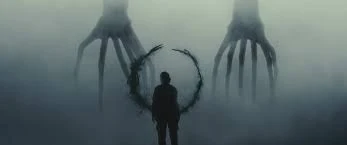
The Heptapods, the extraterrestrial beings in the film, introduce a language that is entirely alien to human understanding. Their written language, composed of intricate circular symbols (logograms), represents a non-linear perception of time. Unlike human languages that follow a linear structure - subject, verb, object - the Heptapod language allows them to perceive events from the past, present, and future simultaneously. This is evident when Dr. Louise Banks begins to have visions of her daughter's entire life as she becomes more immersed in the Heptapod language.
She isn't just learning to read; she is rewiring her brain to perceive the fourth dimension.
The film showcases how language can act as a barrier. As nations around the world attempt to decipher the Heptapods' message, misinterpretations arise. A prime example is when some nations interpret the word "weapon" in the Heptapods' message as a threat, leading to panic. In the proper context, the Heptapods were referring to their language as a "tool" or "gift" for humanity.
This underscores the danger of viewing the unknown through a lens of fear.
II. The Non-Zero-Sum Game: Unity and Collaboration
"Arrival" is not just a story about humanity's encounter with extraterrestrial beings. It is a reflection on the importance of unity. The film frames the alien contact as a "Non-Zero-Sum Game," a scenario where one side's gain does not mean the other side's loss. Everyone can win if they share information.
The Heptapods' arrival serves as a global event that necessitates international cooperation. Their ships don't just land in one country; they are strategically placed across the globe. This global event forces nations to either work together or risk misunderstanding the Heptapods' intentions. Initially, countries collaborate, but fear and misinterpretations begin to fracture this coalition.
The film's climax serves as a testament to the power of communication. When global tensions reach a boiling point, it's Louise's ability to communicate with the Heptapods and her subsequent conversation with Chinese General Shang that prevents a global catastrophe. She uses the alien language to bridge a human divide.
III. Amor Fati: The Nature of Time and Grief
"Arrival" offers a profound exploration of the concept of time, challenging traditional linear perceptions. Unlike humans, who perceive time as a sequence of past, present, and future events, the Heptapods experience all moments simultaneously. This is visually represented by their circular symbols, which have no clear beginning or end.
Louise's immersion in the Heptapod language leads her to experience time in a similar fashion. Throughout the film, she has vivid visions of her daughter's life, from moments of joy to the heart-wrenching realization of her daughter's terminal illness. Initially, these visions seem like flashbacks. However, as the narrative unfolds, it becomes clear that Louise is experiencing memories of a future she has yet to live.
One of the most poignant moments in the film is when Louise, armed with the knowledge of her future, chooses to embrace it. This connects to the philosophical concept of Amor Fati (love of fate). She raises ethical and moral dilemmas: If one knows their future, especially the painful parts, would they choose to change it?
Despite knowing the journey ends in loss, I embrace it. And I welcome every moment of it.
Louise's choice to have a child, despite being aware of the eventual pain and loss, speaks to the film's exploration of the complexities of human experience. It suggests that joy and sorrow are not separate events to be maximized or minimized, but threads in a single tapestry. Hannah's name, a palindrome, reinforces this circularity—it reads the same forward and backward, just as her life exists for Louise.
Conclusion: A Universal Language
"Arrival" stands as a beacon in modern cinema. Through the lens of an extraterrestrial encounter, the film delves deep into the human psyche, exploring our fears, hopes, and the innate desire for understanding.
Director Denis Villeneuve, alongside a dedicated team of writers, actors, and creatives, crafts a story that transcends the screen. It resonates with timeless questions about communication, time, and the essence of human connection. In a world often divided by differences, "Arrival" serves as a poignant reminder that true strength lies not in superior firepower, but in superior empathy.
Film Analysis Arrival: The Architecture of Empathy and Time Denis Villeneuve's sci-fi masterpiece isn't abou...
Read Article →
Lost: 'The Constant' Episode Explained: Desmond's Big Day Out
In the critically acclaimed Lost episode “The Constant” from Season 4, Episode 5, time stops being a clever narrative device and becomes a human crisis. The episode takes the show’s obsession with fate, memory, identity, electromagnetism, and cosmic design, then compresses it into one terrified man trying to remember who he is before his mind breaks apart.
That man is Desmond Hume, one of Lost’s great wild cards. Jack, Locke, Sawyer, Kate, Sayid, and Hurley are bound to the Island by history, trauma, guilt, and Jacob’s long game. Desmond is different. He is bound to the Island by exposure. By accident. By love. By the Swan Station’s electromagnetic catastrophe. By one impossible act of survival that turns him into something the show keeps returning to: a man whose consciousness does not obey time in the same way everyone else’s does.
“The Constant” stands apart from the usual Lost flashback and flashforward structure. It is not simply showing us Desmond’s past. It is throwing Desmond into it. His consciousness begins jumping between 1996 and 2004, while his body remains trapped in the present aboard the freighter. The result is one of the cleanest pieces of science-fiction storytelling the series ever produced: a time-travel episode that works because the emotional rule is clearer than the scientific one.
Desmond needs a constant. Someone who exists in both periods. Someone strong enough in his mind to hold him together. For Desmond, that person is Penny Widmore.
She is his lobster, yes. More importantly, she is his anchor.
The episode was written by Damon Lindelof and Carlton Cuse, and it remains one of Lost’s defining hours because it does what the show did best at its peak. It makes the mythology feel intimate. It makes time travel feel like heartbreak. It makes a phone call feel like salvation.

The episode in one clean explanation
- Desmond leaves the Island by helicopter with Sayid and Frank Lapidus.
- The helicopter does not perfectly follow Daniel Faraday’s bearing, which exposes Desmond to the strange time effects around the Island.
- Desmond’s consciousness begins jumping between 2004 and 1996.
- Daniel Faraday explains that Desmond needs a constant, someone or something present in both time periods.
- Desmond chooses Penny, and their Christmas Eve phone call restores his memory, identity, and emotional centre.
What happens in “The Constant”
1. 2004: Desmond leaves the Island
Desmond, Sayid, and Frank Lapidus leave the Island by helicopter, heading toward the freighter Kahana. Daniel Faraday warns Frank to stay on a very specific bearing, 305 degrees. That detail matters because Lost treats the Island as a place that cannot simply be reached or left like a normal location. The Island has rules. It has thresholds. It has points of entry. Stray from the correct bearing and reality starts to misbehave.
When Frank drifts off course, Desmond begins to panic. He does not merely feel sick. He loses his sense of the present. He no longer understands where he is, who Sayid is, or why he is flying over the ocean. His mind has slipped back into 1996.
2. 1996: Desmond wakes in the Royal Scots Regiment
Desmond finds himself back in his army days, serving in the Royal Scots Regiment. This is not a dream in the ordinary sense. He is experiencing his younger self from the inside while retaining flashes of his 2004 consciousness. The show makes the experience frightening because Desmond is not travelling through time like a tourist. He is being torn between two versions of himself.
This is where “The Constant” becomes more than a plot puzzle. Desmond’s crisis is one of identity. If memory is what makes a person continuous, what happens when memory splits? Which Desmond is real? The frightened soldier in 1996, or the Island survivor in 2004? Lost’s answer is brutally simple: without an anchor, both may collapse.
3. 2004: The freighter is already sick
When Desmond reaches the freighter, the Kahana does not feel like rescue. It feels like another haunted space. The crew are jumpy, secretive, and damaged. The sickbay contains George Minkowski, the communications officer, who has suffered the same temporal dislocation. Minkowski’s condition shows Desmond’s fate in miniature. This is what happens if the mind cannot stabilise itself.
Minkowski and another crew member, Brandon, had previously tried to leave the freighter and approach the Island. That attempt exposed them to the same dangerous boundary effect. Brandon is already dead by the time Desmond arrives. Minkowski is not far behind. Their fate gives the episode a ticking clock. Desmond is not confused for dramatic effect. His brain is under attack from time itself.
4. 1996: Desmond finds Daniel Faraday at Oxford
Following instructions from 2004 Daniel Faraday, Desmond seeks out the younger Daniel at Oxford in 1996. This is one of the episode’s sharpest pieces of writing. Faraday in 2004 understands what is happening, but he needs his younger self to provide the solution. Desmond becomes the message passed between them.
At first, the younger Faraday thinks Desmond is unstable. Then Desmond gives him the settings Faraday told him in 2004: 2.342 and 11 Hz. He also mentions Eloise, Faraday’s lab rat. That convinces Faraday because Eloise is part of his secret experiment. Faraday has been testing the idea that consciousness can be displaced through time.
Eloise the rat becomes a small but important piece of Lost mythology. She completes a maze before she has been taught how to run it, because her consciousness has already experienced the future training. It is a miniature version of the episode’s whole idea: knowledge can arrive before its origin. The problem is that Eloise dies. Her mind cannot survive the strain.
5. The constant rule
Faraday explains that Desmond needs a constant, something or someone present in both time periods that he deeply recognises. The constant is not just a password or memory trick. It is an emotional stabiliser. It gives the mind a fixed point when every other reference has broken loose.
Desmond chooses Penny. That choice is obvious, but it is also loaded. Penny is not on the Island. She is not part of the Oceanic 815 survivor group. She is not one of Jacob’s candidates. She is connected to the Island through her father, Charles Widmore, and through her refusal to stop looking for Desmond. In a show full of broken families, abandoned children, absent parents, and doomed relationships, Penny is one of Lost’s clearest symbols of faithful love.
6. Christmas Eve: The phone call
The climax of “The Constant” is a phone call on Christmas Eve, 2004. Sayid repairs the freighter’s communication equipment just long enough for Desmond to call Penny. The scene works because the show has made us understand both the cosmic stakes and the personal stakes. If Penny answers, Desmond may live. If she still loves him, he may remember himself.
Penny answers. Desmond tells her he loves her. Penny tells him she has been looking for him for three years. The call does not solve the Island. It does not stop Widmore. It does not expose the freighter mission. It does something more basic and more human. It puts Desmond back together.
The deeper Lost lore inside the episode
Desmond is not like the other survivors
Desmond’s role in Lost is strange from the beginning. He is introduced in the Swan Station, literally living inside the Island’s buried machinery. He presses the button. He fails to press it. He turns the failsafe key. He survives an electromagnetic discharge that should probably have killed him. After that, his relationship with time changes.
Season 3’s “Flashes Before Your Eyes” already shows Desmond reliving part of his past after the Swan implosion. He sees Charlie’s future deaths before they happen. He becomes a prophet against his will, trying again and again to save Charlie even as the universe seems determined to course-correct. “The Constant” takes that earlier idea and gives it a more precise mechanism. Desmond is not simply having visions. His consciousness can become unstuck.
This matters because Season 5 later builds a stricter model of time around Daniel Faraday’s rule: whatever happened, happened. The past cannot be changed in the ordinary sense. Yet Desmond sits outside that rule. Faraday says it plainly in Season 5: Desmond is special. The rules do not fully apply to him. “The Constant” is the episode that proves why.
The Island’s electromagnetic force is the hidden engine
Lost’s time mythology is not random magic. It is tied to the Island’s electromagnetic properties. The Swan Station was built to manage one pocket of that energy. The Orchid Station explores another side of it, with experiments involving displacement, exotic matter, and the movement of objects through space and time. By the time the wheel beneath the Orchid moves the Island, the show has already prepared us for the idea that electromagnetism and time are linked.
Desmond is uniquely altered by that force. His exposure in the Swan Station makes him resistant to electromagnetic catastrophe in a way other characters are not. That becomes crucial much later, when Charles Widmore brings Desmond back to the Island in Season 6 and subjects him to another electromagnetic test. Widmore does not see Desmond as a man first. He sees him as a key.
That makes “The Constant” one of the first episodes to reveal Desmond’s larger mythological purpose. He is not just the romantic Scotsman trying to get back to Penny. He is a human bridge between consciousness, time, and the Island’s deepest energy.
The bearing matters
Daniel’s warning about the helicopter bearing is easy to treat as technical flavour, but it is central to the Island’s geography. The Island is hidden not only by distance, but by distorted access. Naomi’s arrival, the freighter’s difficulty locating the Island, the submarine routes used by the Others, and Daniel’s instructions all suggest that reaching or leaving the Island safely requires a precise path.
When Frank drifts from the correct bearing, Desmond suffers the consequences. This is Lost turning navigation into mythology. The Island cannot be approached casually. It sits at a strange intersection of physical place, electromagnetic distortion, and temporal instability.
The freighter sickness foreshadows the cost of exposure
Minkowski’s death is not only there to raise the stakes for Desmond. It shows the cost of interacting with the Island without understanding it. The freighter crew think they are part of an operation. Some believe they are on a rescue mission. Others know more than they say. None of them truly understands what the Island can do.
Minkowski is the human warning label. He is what Desmond becomes if the mind cannot find a fixed point. Later Lost episodes will show other forms of temporal displacement, especially when the Island begins skipping through time after Ben turns the wheel. The nosebleeds, headaches, memory collapse, and deaths all echo the danger introduced here.
Faraday’s journal is one of the show’s great mythology objects
Daniel Faraday’s journal is more than a notebook. It is a survival manual written by a man who half-understands the forces he is playing with. It contains equations, warnings, personal notes, and eventually one of the episode’s most important lines: “If anything goes wrong, Desmond Hume will be my constant.”
That line matters because it suggests a loop in which Desmond helps Faraday understand the very phenomenon Faraday later helps Desmond survive. It is a clean example of the kind of causal knot Lost loved to explore, close to the ontological paradox in films and television, where information can seem to exist without a clear first author.
It also points toward the bootstrap paradox. Faraday gives Desmond the information in 2004. Desmond gives that information to Faraday in 1996. Faraday then carries the consequences of that encounter forward. The show does not reduce this to a puzzle for puzzle’s sake. It uses the loop to deepen both men. Faraday becomes more tragic. Desmond becomes more important.
Charles Widmore is everywhere in the background
“The Constant” also sharpens the Widmore mythology. Penny’s father, Charles Widmore, is not just a disapproving rich man standing between Desmond and Penny. He is one of the central off-Island powers trying to find and control the Island.
The auction scene involving the Black Rock ledger matters because it links Widmore to the Island’s older history. The Black Rock is not a random shipwreck. It is part of the Island’s long pattern of drawing people to itself across centuries. The ledger connects Widmore to that history, and to the Hanso name that also sits behind the Dharma Initiative. The Island has always attracted institutions, explorers, opportunists, believers, and exploiters. Widmore belongs to that lineage.
This gives Penny and Desmond’s love story a larger pressure system. Desmond loves the daughter of a man whose entire life is tangled in the Island’s ownership, secrecy, and power. Penny is Desmond’s constant, but Widmore is one of the reasons Desmond needs a constant in the first place.
How “The Constant” fits the broader Lost framework
It turns the flashback formula inside out
Lost built its early identity on flashbacks. Each episode used the past to reveal what a character was hiding from themselves. Season 4 shifted the game with flashforwards, revealing that some survivors escape the Island and become the Oceanic Six. “The Constant” goes further. It does not simply cut between then and now. It makes then and now collide inside one consciousness.
That is why the episode feels so alive. It takes the show’s signature structure and makes it dangerous. The past is no longer commentary. The past is attacking the present.
It explains Lost’s emotional theory of time
Lost often gets discussed as a mythology show, but its real framework is emotional continuity. Characters survive when they can face what shaped them. Jack must confront his father. Locke must confront his need to be chosen. Sawyer must confront the boy he never stopped being. Ben must confront the damage caused by his hunger for power. Desmond must confront the love he ran from.
That is why “The Constant” is so central. It literalises the show’s deepest character rule: you need something true to hold onto. For Desmond, truth is not a theory. It is Penny.
It prepares the audience for Season 5’s time travel
Season 5 would push Lost fully into time-travel storytelling, with the Island skipping through different eras and several characters becoming trapped in the 1970s with the Dharma Initiative. “The Constant” acts as the bridge to that material. It teaches the audience the emotional and scientific language before the show expands the scale.
Faraday’s explanations, Eloise the rat, the unstable consciousness, the journal, and the constant rule all help prepare viewers for later episodes such as “Because You Left,” “Jughead,” “The Variable,” and “The Incident.” Those episodes ask whether the past can be changed. “The Constant” asks a more personal question first: can a person remain whole when time breaks?
It deepens the fate versus free will argument
Lost is obsessed with whether people can change their destiny. Locke believes the Island has chosen him. Jack spends much of the series resisting that idea. Faraday tries to think mathematically about causality. Desmond lives the contradiction. His life appears guided by forces beyond him, yet his survival depends on a choice: call Penny. Trust Penny. Hold onto Penny.
This is the show’s best version of fate and free will. The universe may have rules. The Island may have designs. Time may close around people like a trap. Even then, love can still function as an act of will.
It foreshadows Desmond’s Season 6 role
In Season 6, Desmond again becomes vital because of his unusual resistance to electromagnetism and his ability to perceive reality differently after exposure. “Happily Ever After” mirrors “The Constant” in important ways. Once again, Desmond is placed inside an experiment. Once again, Penny becomes the emotional key. Once again, love allows consciousness to cross a boundary it should not be able to cross.
The flash-sideways world is not the same kind of time travel as “The Constant,” but the emotional grammar is similar. People awaken through connection. They remember themselves through love, grief, friendship, sacrifice, and recognition. Desmond becomes the guide because he has already lived the pattern. He knows what it means to wake up across realities and find the person who makes the self whole.
It connects Desmond and Penny to Lost’s final argument
Lost’s ending is often misunderstood as a trick ending about death. It is more precise than that. The show’s final movement argues that the relationships formed through the Island are the most important experiences of these people’s lives. “The Constant” is an early, perfect version of that idea.
Desmond does not survive because he solves the equations better than Faraday. He survives because the right person answers the phone. That does not make the science meaningless. It makes the science serve the character. Lost is always at its strongest when its wildest ideas are tied to the simplest human need: do not let me disappear.
Why the Penny phone call works so well
The phone call works because the episode earns it from both directions. In the 1996 scenes, Desmond has to convince Penny to give him her number even though he has hurt her. In the 2004 scenes, Sayid has to repair damaged communications equipment under pressure. Minkowski is dying. Desmond is deteriorating. The window is tiny.
So when Penny answers, the scene releases several kinds of tension at once. It is romantic. It is mythological. It is mechanical. It is temporal. It is also wonderfully simple. Two people hear each other again.
The Christmas Eve setting adds another layer. Lost rarely does sentiment without pain. The call is warm, but it is surrounded by death, distance, and cosmic instability. Penny and Desmond are not reunited physically. They are separated by oceans, years, lies, and the Island. Yet the connection is enough.
“The Constant” is the episode where Lost’s mythology stops being something outside the characters and becomes something inside them. Time is not just bending around Desmond. It is asking whether love can hold a person together when memory fails.
Episode lore and trivia
| Detail | Why it matters |
|---|---|
| First major consciousness time-travel episode | Lost had already played with visions, flashbacks, and flashforwards, but “The Constant” makes Desmond actively experience two periods of his life from within his own mind. |
| The 305 bearing | Daniel’s bearing reinforces the idea that the Island has controlled access points. The wrong path can expose travellers to dangerous temporal effects. |
| Eloise the rat | Faraday’s rat demonstrates consciousness displacement before Desmond fully understands what is happening to him. The rat learning the maze before being taught is a tiny version of the episode’s causal loop. |
| George Minkowski | Minkowski shows Desmond what happens without a constant. His death gives the episode its horror edge and connects the freighter plot to the Island’s time sickness. |
| Penny’s phone number | Penny’s number becomes one of the most important practical details in the episode. It turns love into a survival mechanism, not just a theme. |
| Christmas Eve | The episode takes place on Christmas Eve in 2004, which gives the phone call a quiet seasonal charge without turning the episode sentimental. |
| The Black Rock ledger | Widmore’s purchase links him to the Island’s older history, the slave ship Black Rock, and the long trail of people trying to understand or possess the Island. |
| Faraday’s journal | The journal becomes one of Lost’s key mythology objects, connecting Desmond, Faraday, time travel, and the show’s causal loops. |
| “Desmond Hume will be my constant” | The final journal note turns Desmond from patient into anchor. He is not only saved by a constant. He may become one for Faraday. |
| “Southfields” | The auction house name has often been noted by fans because “Southfields” can be read as an anagram of “shifted soul,” a neat fit for Desmond’s displaced consciousness. |
The episode’s place in Desmond’s full arc
Desmond begins as the man in the hatch, a stranger introduced with mystery and music and routine. He becomes a coward in his own eyes, then a failed monk, a soldier, a prisoner, a lover, a button-pusher, a castaway, a prophet, and finally one of the few people capable of enduring the Island’s deepest force.
“The Constant” is the centre of that arc because it gives Desmond’s suffering a shape. He is not special because he is powerful in the superhero sense. He is special because the Island’s power has damaged him and opened him at the same time. He can survive what others cannot, but survival costs him his stability. Penny gives that stability back to him.
That is why Desmond’s story never feels like a side plot, even when he is physically away from the main survivor camp. He is the character Lost uses when it wants to talk about the boundary between science and faith without losing the heart of the story. Jack and Locke argue about meaning. Desmond lives inside meaning’s machinery.
Why “The Constant” remains one of Lost’s best episodes
The episode works because every part of it supports every other part. The science-fiction concept is clean. The rules are understandable. The freighter setting is tense. The editing has momentum. Faraday is strange but useful. Sayid is practical. Minkowski is tragic. Widmore’s shadow adds mythology. Penny gives the story its emotional destination.
Most importantly, Desmond’s problem is both cosmic and ordinary. He is unstuck in time, yes. But underneath that, he is a man terrified that he has lost the person he loves and the person he used to be. Lost often asked whether people could escape their past. “The Constant” asks what happens when the past refuses to stay past.
The answer is one of the show’s most moving ideas. You do not survive chaos by understanding all of it. You survive by finding the thing that remains true when everything else slips.
For Desmond Hume, that truth is Penny Widmore. For Lost, “The Constant” is proof that the show’s mythology was never just about hatches, numbers, stations, wheels, and smoke. It was about people trying to stay themselves in a world that kept breaking the rules around them.
In the critically acclaimed Lost episode “The Constant” from Season 4, Episode 5, time stops being a clever narrative device and becom...
Read Article →


_poster.jpg)


