Denis Villeneuve's sci-fi masterpiece isn't about an alien invasion. It is a linguistic treatise on how we process grief, memory, and the choice to embrace a destiny that breaks your heart.
At its core, the film is a profound exploration of communication, time, fear, unity, personal relationships, and empathy. These themes are intricately woven into a narrative that challenges viewers to reflect on the nature of human existence, the complexities of language, and the profound impact of understanding and connection.
Villeneuve, known for his meticulous attention to detail and ability to craft deeply emotional narratives, brings to life a story that is as much about global events as it is about personal experiences. His direction ensures that the film is not just a visual spectacle but also a deeply introspective journey.
The screenplay, adapted by Eric Heisserer, stays true to the essence of Chiang's original story while adding layers of complexity that make it suitable for the cinematic medium.
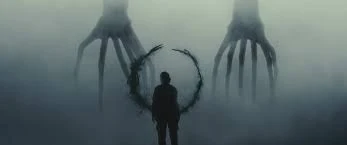
Dr. Louise Banks facing the unknown.
Amy Adams, in the role of Dr. Louise Banks, delivers a captivating performance. She portrays a linguist's journey from skepticism to profound understanding. Her nuanced portrayal captures the emotional depth of a mother and a scientist trying to bridge the gap between humans and extraterrestrials.
Jeremy Renner (The Hurt Locker, Avengers), as physicist Ian Donnelly, complements Adams with a performance that balances scientific curiosity with human compassion. Their on-screen chemistry adds depth to the film's exploration of personal relationships. Forest Whitaker (Rogue One, The Shield) offers very strong support as Colonel Weber, representing the pragmatic anxiety of the state.
I. The Sapir-Whorf Hypothesis: Language as Reality
"Arrival" places communication and language at the forefront of its narrative, emphasizing their profound impact on human understanding and perception. The film's exploration of language goes beyond mere words and delves into the intricacies of how language shapes our worldview, a concept known as the Sapir-Whorf hypothesis.
The Heptapods, the extraterrestrial beings in the film, introduce a language that is entirely alien to human understanding. Their written language, composed of intricate circular symbols (logograms), represents a non-linear perception of time. Unlike human languages that follow a linear structure - subject, verb, object - the Heptapod language allows them to perceive events from the past, present, and future simultaneously. This is evident when Dr. Louise Banks begins to have visions of her daughter's entire life as she becomes more immersed in the Heptapod language.
She isn't just learning to read; she is rewiring her brain to perceive the fourth dimension.
The film showcases how language can act as a barrier. As nations around the world attempt to decipher the Heptapods' message, misinterpretations arise. A prime example is when some nations interpret the word "weapon" in the Heptapods' message as a threat, leading to panic. In the proper context, the Heptapods were referring to their language as a "tool" or "gift" for humanity.
This underscores the danger of viewing the unknown through a lens of fear.
II. The Non-Zero-Sum Game: Unity and Collaboration
"Arrival" is not just a story about humanity's encounter with extraterrestrial beings. It is a reflection on the importance of unity. The film frames the alien contact as a "Non-Zero-Sum Game," a scenario where one side's gain does not mean the other side's loss. Everyone can win if they share information.
The Heptapods' arrival serves as a global event that necessitates international cooperation. Their ships don't just land in one country; they are strategically placed across the globe. This global event forces nations to either work together or risk misunderstanding the Heptapods' intentions. Initially, countries collaborate, but fear and misinterpretations begin to fracture this coalition.
The "Tool" vs. The "Weapon": A test of perception.
III. Amor Fati: The Nature of Time and Grief
"Arrival" offers a profound exploration of the concept of time, challenging traditional linear perceptions. Unlike humans, who perceive time as a sequence of past, present, and future events, the Heptapods experience all moments simultaneously. This is visually represented by their circular symbols, which have no clear beginning or end.
Louise's immersion in the Heptapod language leads her to experience time in a similar fashion. Throughout the film, she has vivid visions of her daughter's life, from moments of joy to the heart-wrenching realization of her daughter's terminal illness. Initially, these visions seem like flashbacks. However, as the narrative unfolds, it becomes clear that Louise is experiencing memories of a future she has yet to live.
One of the most poignant moments in the film is when Louise, armed with the knowledge of her future, chooses to embrace it. This connects to the philosophical concept of Amor Fati (love of fate). She raises ethical and moral dilemmas: If one knows their future, especially the painful parts, would they choose to change it?
Despite knowing the journey ends in loss, I embrace it. And I welcome every moment of it.
Louise's choice to have a child, despite being aware of the eventual pain and loss, speaks to the film's exploration of the complexities of human experience. It suggests that joy and sorrow are not separate events to be maximized or minimized, but threads in a single tapestry. Hannah's name, a palindrome, reinforces this circularity—it reads the same forward and backward, just as her life exists for Louise.
Conclusion: A Universal Language
"Arrival" stands as a beacon in modern cinema. Through the lens of an extraterrestrial encounter, the film delves deep into the human psyche, exploring our fears, hopes, and the innate desire for understanding.
Director Denis Villeneuve, alongside a dedicated team of writers, actors, and creatives, crafts a story that transcends the screen. It resonates with timeless questions about communication, time, and the essence of human connection. In a world often divided by differences, "Arrival" serves as a poignant reminder that true strength lies not in superior firepower, but in superior empathy.
In the critically acclaimed Lost episode “The Constant” from Season 4, Episode 5, time stops being a clever narrative device and becomes a human crisis. The episode takes the show’s obsession with fate, memory, identity, electromagnetism, and cosmic design, then compresses it into one terrified man trying to remember who he is before his mind breaks apart.
That man is Desmond Hume, one of Lost’s great wild cards. Jack, Locke, Sawyer, Kate, Sayid, and Hurley are bound to the Island by history, trauma, guilt, and Jacob’s long game. Desmond is different. He is bound to the Island by exposure. By accident. By love. By the Swan Station’s electromagnetic catastrophe. By one impossible act of survival that turns him into something the show keeps returning to: a man whose consciousness does not obey time in the same way everyone else’s does.
“The Constant” stands apart from the usual Lost flashback and flashforward structure. It is not simply showing us Desmond’s past. It is throwing Desmond into it. His consciousness begins jumping between 1996 and 2004, while his body remains trapped in the present aboard the freighter. The result is one of the cleanest pieces of science-fiction storytelling the series ever produced: a time-travel episode that works because the emotional rule is clearer than the scientific one.
Desmond needs a constant. Someone who exists in both periods. Someone strong enough in his mind to hold him together. For Desmond, that person is Penny Widmore.
She is his lobster, yes. More importantly, she is his anchor.
The episode was written by Damon Lindelof and Carlton Cuse, and it remains one of Lost’s defining hours because it does what the show did best at its peak. It makes the mythology feel intimate. It makes time travel feel like heartbreak. It makes a phone call feel like salvation.
Desmond’s call to Penny turns a dense time-travel episode into one of Lost’s most emotionally direct scenes.
The episode in one clean explanation
Desmond leaves the Island by helicopter with Sayid and Frank Lapidus.
The helicopter does not perfectly follow Daniel Faraday’s bearing, which exposes Desmond to the strange time effects around the Island.
Desmond’s consciousness begins jumping between 2004 and 1996.
Daniel Faraday explains that Desmond needs a constant, someone or something present in both time periods.
Desmond chooses Penny, and their Christmas Eve phone call restores his memory, identity, and emotional centre.
What happens in “The Constant”
1. 2004: Desmond leaves the Island
Desmond, Sayid, and Frank Lapidus leave the Island by helicopter, heading toward the freighter Kahana. Daniel Faraday warns Frank to stay on a very specific bearing, 305 degrees. That detail matters because Lost treats the Island as a place that cannot simply be reached or left like a normal location. The Island has rules. It has thresholds. It has points of entry. Stray from the correct bearing and reality starts to misbehave.
When Frank drifts off course, Desmond begins to panic. He does not merely feel sick. He loses his sense of the present. He no longer understands where he is, who Sayid is, or why he is flying over the ocean. His mind has slipped back into 1996.
2. 1996: Desmond wakes in the Royal Scots Regiment
Desmond finds himself back in his army days, serving in the Royal Scots Regiment. This is not a dream in the ordinary sense. He is experiencing his younger self from the inside while retaining flashes of his 2004 consciousness. The show makes the experience frightening because Desmond is not travelling through time like a tourist. He is being torn between two versions of himself.
This is where “The Constant” becomes more than a plot puzzle. Desmond’s crisis is one of identity. If memory is what makes a person continuous, what happens when memory splits? Which Desmond is real? The frightened soldier in 1996, or the Island survivor in 2004? Lost’s answer is brutally simple: without an anchor, both may collapse.
3. 2004: The freighter is already sick
When Desmond reaches the freighter, the Kahana does not feel like rescue. It feels like another haunted space. The crew are jumpy, secretive, and damaged. The sickbay contains George Minkowski, the communications officer, who has suffered the same temporal dislocation. Minkowski’s condition shows Desmond’s fate in miniature. This is what happens if the mind cannot stabilise itself.
Minkowski and another crew member, Brandon, had previously tried to leave the freighter and approach the Island. That attempt exposed them to the same dangerous boundary effect. Brandon is already dead by the time Desmond arrives. Minkowski is not far behind. Their fate gives the episode a ticking clock. Desmond is not confused for dramatic effect. His brain is under attack from time itself.
4. 1996: Desmond finds Daniel Faraday at Oxford
Following instructions from 2004 Daniel Faraday, Desmond seeks out the younger Daniel at Oxford in 1996. This is one of the episode’s sharpest pieces of writing. Faraday in 2004 understands what is happening, but he needs his younger self to provide the solution. Desmond becomes the message passed between them.
At first, the younger Faraday thinks Desmond is unstable. Then Desmond gives him the settings Faraday told him in 2004: 2.342 and 11 Hz. He also mentions Eloise, Faraday’s lab rat. That convinces Faraday because Eloise is part of his secret experiment. Faraday has been testing the idea that consciousness can be displaced through time.
Eloise the rat becomes a small but important piece of Lost mythology. She completes a maze before she has been taught how to run it, because her consciousness has already experienced the future training. It is a miniature version of the episode’s whole idea: knowledge can arrive before its origin. The problem is that Eloise dies. Her mind cannot survive the strain.
5. The constant rule
Faraday explains that Desmond needs a constant, something or someone present in both time periods that he deeply recognises. The constant is not just a password or memory trick. It is an emotional stabiliser. It gives the mind a fixed point when every other reference has broken loose.
Desmond chooses Penny. That choice is obvious, but it is also loaded. Penny is not on the Island. She is not part of the Oceanic 815 survivor group. She is not one of Jacob’s candidates. She is connected to the Island through her father, Charles Widmore, and through her refusal to stop looking for Desmond. In a show full of broken families, abandoned children, absent parents, and doomed relationships, Penny is one of Lost’s clearest symbols of faithful love.
6. Christmas Eve: The phone call
The climax of “The Constant” is a phone call on Christmas Eve, 2004. Sayid repairs the freighter’s communication equipment just long enough for Desmond to call Penny. The scene works because the show has made us understand both the cosmic stakes and the personal stakes. If Penny answers, Desmond may live. If she still loves him, he may remember himself.
Penny answers. Desmond tells her he loves her. Penny tells him she has been looking for him for three years. The call does not solve the Island. It does not stop Widmore. It does not expose the freighter mission. It does something more basic and more human. It puts Desmond back together.
The deeper Lost lore inside the episode
Desmond is not like the other survivors
Desmond’s role in Lost is strange from the beginning. He is introduced in the Swan Station, literally living inside the Island’s buried machinery. He presses the button. He fails to press it. He turns the failsafe key. He survives an electromagnetic discharge that should probably have killed him. After that, his relationship with time changes.
Season 3’s “Flashes Before Your Eyes” already shows Desmond reliving part of his past after the Swan implosion. He sees Charlie’s future deaths before they happen. He becomes a prophet against his will, trying again and again to save Charlie even as the universe seems determined to course-correct. “The Constant” takes that earlier idea and gives it a more precise mechanism. Desmond is not simply having visions. His consciousness can become unstuck.
This matters because Season 5 later builds a stricter model of time around Daniel Faraday’s rule: whatever happened, happened. The past cannot be changed in the ordinary sense. Yet Desmond sits outside that rule. Faraday says it plainly in Season 5: Desmond is special. The rules do not fully apply to him. “The Constant” is the episode that proves why.
The Island’s electromagnetic force is the hidden engine
Lost’s time mythology is not random magic. It is tied to the Island’s electromagnetic properties. The Swan Station was built to manage one pocket of that energy. The Orchid Station explores another side of it, with experiments involving displacement, exotic matter, and the movement of objects through space and time. By the time the wheel beneath the Orchid moves the Island, the show has already prepared us for the idea that electromagnetism and time are linked.
Desmond is uniquely altered by that force. His exposure in the Swan Station makes him resistant to electromagnetic catastrophe in a way other characters are not. That becomes crucial much later, when Charles Widmore brings Desmond back to the Island in Season 6 and subjects him to another electromagnetic test. Widmore does not see Desmond as a man first. He sees him as a key.
That makes “The Constant” one of the first episodes to reveal Desmond’s larger mythological purpose. He is not just the romantic Scotsman trying to get back to Penny. He is a human bridge between consciousness, time, and the Island’s deepest energy.
The bearing matters
Daniel’s warning about the helicopter bearing is easy to treat as technical flavour, but it is central to the Island’s geography. The Island is hidden not only by distance, but by distorted access. Naomi’s arrival, the freighter’s difficulty locating the Island, the submarine routes used by the Others, and Daniel’s instructions all suggest that reaching or leaving the Island safely requires a precise path.
When Frank drifts from the correct bearing, Desmond suffers the consequences. This is Lost turning navigation into mythology. The Island cannot be approached casually. It sits at a strange intersection of physical place, electromagnetic distortion, and temporal instability.
The freighter sickness foreshadows the cost of exposure
Minkowski’s death is not only there to raise the stakes for Desmond. It shows the cost of interacting with the Island without understanding it. The freighter crew think they are part of an operation. Some believe they are on a rescue mission. Others know more than they say. None of them truly understands what the Island can do.
Minkowski is the human warning label. He is what Desmond becomes if the mind cannot find a fixed point. Later Lost episodes will show other forms of temporal displacement, especially when the Island begins skipping through time after Ben turns the wheel. The nosebleeds, headaches, memory collapse, and deaths all echo the danger introduced here.
Faraday’s journal is one of the show’s great mythology objects
Daniel Faraday’s journal is more than a notebook. It is a survival manual written by a man who half-understands the forces he is playing with. It contains equations, warnings, personal notes, and eventually one of the episode’s most important lines: “If anything goes wrong, Desmond Hume will be my constant.”
That line matters because it suggests a loop in which Desmond helps Faraday understand the very phenomenon Faraday later helps Desmond survive. It is a clean example of the kind of causal knot Lost loved to explore, close to the ontological paradox in films and television, where information can seem to exist without a clear first author.
It also points toward the bootstrap paradox. Faraday gives Desmond the information in 2004. Desmond gives that information to Faraday in 1996. Faraday then carries the consequences of that encounter forward. The show does not reduce this to a puzzle for puzzle’s sake. It uses the loop to deepen both men. Faraday becomes more tragic. Desmond becomes more important.
Charles Widmore is everywhere in the background
“The Constant” also sharpens the Widmore mythology. Penny’s father, Charles Widmore, is not just a disapproving rich man standing between Desmond and Penny. He is one of the central off-Island powers trying to find and control the Island.
The auction scene involving the Black Rock ledger matters because it links Widmore to the Island’s older history. The Black Rock is not a random shipwreck. It is part of the Island’s long pattern of drawing people to itself across centuries. The ledger connects Widmore to that history, and to the Hanso name that also sits behind the Dharma Initiative. The Island has always attracted institutions, explorers, opportunists, believers, and exploiters. Widmore belongs to that lineage.
This gives Penny and Desmond’s love story a larger pressure system. Desmond loves the daughter of a man whose entire life is tangled in the Island’s ownership, secrecy, and power. Penny is Desmond’s constant, but Widmore is one of the reasons Desmond needs a constant in the first place.
How “The Constant” fits the broader Lost framework
It turns the flashback formula inside out
Lost built its early identity on flashbacks. Each episode used the past to reveal what a character was hiding from themselves. Season 4 shifted the game with flashforwards, revealing that some survivors escape the Island and become the Oceanic Six. “The Constant” goes further. It does not simply cut between then and now. It makes then and now collide inside one consciousness.
That is why the episode feels so alive. It takes the show’s signature structure and makes it dangerous. The past is no longer commentary. The past is attacking the present.
It explains Lost’s emotional theory of time
Lost often gets discussed as a mythology show, but its real framework is emotional continuity. Characters survive when they can face what shaped them. Jack must confront his father. Locke must confront his need to be chosen. Sawyer must confront the boy he never stopped being. Ben must confront the damage caused by his hunger for power. Desmond must confront the love he ran from.
That is why “The Constant” is so central. It literalises the show’s deepest character rule: you need something true to hold onto. For Desmond, truth is not a theory. It is Penny.
It prepares the audience for Season 5’s time travel
Season 5 would push Lost fully into time-travel storytelling, with the Island skipping through different eras and several characters becoming trapped in the 1970s with the Dharma Initiative. “The Constant” acts as the bridge to that material. It teaches the audience the emotional and scientific language before the show expands the scale.
Faraday’s explanations, Eloise the rat, the unstable consciousness, the journal, and the constant rule all help prepare viewers for later episodes such as “Because You Left,” “Jughead,” “The Variable,” and “The Incident.” Those episodes ask whether the past can be changed. “The Constant” asks a more personal question first: can a person remain whole when time breaks?
It deepens the fate versus free will argument
Lost is obsessed with whether people can change their destiny. Locke believes the Island has chosen him. Jack spends much of the series resisting that idea. Faraday tries to think mathematically about causality. Desmond lives the contradiction. His life appears guided by forces beyond him, yet his survival depends on a choice: call Penny. Trust Penny. Hold onto Penny.
This is the show’s best version of fate and free will. The universe may have rules. The Island may have designs. Time may close around people like a trap. Even then, love can still function as an act of will.
It foreshadows Desmond’s Season 6 role
In Season 6, Desmond again becomes vital because of his unusual resistance to electromagnetism and his ability to perceive reality differently after exposure. “Happily Ever After” mirrors “The Constant” in important ways. Once again, Desmond is placed inside an experiment. Once again, Penny becomes the emotional key. Once again, love allows consciousness to cross a boundary it should not be able to cross.
The flash-sideways world is not the same kind of time travel as “The Constant,” but the emotional grammar is similar. People awaken through connection. They remember themselves through love, grief, friendship, sacrifice, and recognition. Desmond becomes the guide because he has already lived the pattern. He knows what it means to wake up across realities and find the person who makes the self whole.
It connects Desmond and Penny to Lost’s final argument
Lost’s ending is often misunderstood as a trick ending about death. It is more precise than that. The show’s final movement argues that the relationships formed through the Island are the most important experiences of these people’s lives. “The Constant” is an early, perfect version of that idea.
Desmond does not survive because he solves the equations better than Faraday. He survives because the right person answers the phone. That does not make the science meaningless. It makes the science serve the character. Lost is always at its strongest when its wildest ideas are tied to the simplest human need: do not let me disappear.
Why the Penny phone call works so well
The phone call works because the episode earns it from both directions. In the 1996 scenes, Desmond has to convince Penny to give him her number even though he has hurt her. In the 2004 scenes, Sayid has to repair damaged communications equipment under pressure. Minkowski is dying. Desmond is deteriorating. The window is tiny.
So when Penny answers, the scene releases several kinds of tension at once. It is romantic. It is mythological. It is mechanical. It is temporal. It is also wonderfully simple. Two people hear each other again.
The Christmas Eve setting adds another layer. Lost rarely does sentiment without pain. The call is warm, but it is surrounded by death, distance, and cosmic instability. Penny and Desmond are not reunited physically. They are separated by oceans, years, lies, and the Island. Yet the connection is enough.
“The Constant” is the episode where Lost’s mythology stops being something outside the characters and becomes something inside them. Time is not just bending around Desmond. It is asking whether love can hold a person together when memory fails.
Episode lore and trivia
Detail
Why it matters
First major consciousness time-travel episode
Lost had already played with visions, flashbacks, and flashforwards, but “The Constant” makes Desmond actively experience two periods of his life from within his own mind.
The 305 bearing
Daniel’s bearing reinforces the idea that the Island has controlled access points. The wrong path can expose travellers to dangerous temporal effects.
Eloise the rat
Faraday’s rat demonstrates consciousness displacement before Desmond fully understands what is happening to him. The rat learning the maze before being taught is a tiny version of the episode’s causal loop.
George Minkowski
Minkowski shows Desmond what happens without a constant. His death gives the episode its horror edge and connects the freighter plot to the Island’s time sickness.
Penny’s phone number
Penny’s number becomes one of the most important practical details in the episode. It turns love into a survival mechanism, not just a theme.
Christmas Eve
The episode takes place on Christmas Eve in 2004, which gives the phone call a quiet seasonal charge without turning the episode sentimental.
The Black Rock ledger
Widmore’s purchase links him to the Island’s older history, the slave ship Black Rock, and the long trail of people trying to understand or possess the Island.
Faraday’s journal
The journal becomes one of Lost’s key mythology objects, connecting Desmond, Faraday, time travel, and the show’s causal loops.
“Desmond Hume will be my constant”
The final journal note turns Desmond from patient into anchor. He is not only saved by a constant. He may become one for Faraday.
“Southfields”
The auction house name has often been noted by fans because “Southfields” can be read as an anagram of “shifted soul,” a neat fit for Desmond’s displaced consciousness.
The episode’s place in Desmond’s full arc
Desmond begins as the man in the hatch, a stranger introduced with mystery and music and routine. He becomes a coward in his own eyes, then a failed monk, a soldier, a prisoner, a lover, a button-pusher, a castaway, a prophet, and finally one of the few people capable of enduring the Island’s deepest force.
“The Constant” is the centre of that arc because it gives Desmond’s suffering a shape. He is not special because he is powerful in the superhero sense. He is special because the Island’s power has damaged him and opened him at the same time. He can survive what others cannot, but survival costs him his stability. Penny gives that stability back to him.
That is why Desmond’s story never feels like a side plot, even when he is physically away from the main survivor camp. He is the character Lost uses when it wants to talk about the boundary between science and faith without losing the heart of the story. Jack and Locke argue about meaning. Desmond lives inside meaning’s machinery.
Why “The Constant” remains one of Lost’s best episodes
The episode works because every part of it supports every other part. The science-fiction concept is clean. The rules are understandable. The freighter setting is tense. The editing has momentum. Faraday is strange but useful. Sayid is practical. Minkowski is tragic. Widmore’s shadow adds mythology. Penny gives the story its emotional destination.
Most importantly, Desmond’s problem is both cosmic and ordinary. He is unstuck in time, yes. But underneath that, he is a man terrified that he has lost the person he loves and the person he used to be. Lost often asked whether people could escape their past. “The Constant” asks what happens when the past refuses to stay past.
The answer is one of the show’s most moving ideas. You do not survive chaos by understanding all of it. You survive by finding the thing that remains true when everything else slips.
For Desmond Hume, that truth is Penny Widmore. For Lost, “The Constant” is proof that the show’s mythology was never just about hatches, numbers, stations, wheels, and smoke. It was about people trying to stay themselves in a world that kept breaking the rules around them.




_poster.jpg)


