
Earth Defence Forces Archive // X-Project
X-Bomber and Star Fleet Explained
The complete story of Go Nagai's space-puppet epic, from the destruction of Pluto Base and the mystery of F-01 to Dai-X, Commander Makara, the Imperial Master and Brian May's legendary rock tribute.
Spoiler warning: This guide covers Lamia's identity, the deaths of major characters and the ending of the series.
X-Bomber, retitled Star Fleet for English-speaking audiences, is one of the strangest and most compelling collisions in science-fiction television. Its DNA includes Go Nagai's super robots, the model-based spectacle of Thunderbirds, the battered spacecraft of Star Wars, Japanese tokusatsu and the continuing momentum of a serialised space opera.
The result looks familiar for only a few seconds. Rod puppets occupy manga-inspired sets. Massive practical spacecraft exchange laser fire. A red combining robot launches from inside a prototype battleship. Characters are brainwashed, poisoned and killed. A young alien woman discovers that every major power in the galaxy has reduced her identity to a military designation: F-01.

The English-language Star Fleet presentation made X-Bomber and Dai-X Saturday-morning icons for a generation of British viewers.
What X-Bomber actually was
X-Bomber was created by manga artist Go Nagai, developed and written by Keisuke Fujikawa, and produced in Japan by Cosmo Productions and Jin Productions for Fuji TV. Michio Mikami was the principal director. The production described its technique as Supermariorama, a Japanese answer to the kind of puppet-and-miniature spectacle associated with Gerry Anderson.
Gerry Anderson and Toei Animation did not produce X-Bomber
The confusion is understandable because the series openly resembles Anderson's work, English-dub personnel later worked on Terrahawks, and Anderson appeared in a retrospective documentary. The on-screen production record credits Fuji Television, Jin Productions and Cosmo Productions. The English version was produced by Leah International and ITV. Toei Animation was not the Japanese animation studio behind the programme because X-Bomber was a live-action puppetry and effects production, rather than a conventional animated series.
| Mission file | Verified detail |
|---|---|
| Original title | X-Bomber, written in Japanese as Xボンバー |
| English title | Star Fleet |
| Creator | Go Nagai, creator of Mazinger Z and a foundational figure in super-robot fiction |
| Japanese broadcast | Fuji TV, 1980 to 1981 |
| English broadcast | Regional ITV transmission began in October 1982, with 24 dubbed episodes |
| Format | Rod puppets, practical miniatures, pyrotechnics, optical effects and a performer inside the Dai-X suit |
| Central conflict | The Earth Defence Forces protect F-01 from Commander Makara and the Imperial Alliance as the year 3000 approaches |
The complete Star Fleet story
The series begins in the year 2999, with Earth enjoying an uneasy peace after earlier Space Wars. That peace collapses when Commander Makara's enormous battlecruiser destroys the Earth Defence Forces base on Pluto. Makara issues an ultimatum: surrender F-01 or Earth will be destroyed.
Earth has an immediate problem. Its leaders do not know what F-01 is.
1. Pluto falls and X-Project launches
General Kyle orders Moonbase commander Dr Benn to activate X-Project. The project is only about 90 per cent complete, but there is no alternative. X-Bomber launches with newly qualified pilots Shiro Hagen, Barry Hercules and John Lee, supported by Dr Benn, Lamia, her guardian Kirara and PPA. Their first mission establishes the series' central tension: the EDF has built an extraordinary weapon without knowing whether its young crew can survive using it.
2. The search for F-01 becomes personal
The mysterious sailing ship Skull appears and communicates with Lamia through the strange token she carries. Lamia had been found as an infant on Mars with Kirara and raised by Professor Hagen, Shiro's missing father. Her unknown origin, telepathic awakening and connection to the Skull point toward the truth. F-01 is a person, and Lamia is at the centre of it.
3. The Imperial Alliance weaponises memory
Captain Carter, the respected academy mentor of Shiro, Hercules and Lee, survives the destruction of Pluto Base only to be captured and brainwashed. The Alliance turns his knowledge of the EDF against his former students and replaces parts of his body with machinery. His return forces Shiro to fight a corrupted version of the man who trained him. Carter's death gives the adventure a wound that cannot be repaired by the next episode.
4. Lamia learns the cost of destiny
Captain Halley, commander of the Skull and a survivor from Lamia's lost world of Esper, reveals more of the prophecy surrounding F-01. Lamia is pursued, kidnapped and repeatedly pushed toward self-sacrifice. Dr Benn dies after shielding her from Caliban's poison-bearing assassin, removing the crew's commander and moral centre just as the conflict enters its most dangerous stage.
5. Callinean tests the limits of pacifism
The refugees associated with Halley have found shelter on Callinean, whose ruler refuses to answer violence with violence. The Imperial Alliance exploits that principle, attacking a society unwilling to defend itself. Halley and the X-Bomber crew must protect Callinean while preserving the values that made it a refuge. The episodes turn a simple space battle into an argument about whether peace can survive without someone willing to stand between civilians and conquest.
6. Makara makes her last attack
Failure brings no mercy within the Imperial Alliance. The Imperial Master humiliates, threatens and finally discards Makara and Orion. Makara refuses to disappear quietly. Her final assault ends when Dai-X penetrates the Imperial battlecruiser and destroys her command. The scene is abrupt and brutal, giving the series' most charismatic villain an ending shaped by the same violence she inflicted on others.
7. F-01 awakens at the millennium
As the year 3000 arrives and the planets align, Lamia, Halley and the Skull unite in the full manifestation of F-01. The Imperial Master attacks Earth with his fortress and the Delta Laser, but F-01 survives his power and destroys both the Master and the heart of the Imperial Alliance. Lamia fulfils the prophecy and brings peace, but her transformation also separates her from the human family that protected her.
X-Bomber, Dai-X and the mechanics of teamwork
X-Bomber is the experimental battleship built under Professor Hagen's X-Project. It carries heavy weapons, travels between worlds and serves as the crew's home. It does not transform into a giant robot.
The giant robot is Dai-X, which is stored inside X-Bomber as three separate craft. During the Dai-X Junction sequence, those vehicles combine in space into the red humanoid machine that became the show's most recognisable image.

Dai-X is formed by BrainCom, MainBody and LegTrax. X-Bomber is the carrier spacecraft from which the three components deploy.
BrainCom, piloted by Shiro Hagen
The fast, manoeuvrable command craft forms Dai-X's head. Shiro becomes the controlling pilot after junction, making his judgment as important as his reflexes.
MainBody, piloted by Barry Hercules
The heavily armoured central unit forms the chest and arms. Its role suits Hercules, whose confidence and physical courage often drive the team through direct confrontation.
LegTrax, piloted by John Lee
The lower unit forms the hips, legs and feet and can operate as a tracked ground vehicle. Lee's steadiness provides the literal and emotional balance of the combined machine.
The junction sequence expresses the series' ethics in mechanical form. Dai-X reaches full power only when three very different pilots align their actions. The Imperial Alliance concentrates power in one ruler and treats subordinates as disposable. The EDF's decisive machine distributes control across a team.
Star Fleet character guide
Dr Benn Robinson
Moonbase commander, scientist, captain and surrogate father to Lamia. Benn is disciplined without being cold, and he understands that X-Bomber's power creates responsibility rather than glory. His death protecting Lamia removes the adult who could turn experience into restraint. Peter Marinker voiced him in English.
Professor Hagen
Shiro's estranged father designed X-Bomber and Dai-X, discovered the infant Lamia on Mars and raised her in secrecy. His disappearance creates two mysteries at once: where Lamia came from and why Shiro grew up without him. Halley later reveals that he rescued Hagen during the professor's search for Lamia's homeworld. When Hagen rejoins the struggle on Callinean, the inventor finally has to confront what his machines and his decisions have cost his children.
Shiro Hagen
The young tactical leader of the pilots and son of Professor Hagen. Shiro is brave, talented and emotionally impulsive. His feelings for Lamia, anger over Carter and desire to escape his father's shadow make him more than a standard heroic commander. Jay Benedict supplied his English voice.
Barry Hercules
The crew's loudest personality and most confrontational fighter. Hercules can look like comic muscle, yet he is also fiercely loyal and quick to challenge Shiro when emotion threatens the crew. Constantine Gregory voiced him.
John Lee
The calmest of the three pilots. Lee absorbs tension, reads the room and keeps Shiro and Hercules working together. His function inside Dai-X mirrors his place in the crew: he stabilises the whole structure. Mark Rolston voiced Lee in the English version.
Princess Lamia
Found on Mars as an infant and raised by Professor Hagen and Dr Benn, Lamia grows from protected outsider to the central agent of the story. The Alliance calls her F-01, the crew calls her Lamia, and the difference matters. Her arc asks whether destiny can be fulfilled without surrendering identity. Liza Ross voiced her in English, while Mami Koyama performed the Japanese role.
Kirara
Lamia's powerful, mostly non-verbal protector accompanied her from infancy. Kirara's creature-like appearance encourages outsiders to underestimate him, yet his devotion preserves Lamia's connection to a past she cannot remember.
PPA
The Perfectly Programmed Android maintains systems, analyses danger and provides comic friction, especially with Hercules. His fussiness prevents the humour from feeling detached from the ship. The jokes usually arise because the crew needs his competence while finding his manner intolerable. John Baddeley voiced PPA.
Captain Carter
Carter commanded Pluto Base and had previously trained Shiro, Hercules and Lee at the Star Fleet academy. Makara's forces capture, brainwash and mechanically alter him, then exploit his knowledge of the EDF. Shiro ultimately kills the mentor he cannot recover. Carter's fate condenses the Alliance's entire method into one character: seize a person, erase loyalty, preserve useful knowledge and weaponise what remains.
Captain Halley
A telepathic survivor from Esper and commander of the mysterious Skull. Halley first appears as an unsettling rival for Shiro's trust, then becomes essential to Lamia's awakening and the resistance on Callinean. His promised union with Lamia is ultimately metaphysical: Halley, Lamia and the Skull combine as F-01.
The Imperial Alliance
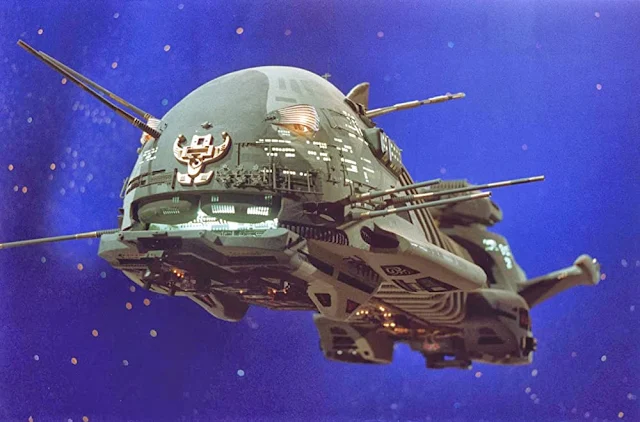
The scale and aggressive silhouette of Makara's battlecruiser made the Imperial Alliance feel physically overwhelming.
Commander Makara
Called Bloody Mary in the Japanese version, Makara is theatrical, ruthless and increasingly desperate. Her cruelty is real, but so is the terror governing her from above. Every failure brings the threat of punishment from the Imperial Master. She becomes the clearest example of an authoritarian system reproducing itself through fear. Denise Bryer's forceful English performance made Makara one of the series' defining characters.
Captain Orion
Known as Kozlo in Japan, Orion serves as Makara's loyal aide and frequent target of her rage. His position reveals how little security rank provides inside the Alliance. He can command armies and still be discarded by a superior without hesitation.
Caliban
Doctor Gedora in the Japanese version, Caliban supplies the Alliance with brainwashing, assassins and grotesque technological attacks. Where Professor Hagen builds machines that require cooperation, Caliban treats bodies and minds as material to be altered.
The Imperial Master
The Master's skull-covered design and cavernous presence make him feel less like a politician than a cult object. He rules from distance, demands impossible results and converts failure into terror. His obsession with F-01 exposes the weakness beneath the spectacle: his empire can conquer worlds but cannot survive the arrival of a power it cannot own.

Commander Makara is both an agent of imperial violence and a subordinate trapped inside the Imperial Master's machinery of fear.
The themes beneath the space battles
Identity against classification
F-01 sounds like a weapon, specimen or file number. That language allows generals and emperors to discuss Lamia without confronting her humanity. The crew's defence of Lamia therefore carries more weight than protecting a strategic asset. They insist that a person cannot be reduced to the power others expect her to provide.
Destiny and consent
Lamia's future is mapped by prophecy, planetary alignment and her connection with Halley. The story still gives emotional force to her choices. She repeatedly decides whether to surrender, fight, trust Halley or protect her friends. Her destiny becomes meaningful because she moves toward it through sacrifice and understanding, rather than behaving like a key inserted into a cosmic lock.
The corruption of memory
Captain Carter's brainwashing is the show's darkest expression of imperial power. The Alliance does more than kill an enemy. It steals his history, turns mentorship into tactical data and makes his students destroy what remains. Carter becomes a warning that authoritarian control seeks ownership of the past as well as the future.
Pacifism under siege
Callinean's refusal of violence is morally serious, but the Alliance exploits it. The series avoids an easy answer. Unrestrained militarism built the Imperial Alliance, while defenceless idealism leaves civilians exposed to it. X-Bomber occupies the difficult middle ground: force may be necessary, but its legitimacy depends on whom it protects and whether its users remain answerable to human values.
Found family and irreversible loss
Lamia's biological origins matter to the prophecy, but her moral character was shaped by Professor Hagen, Dr Benn, Kirara and the X-Bomber crew. The serial structure allows those bonds to grow before demanding a price from them. Carter and Benn stay dead. Lamia saves the galaxy but cannot simply return to her former life. Victory changes the survivors.
Why Star Fleet felt different on British television
The English-language version was more than a direct change of voices. Leah International produced the adaptation for ITV, with Louis Elman and Peter Marinker directing and Michael Sloan adapting the scripts. Paul Bliss wrote a new score and the unforgettable English theme. Sloan later co-created The Equalizer, while Marinker also voiced Dr Benn.
The adaptation preserved the continuing storyline and much of the Japanese version's severity. That mattered. Many children's imports were heavily recut or reorganised, but Star Fleet retained its sense that one episode's damage would shape the next. The young audience saw torture, brainwashing, grief, failed leadership and genuine death inside a programme filled with robots and laser battles.
The visual mix also arrived at the right moment. British viewers understood model spacecraft and puppets through Gerry Anderson, while Star Wars had transformed expectations of cinematic space adventure. Star Fleet connected those traditions to the combining-robot grammar of Japanese popular culture before Transformers became a dominant British television brand.
Brian May, Eddie Van Halen and the Star Fleet Project
Paul Bliss's theme reached its most unlikely destination through Brian May. The Queen guitarist watched Star Fleet with his young son Jimmy and could hear the melody as a hard-rock vehicle. During a break from Queen in 1983, May gathered Eddie Van Halen, REO Speedwagon drummer Alan Gratzer, bassist Phil Chen and keyboardist Fred Mandel at the Record Plant in Los Angeles.
The sessions produced the three-track Brian May + Friends: Star Fleet Project, built around May's expanded arrangement of Bliss's theme, the blues song “Let Me Out” and the improvisation “Blues Breaker”. The music was recorded on 21 and 22 April 1983. An expanded Star Fleet Sessions set arrived in 2023, opening the archive to alternate takes, studio conversation and multiple Van Halen solos.
Brian May also recorded a guitar tutorial for the Star Fleet theme, completing a remarkable cultural loop: a Japanese puppet series inspired by British television returned to Britain, became a cult hit, and then generated a record featuring two of rock's most recognisable guitarists.
Star Fleet and X-Bomber trivia
- X-Bomber is the ship and Dai-X is the robot. The three Dai-X craft deploy from X-Bomber and combine through the Dai-X Junction sequence.
- The Japanese technique was branded Supermariorama. The puppets were largely controlled with rods from beneath the sets, which explains why characters are frequently framed from the waist upward.
- The English version contains 24 episodes. The recap-heavy Japanese episode commonly translated as “Bloody Mary's Promotion” was omitted from the international package.
- The commonly recorded ITV premiere date is 23 October 1982. That placed the opening of Star Fleet one day before the first British television broadcast of Star Wars, although ITV scheduling could vary by region.
- The series used a continuing plot. Its escalating F-01 mystery, character deaths and final resolution distinguished it from adventure shows that reset after every instalment.
- Many character names changed in translation. Bloody Mary became Commander Makara, Kozlo became Captain Orion, Doctor Gedora became Caliban, Captain Custer became Captain Carter and Shiro Ginga became Shiro Hagen.
- PPA means Perfectly Programmed Android. Despite the name, his compact hovering form looks closer to a utility robot than a human-shaped android.
- Three members of the English voice cast later appeared in Aliens. Jay Benedict played Russ Jorden, Mark Rolston played Drake and Al Matthews played Sergeant Apone.
- Denise Bryer had deep links to British puppet television. After voicing Makara, she performed major roles in Gerry Anderson and Christopher Burr's Terrahawks, including Zelda.
- The English dub was recorded at Anvil Studios. Michael Sloan wrote the adaptation, Paul Bliss supplied the music and Tony Lenny supervised the editing.
- The Japanese themes were different. Bow Wow performed the opening “Soldier in the Space” and ending “The Drifting Galaxy”, with Kyoji Yamamoto composing the theme music.
- British readers received more adventures in print. Look-In ran a Star Fleet comic strip for 32 weeks beginning in 1983.
- Two Japanese manga adaptations appeared in 1980. Naoki Kamohara drew one for Monthly Shōnen Jump, while Makoto Ono drew another for TV-kun.
- Home-video versions were often compilations. British viewers encountered edited tapes such as The Thalian Space Wars and Space Quest for F-01 before the complete English series reached DVD.
- The programme also reached the United States. The English-language Star Fleet version was offered in first-run syndication, and later American home-video editions frequently used episode compilations.
- The complete 2009 UK DVD restored all 24 English episodes. A 2019 Discotek standard-definition Blu-ray later paired the English Star Fleet run with the Japanese-language X-Bomber episodes and English subtitles.
- Dai-X returned as a modern model kit. Good Smile Company's 2023 MODEROID Big Dai-X can be displayed as Brainder, Jumbody and Legstar, the Japanese names for the three combining craft.
Why X-Bomber still matters
Star Fleet survived because its novelty had structure beneath it. The practical effects give the ships weight. The puppet designs turn Makara and the Imperial Master into nightmare figures. Dai-X delivers the transforming-robot spectacle. The continuing story makes every victory temporary and every loss cumulative.
Its most durable idea, however, is Lamia. The galaxy calls her F-01 because institutions prefer a controllable label. Her friends defend the name, history and person inside that label. When she finally becomes the power everyone feared, she uses it to end domination rather than inherit it.
That is the principle holding the entire production together. X-Bomber is a weapon whose best commander prefers peace. Dai-X is strongest when three pilots cooperate. F-01 defeats the Imperial Master because power reaches its highest form through union rather than obedience. Beneath the explosions, Star Fleet is a story about who gets to decide what power is for.
Return to the X-Project
Explore available Star Fleet and X-Bomber editions, music and collector releases.
View Star Fleet releases
_poster.jpg)


