
An astromech droid is supposed to maintain starships, calculate hyperspace jumps, patch damaged systems, and plug into computers that organics either cannot reach or cannot understand. R2-D2 does all of that. Then he goes several steps further and becomes one of the quiet engines of the entire Star Wars saga.
R2-D2 is not just the little blue droid who squeals, swears in binary, and saves the heroes when the plot needs a miracle. He is a courier, mechanic, saboteur, pilot's partner, hidden witness, memory vault, and walking archive of the Skywalker age. If the galaxy keeps falling apart, R2 is usually somewhere nearby, recording the damage and fixing the door.
When it comes to astromech droids, R2-D2 is undoubtedly the greatest of all time. The joke is that C-3PO gets all the words and R2 gets only beeps. The truth is sharper: R2 does not need exposition. He acts. He moves the story. He survives war after war with more nerve than many Jedi, senators, generals, and smugglers around him.
Across the films, R2-D2 repeatedly becomes the character who preserves the crucial thing everyone else is trying to lose, steal, bury, or forget. Leia's Death Star plans. Luke's path to Obi-Wan. Padmé's ship. Anakin's fighter. The map to Luke Skywalker. The old hologram of Leia that finally breaks through Luke's bitterness in The Last Jedi. R2 is a droid, but his real function is memory.

R2-D2 as the saga's secret main character
R2-D2's heroism is first demonstrated in the original Star Wars film, where Princess Leia hides the stolen Death Star plans inside him before sending him away with C-3PO. That one decision turns R2 into the living hinge of the Star Wars opening crawl. The Rebellion has won its first victory. The Empire is chasing the plans. Leia needs Obi-Wan. R2 carries the answer.
That is why his arrival on Tatooine matters more than it first appears. Luke Skywalker does not leave the moisture farm because he is brave enough to begin the hero's journey on his own. He leaves because R2 forces the issue. R2 runs away, finds Obi-Wan Kenobi, plays Leia's message, and drags Luke into history. Without R2's stubborn disobedience, Luke may never reach Mos Eisley, never meet Han Solo, never rescue Leia, and never fire the shot that destroys the Death Star.
That is R2's pattern. He does not make speeches. He turns the wheel. He opens the locked door. He wakes the sleeping system. He knows when to ignore orders. In a saga filled with prophecies, bloodlines, dynasties, Force visions, and political collapse, R2's gift is practical rebellion. He refuses to stay where he is told to stay.
That makes R2-D2 a perfect Star Wars character. The saga often turns on myth, but its victories are usually won through ordinary acts of nerve: a stolen transmission, a repaired hyperdrive, a shield generator disabled at the right moment, a droid plugging into a socket while blaster fire fills the hallway.
The original trilogy: the droid who keeps saving the heroes
In A New Hope, R2-D2 helps rescue Princess Leia, assists the escape from the Death Star, and stops Luke, Han, Leia, and Chewbacca from being crushed in the trash compactor. He is also present in the final assault on the Death Star, riding behind Luke in the trench run until Darth Vader's fire damages him. Even there, his place in the story is clear. Luke may use the Force, but he still needs the droid at his back.
In The Empire Strikes Back, R2 is less flashy but just as essential. He accompanies Luke to Dagobah, survives Yoda's swamp, and later helps repair the damaged Millennium Falcon. When the hyperdrive finally works during the escape from Cloud City, it is not because Han is charming or Lando is repentant. It is because R2 understands machines faster than organics understand their own plans.
In Return of the Jedi, R2 again becomes the small machine smuggled into the heart of an enemy system. At Jabba's palace, he carries Luke's lightsaber. On Endor, he helps the strike team at the shield bunker. R2 is not the one who destroys the second Death Star, but he helps create the conditions that let everyone else do their part. That is the droid's strange genius. He is rarely the face of the victory, but he is often one of its causes.
The prequels: R2-D2 before the Rebellion
The prequel trilogy gives R2-D2 a deeper history. Before the Empire, before Luke, and before Leia's desperate message, R2 serves the Royal House of Naboo. In The Phantom Menace, he helps repair Queen Amidala's starship during the escape from the Trade Federation blockade, earning recognition because he survives where other astromechs are destroyed.
That detail matters. R2's loyalty begins not with the Rebellion but with Naboo, Padmé Amidala, and the dying days of the Republic. He is already tied to the political crisis that will become the Clone Wars. He watches Anakin Skywalker rise from gifted child to Jedi Knight to Sith Lord. He sees Padmé's life collapse under the weight of Anakin's fear. He survives the Republic's transformation into the Empire.
In Attack of the Clones, R2 and C-3PO are pulled into the chaos of Geonosis, where romance, war, and political deception collide. The film uses them for comedy, but their presence also links the private story of Anakin and Padmé to the public birth of the Clone Wars. They are witnesses to the moment the galaxy starts marching toward dictatorship.
In Revenge of the Sith, R2 is still with Anakin during the Battle of Coruscant. He helps aboard the Invisible Hand, fights off buzz droids, and behaves with the same rude confidence he will later show around Luke and Han. The tragedy is that R2 knows Anakin as a hero before the galaxy remembers him as Darth Vader. That gives the droid's silence a strange weight. He carries history that almost no one else is allowed to carry.
R2-D2 and Anakin Skywalker
R2-D2's relationship with Anakin is one of the more underrated threads in Star Wars. Anakin trusts machines. He builds them, repairs them, improves them, and speaks to them as if they are companions rather than tools. That is why his bond with R2 feels natural. R2 is not just equipment in Anakin's fighter. He is a partner in motion.
That partnership also sharpens the tragedy of Anakin's fall. R2 serves Anakin at his most heroic and remains part of the story after Anakin becomes Vader. The droid outlives the young pilot, the Jedi Knight, the Sith Lord, and the redeemed father. In a saga obsessed with legacy, R2 is one of the few characters who sees the full shape of that legacy without ever explaining it in words.
R2-D2 and Luke Skywalker
With Luke, R2 becomes something different. He is no longer the droid of a queen or a Jedi general. He becomes the stubborn companion of a farm boy who does not yet know what he is carrying inside himself. The symmetry is clean: R2 served Anakin during the Clone Wars, then helps Anakin's son enter the fight against the Empire Anakin helped create.
R2 also understands Luke in ways other characters sometimes do not. He follows him to Dagobah. He waits near the X-wing. He rides into danger. In The Last Jedi, when Luke has withdrawn from the galaxy, R2 does what only R2 could do. He plays Leia's original message. Not as strategy. Not as debate. As memory. He reminds Luke who he was before disappointment, guilt, and exile hardened him.
That moment works because R2 is not manipulating Luke in the usual sense. He is showing him the beginning again. R2-D2 has become the archive of Luke Skywalker's conscience.
R2-D2 and C-3PO: the saga's oldest double act
All of this happens in the context of R2-D2's friendship with C-3PO, one of the most enduring partnerships in the franchise. C-3PO is a protocol droid, built for language, etiquette, translation, and panic. R2-D2 is an astromech, built for starships, sockets, repairs, and getting things done. Together, they turn Star Wars' cosmic myth into something more human, funny, and lived-in.
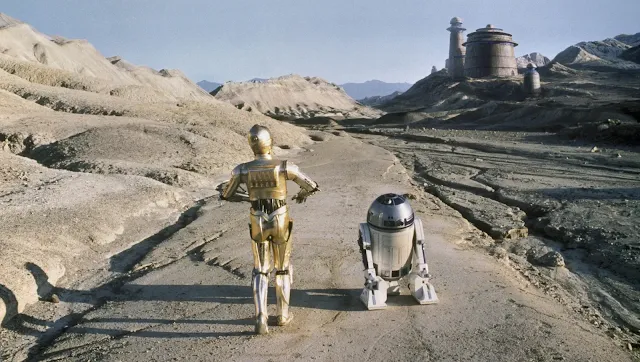
Their comedy works because they are almost always mismatched. C-3PO worries about rules, danger, decorum, and the statistical likelihood of death. R2 ignores him and does whatever needs doing. C-3PO translates the galaxy. R2 changes it. C-3PO tells everyone how bad the situation is. R2 usually finds the panel that might fix it.
Despite their bickering, they protect each other. In The Empire Strikes Back, R2 helps recover the disassembled C-3PO on Cloud City. In the prequels, they share the absurdity of being dragged through galactic history by masters who rarely understand how much the droids are absorbing. In the sequels, their age gives them added warmth. These are not just comic relief machines. They are veterans.
Their partnership also connects Star Wars to older cinematic traditions: Laurel and Hardy, Abbott and Costello, samurai sidekicks, fairy-tale servants, and wandering witnesses. C-3PO and R2-D2 are often the first characters we follow into the story, which matters. The galaxy may belong to Jedi and Sith, but the audience often enters it through two frightened, quarrelling droids trying not to get blasted.
The Force Awakens and the map to Luke Skywalker
In The Force Awakens, R2-D2 spends much of the film in low-power mode after Luke Skywalker disappears. On paper, that could make him seem passive. In practice, it turns him into a dormant archive. BB-8 carries one part of the map to Luke. R2 holds the older data needed to complete it. The new droid and the old droid literally have to combine memory systems to find the missing Jedi.
That is a neat piece of sequel trilogy symbolism. BB-8 brings speed, youth, and new energy. R2 brings buried history. The Resistance needs both. Star Wars keeps insisting that the future cannot move unless someone remembers where the past went wrong.
R2-D2 as a technical miracle with a personality problem
R2-D2's toolset is absurdly useful. He can interface with computer systems, project holograms, repair starships, manage navigation data, scan environments, deliver shocks, cut through obstacles, and operate inside systems designed by multiple civilizations across decades of galactic history. He is effectively a mobile repair bay with opinions.
The important part is the opinion. R2 is not a neutral appliance. He lies, refuses, improvises, complains, and takes risks. He often acts before permission is granted. That rebellious streak is not a side detail. It is the reason he survives. Most droids in Star Wars are owned, sold, memory-wiped, restrained, and treated as property. R2 behaves like someone who knows obedience is sometimes the enemy of survival.
That is part of why he feels so alive. R2-D2 has no visible face, no spoken English dialogue, and almost no conventional body language. Yet he has one of the clearest personalities in the saga. He is brave, rude, loyal, secretive, clever, sentimental when it counts, and completely uninterested in being underestimated.
Expanded R2-D2 trivia and lore notes
- R2-D2 was created by George Lucas as part of the original Star Wars vision. He was designed to function as both practical science fiction hardware and silent-film comedy. The character needed to look useful, move strangely, and communicate without normal dialogue.
- The character's look was shaped by the wider design language of the original film. R2-D2 feels industrial rather than magical. Scratches, panels, tools, grime, and exposed utility make him look like something that has worked inside starships for years.
- Kenny Baker brought physical life to R2-D2 in the original trilogy. Baker's performance helped turn the droid from a moving prop into a character with timing, irritation, curiosity, and courage.
- R2-D2's beeps and whistles were created by sound designer Ben Burtt. Burtt's work is central to Star Wars texture, from lightsabers to Vader's breathing. His R2 sound design gives the droid emotion without translating every line for the audience. That restraint is why Ben Burtt's larger Star Wars sound legacy matters so much.
- R2-D2's name has long been associated with the phrase "Reel 2, Dialogue 2." The popular production-story version is that the phrase was heard during editing and stuck in George Lucas's mind. Whether treated as studio folklore or origin shorthand, it fits the character's strange blend of machinery and personality.
- R2-D2 is strongly associated with Naboo in canon. Before he belongs to the Skywalker family story, he serves aboard Queen Amidala's royal starship. That gives him a political origin before he becomes a rebel icon.
- R2-D2 serves Padmé Amidala, Anakin Skywalker, Luke Skywalker, Leia Organa, and the Resistance cause. That gives him one of the broadest loyalty arcs in the saga. He moves through monarchy, republic, rebellion, and resistance without losing his own blunt sense of purpose.
- He appears across the nine Skywalker Saga films. That makes him one of the saga's great connective figures, linking the prequel, original, and sequel eras through presence rather than speeches.
- R2-D2 also appears in Rogue One. His brief appearance near C-3PO helps connect the film's stolen Death Star plans directly to the opening movement of A New Hope.
- He is not just comic relief in A New Hope. Leia trusts him with the Death Star plans, and Obi-Wan receives Leia's plea through him. R2 is the data courier who turns espionage into myth.
- R2-D2 is one of the few characters who knows more than he says. The saga often uses memory wipes to reset droids, but R2's continuity makes him feel like a hidden record of the Skywalker disaster.
- C-3PO has his memory wiped at the end of Revenge of the Sith, but R2-D2 does not receive the same treatment on screen. That distinction is loaded with story potential. R2 may not tell the audience everything, but he remains a witness to the fall of Anakin, the death of Padmé, and the birth of the twins.
- R2-D2 carries Leia's hologram, one of the most famous messages in cinema. "Help me, Obi-Wan Kenobi" is not just a plea. It is a political act, a rebel transmission, and the spark that brings Luke into the war.
- He helps save the heroes in the Death Star trash compactor. The scene is funny, frantic, and telling. While the human heroes shout over each other, R2 solves the mechanical problem.
- R2-D2 is Luke's astromech during the Death Star trench run. This visually links him to fighter-pilot culture inside Star Wars. He is part mechanic, part navigator, part co-pilot, and part lucky charm.
- In The Empire Strikes Back, R2-D2 travels with Luke to Dagobah. His muddy, indignant swamp scenes give the film comedy, but they also keep Luke's Jedi quest connected to the practical world of machines and survival.
- R2-D2 helps restore the Millennium Falcon's hyperdrive on Cloud City. That moment gives him one of the most quietly important saves in the original trilogy. The escape works because R2 can read systems faster than anyone else aboard.
- In Return of the Jedi, R2-D2 hides Luke's lightsaber inside his dome. The reveal at the Sarlacc pit turns the droid into a weapon cache and signals how completely Luke trusts him.
- R2-D2's rocket boosters in the prequels remain one of his flashier tools. They help sell him as more advanced than the clunkier, dustier version seen during the original trilogy, though fans have long joked about why he does not use them later.
- His tool compartments include devices for cutting, shocking, scanning, projecting, repairing, and interfacing. The exact kit shifts depending on the story, which is part of the gag. R2 always seems to have one more attachment hidden somewhere.
- R2-D2 is often braver than the organic characters around him. He rolls into blaster fire, hostile ships, enemy bunkers, swamps, deserts, and battlefields with almost no hesitation.
- R2's personality is communicated through sound, movement, and reaction timing. He can seem sarcastic, furious, smug, frightened, or affectionate without a translated line of dialogue. That is a major filmmaking achievement.
- R2-D2 and C-3PO echo old comedy pairings. C-3PO is the nervous talker. R2 is the rude problem-solver. Together, they make galactic catastrophe feel personal, petty, and funny.
- Their friendship survives ownership changes, wars, kidnappings, memory loss, and near destruction. They argue constantly, but their bond becomes one of the emotional constants of Star Wars.
- R2-D2 is part of The Clone Wars' droid-focused D-Squad arc. That storyline leans into the idea that droids can carry entire missions, not just assist Jedi and soldiers from the sidelines.
- The Force Awakens turns R2-D2 into a dormant archive. His low-power state is not just a plot delay. It gives him the feeling of a machine carrying a buried piece of history until the next generation is ready for it.
- In The Last Jedi, R2-D2 replays Leia's old message for Luke. It is one of the sequel trilogy's cleanest uses of memory. R2 does not win Luke over with argument. He reminds him of the first call to adventure.
- R2-D2 is funny because he seems to swear constantly. Star Wars never needs to translate him fully. C-3PO's offended reactions do the work, letting the audience imagine that R2's beeps are far less polite than they sound.
- He is a rare Star Wars character whose heroism is almost entirely practical. He does not seek power, redemption, romance, prophecy, or revenge. He repairs things, carries truth, and refuses to quit.
- R2-D2 may be the closest thing Star Wars has to a living archive. He stores messages, maps, secrets, and memories. That makes him more than an astromech. He is the galaxy's blue and white witness.
Why R2-D2 still stands above the rest
R2-D2 is the greatest astromech in Star Wars because he combines usefulness with character. Plenty of droids can repair a ship. Plenty can calculate a jump. Plenty can plug into a wall socket and scream at a computer. R2 does those things while also behaving like a tiny rebel agent with a welding arm and a bad attitude.
His importance is easy to miss because the films often frame him as comic relief. But look at the structure of the saga. R2-D2 carries the Death Star plans. He leads Luke to Obi-Wan. He accompanies Anakin and Luke at crucial moments. He helps the heroes escape again and again. He preserves the memory of Leia's plea. He helps complete the map to Luke. He links Naboo, the Republic, the Rebellion, the Resistance, and the Skywalker family across generations.
That is why R2-D2 feels bigger than a supporting character. He is Star Wars' great little survivor, the droid who keeps rolling through the wreckage of history with just enough tools, nerve, and profanity to keep hope alive.


_poster.jpg)


