
Wings of Fire, the Full Arc Guide
Wings of Fire began as a focused mission. Five dragonets. One prophecy. A continent at war. The first five books landed, readers showed up in waves, and the story proved bigger than a single ending.
Author Tui T. Sutherland expanded the canvas in stages that made sense inside the world. Arc One closes the war on Pyrrhia and asks what peace actually requires. Arc Two follows a new class at Jade Mountain Academy, where old grudges, new powers, and fragile unity collide. Arc Three sails to Pantala, a second continent with its own tribes, its own tyrannies, and a living enemy that rewrites the rules. Between these arcs, companion stories and winglets deepen backstories, fill in missing motives, and show how choices ripple across tribes and generations. Below, each novel and the featured companion collection gets its own card, with plot, insight, and the themes that carry the series forward.
Book One. The Dragonet Prophecy

Clay, Tsunami, Glory, Starflight, and Sunny are raised in secret by the Talons of Peace to end a multi-tribe war. Captivity keeps them safe, it also keeps them in the dark.
Escape brings the larger world into focus, including SkyWing queen Scarlet and a brutal arena that treats dragons like weapons. The prophecy starts to feel more like a cage than a map.
Themes. The crushing weight of a prophecy versus the right to choose your own path. Finding a 'we' in a group of strangers. Realizing you're not a hero, but a tool—and deciding to break free.
Book Two. The Lost Heir

Tsunami learns she is Queen Coral’s lost daughter. The SeaWing palace glitters, then cracks. Heirs vanish. Proof of identity becomes a weapon.
Court politics force Tsunami to choose who she will be, a pawn of tradition or a protector who asks dangerous questions. The dragonets learn that prophecy cannot solve a murder.
Themes. The desperate need to belong, and the terrible price of finding you don't. How 'safety' can be another kind of cage. Learning that true leadership isn't about bloodlines, but about the choices you make when no one else will.
Book Three. The Hidden Kingdom

The dragonets travel to the RainWing jungle. Glory has been dismissed as decorative for too long. Missing dragons and a brewing coup pull her to the center.
She remakes a sleepy kingdom into a force, proving that softness is not weakness and that justice can look like care and consequence at once.
Themes. Proving your worth when everyone has written you off. The power of being underestimated. How true strength isn't about being the loudest, but about being the one who sees, cares, and *acts*.
Book Four. The Dark Secret

Starflight is taken to the NightWing homeland and finds rot under the legends. A proud tribe hides scarcity, fear, and a plan that could burn the continent.
He must decide if loyalty means silence or warning the friends who became his real family. Knowledge alone is not courage. Speaking it is.
Themes. When the heroes you worship are actually monsters. The paralyzing fear of speaking up. The moment you realize that knowing the truth is useless without the courage to act on it.
Book Five. The Brightest Night

The dragonets assemble the last pieces of the prophecy. A traitor moves in the shadows. Queen Scarlet returns as a test of mercy and resolve.
The ending offers victory without forgetting the bodies it took to reach it. Peace is earned, then guarded.
Themes. What happens when the grand, 'destined' solution fails? The power of small, kind dragons to fix what empires broke. Redefining victory: not as a perfect ending, but as the hard, messy work of starting over, together.
Book Six. Moon Rising
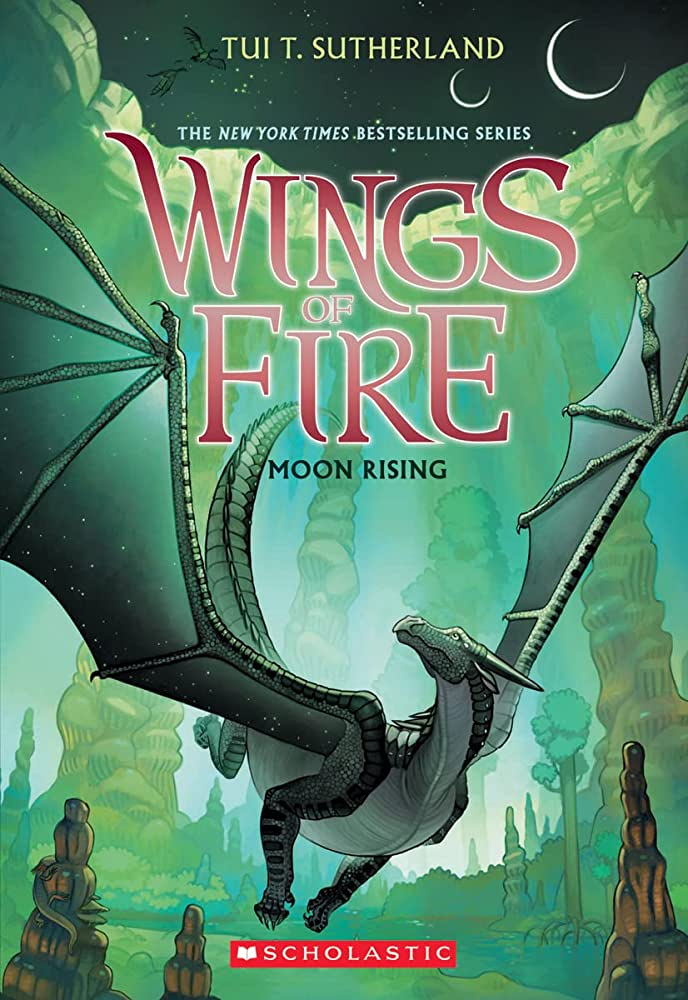
Moonwatcher can read minds and glimpse futures. At the academy, secrets roar louder than classes. An unseen enemy threatens the school and the fragile peace it represents.
Moon learns consent in thought is as vital as consent in action. She chooses honesty and connection over control.
Themes. The burden of knowing too much. Is empathy a gift or a curse? The terrifying line between understanding someone and violating their privacy. Can old enemies ever truly learn to trust each other?
Book Seven. Winter Turning

Winter arrives with orders and old stories about enemies. Friendship challenges his training, then a scandal with scavengers threatens a new war.
He must redefine honor. It is not blind obedience. It is seeing clearly and acting anyway.
Themes. The painful process of realizing your entire worldview is wrong. Unlearning a lifetime of prejudice. Discovering that 'honor' and 'duty' might mean defying your family to do what's right.
Book Eight. Escaping Peril

Peril carries heat that can melt anything. Queen Scarlet treated her like a blade. The dragonets offer another path, but the kingdom still demands fire.
Redemption is not a speech. It is daily work, and it burns.
Themes. Can you be 'good' if you've only ever been used as a weapon? The difference between being forgiven and forgiving yourself. Reclaiming your own identity after escaping a manipulator.
Book Nine. Talons of Power

Turtle is an animus who hides his power because he knows what it does to souls. The hunt for stability forces him to act anyway.
The question shifts. Not can we, but should we. And if yes, then how, and at what cost.
Themes. The terror of holding too much power. If you *can* fix everything, *should* you? The moral weight of 'helping' when it means taking away someone else's choice. The courage of inaction.
Book Ten. Darkness of Dragons

Qibli navigates SandWing politics, a dangerous artifact, and the promise of a shortcut that could break more than it fixes.
The finale rewards thinking as much as fighting. The series doubles down on brains, not brute force.
Themes. The temptation to take a magical shortcut to solve all your problems. Choosing to be clever, empathetic, and *enough*, even when you're offered absolute power. The victory of a sharp mind over a magic spell.
Book Eleven. The Lost Continent

Blue, a SilkWing, lives under Queen Wasp’s hive control. Cricket, a HiveWing, refuses to stop asking why. Together they find cracks in a system that fears questions.
Pantala reframes the series. Freedom is not a Pyrrhia problem. It is universal, and always contested.
Themes. Living in a society of total control. The power of a single 'why?' in a culture of conformity. How small, quiet acts of rebellion can crack an empire's foundation.
Book Twelve. The Hive Queen

Cricket uncovers how control functions in the hive, from story to signal. Answers come with a price, and a larger threat clicks into place.
Knowledge spreads like light, quietly and then all at once.
Themes. When curiosity is a crime. The danger of uncovering a truth that the powerful want to keep buried. Using knowledge not as a weapon, but as a light to expose the rot in the system.
Book Thirteen. The Poison Jungle

The othermind spreads through the jungle, turning dragons into extensions of itself. Sundew wants payback. The mission demands more than anger.
Alliances form across old battle lines. Ecology becomes destiny, then choice breaks destiny apart.
Themes. The all-consuming fire of vengeance. What good is saving your people if you become a monster to do it? Learning to channel righteous anger into focused, healing action. The line between justice and pure revenge.
Book Fourteen. The Dangerous Gift

An illness in the IceWing kingdom and rising pressure from Pantala force Snowfall to lead, not hide. History will not stay buried, and borders are only lines until someone crosses them.
She learns that security without compassion is a fortress that collapses from the inside.
Themes. The crushing anxiety of leadership. How paranoia and isolation can destroy a ruler. The moment a leader must choose between clinging to old, 'safe' traditions and embracing a dangerous, compassionate new truth.
Book Fifteen. Flames of Hope

A new point of view carries the final push to free Pantala from the othermind. Friendship and sacrifice shape the plan, then the future.
Victory is measured by the worlds you make possible, not the enemies you erase.
Themes. Hope not as a feeling, but as a deliberate, difficult choice. The power of collective action over a single hero's journey. How empathy and understanding can defeat an enemy that feeds on control.
Winglets Quartet 4. Rescue
Rescue follows Fierceteeth on a volcanic mission that doubles as a reckoning with her past. Motive matters as much as outcome.
Fierce Winds tracks Sirocco, a SkyWing, learning to steer power instead of letting power steer him during a storm that tests every instinct.
Journey to the East sends Oyster, a SeaWing, after a missing sister and into contact with beings that push the definition of tribe and kin.
Return to the Ice Kingdom brings Prince Arctic home to face history and family, where apology and accountability share the same language.
Themes. How your past defines your present—and whether you can escape it. The unseen choices and hidden motives that shape the 'big' historical moments. A look at the 'villains' and side characters, asking what choices *they* had.

_poster.jpg)


