
The Bene Gesserit Test That Changed Paul Atreides Forever
The Gom Jabbar is one of the smallest objects in Dune, yet it carries the weight of the entire saga. It is a poisoned needle, a death sentence, a psychological instrument, and the first clear sign that Paul Atreides has been born into a universe where power is measured through pain, breeding, fear, and control.
The Gom Jabbar appears early in Frank Herbert’s original Dune, before the desert of Arrakis swallows House Atreides, before Paul becomes Muad’Dib, before the Fremen jihad begins to gather in the future like a storm he can see but cannot fully escape. The scene is quiet, enclosed, and terrifyingly simple. Reverend Mother Gaius Helen Mohiam orders Paul to place his hand inside a box. She holds a poisoned needle at his neck. If he removes his hand, he dies.
That is the entire setup. A boy, a box, a needle, an old woman, and a mother forced to stand nearby while her son is measured by the Sisterhood that made her.
Yet this scene opens the deepest machinery of Dune. It introduces the Bene Gesserit as the hidden Sisterhood shaping imperial politics. It reveals that Paul is no ordinary ducal heir. It shows that Lady Jessica’s decision to bear a son has disrupted a political and genetic design that has been moving for generations.
Most importantly, it asks the question Herbert places beneath the whole saga: what makes a human being more than a creature reacting to fear?

What Is the Gom Jabbar?
The Gom Jabbar is a poisoned needle used by the Bene Gesserit during a test of human awareness. In Herbert’s glossary, the phrase carries the sense of a “high-handed enemy,” which suits the object perfectly. It is intimate, arrogant, and absolute. A battlefield weapon gives the victim a chance to fight. The Gom Jabbar leaves only one contest: the mind against panic.
The needle itself is tipped with poison. In Paul’s test, it is held against his neck by Reverend Mother Mohiam while his hand is trapped inside the pain box. The box creates the sensation of unbearable injury. The needle supplies the real danger. Paul must understand the difference while his nervous system is screaming at him to pull away.
That distinction is the heart of the test. The pain in the box feels real. The death at his neck is real. If Paul responds only to pain, he dies. If he can observe pain, master fear, and keep the larger situation in view, he survives.
How Paul Atreides Is Tested in the Original Dune
The Gom Jabbar is introduced on Caladan, the ancestral world of House Atreides. Paul has not yet travelled to Arrakis. He is still the son of Duke Leto and Lady Jessica, still living within the formal protections of noble rank, family name, and political privilege. Reverend Mother Mohiam cuts through all of that.
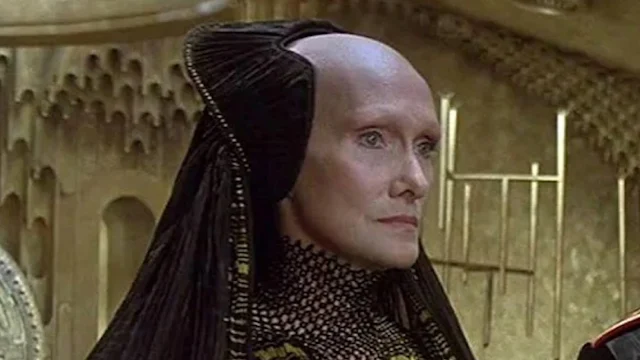
She arrives with the authority of the Bene Gesserit and the Emperor’s court. She is the Emperor’s Truthsayer, trained to detect falsehood through the smallest signs in breath, pulse, tone, posture, and fear. She is also part of the same Sisterhood that trained Jessica. To understand why this order carries so much power without sitting openly on the throne, it helps to first understand who the Bene Gesserit are and how they operate.
Jessica understands the danger immediately. Her fear gives the scene its emotional charge. She is no helpless outsider. She knows the Sisterhood, the test, the discipline, and the needle. She also knows that her love for Duke Leto has placed Paul in this position. The Bene Gesserit ordered Jessica to bear a daughter. She gave Leto a son. That private act of defiance sits at the centre of Lady Jessica’s character arc, because her love becomes one of the great disruptions in the history of the Imperium.
Mohiam commands Paul to place his hand in the box. Then she presses the Gom Jabbar to his neck. Paul feels heat, burning, and the sensation of physical destruction. The test escalates until every instinct tells him to withdraw. He does not. He recites the Litany Against Fear internally and holds himself inside the moment.
He survives because he understands the structure of the trap. Pain is information. Fear is pressure. The needle is the true boundary.

What Is the Test Trying to Ascertain?
The Gom Jabbar test is often described as a test of humanity, but that phrase needs care. The Bene Gesserit are not asking whether Paul is kind, moral, compassionate, or noble. They are asking whether he can govern instinct through conscious control.
To the Sisterhood, an animal reacts. A human observes, delays, interprets, and chooses. That is the brutal logic of the test. If pain alone rules Paul, he pulls his hand from the box and dies. If awareness remains above reflex, he endures.
The test is trying to measure several things at once:
| What the Bene Gesserit test | What it means in Paul’s ordeal | Why it matters later in the saga |
|---|---|---|
| Self-command | Paul must master the impulse to remove his hand from the box. | His later survival on Arrakis depends on disciplined reaction under pressure. |
| Awareness under pain | He must separate the felt pain in the box from the real threat at his neck. | Prescience later forces Paul to separate possible futures from immediate desire. |
| Delayed reaction | He must refuse the fastest bodily response. | His political life becomes a long series of delayed reactions to catastrophe. |
| Fear discipline | He uses Bene Gesserit mental conditioning to stay present. | The Litany Against Fear becomes a key to understanding Paul’s training. |
| Dangerous potential | Mohiam is testing whether Paul is more than the Sisterhood expected. | Paul’s existence confirms the breeding program has produced a result beyond Bene Gesserit control. |
This is why the test is larger than physical toughness. A soldier can be brave. A fanatic can tolerate pain. A proud noble can refuse to scream. The Bene Gesserit are searching for something stranger and colder: command of the entire self when the body has become an enemy.
The Bene Gesserit Context: Breeding, Control, and Fear
The Gom Jabbar belongs to a much larger Bene Gesserit system. The Sisterhood does not operate through open rule. It survives through placement, breeding, religious manipulation, training, and patience. Its women stand beside emperors, dukes, heirs, warlords, and prophets. They rarely appear to rule, which is one reason they endure.
Their long project is the Kwisatz Haderach, a male figure who can survive the psychic and genetic thresholds that Reverend Mothers cannot cross. Paul’s existence sits inside the Bene Gesserit breeding program, a generational design that treats noble bloodlines as material, marriage as strategy, and human love as a risk to be managed.
Paul is the program arriving too soon. Jessica was supposed to produce a daughter by Duke Leto. That daughter would later be joined with the Harkonnen line, creating the intended Kwisatz Haderach under Sisterhood control. Jessica’s choice gives the universe Paul instead. The Sisterhood receives its possible miracle one generation early, shaped by maternal defiance rather than institutional timing.
The Gom Jabbar test is Mohiam’s attempt to measure that mistake.
She is asking: is Paul merely a gifted boy? Is he a genetic accident? Is he a threat? Is he the thing the Bene Gesserit have spent centuries preparing for, but in a form they can no longer command?
The Gom Jabbar and the Kwisatz Haderach
The Gom Jabbar matters because Paul may be the Kwisatz Haderach. The Bene Gesserit want a male Reverend Mother, a mind capable of accessing both female and male ancestral memory, seeing patterns hidden from ordinary humanity, and ideally serving as a tool of Sisterhood design. That concept becomes much clearer when placed beside the broader question of what the Kwisatz Haderach actually is.
Paul’s survival of the Gom Jabbar does not prove that he is the Kwisatz Haderach by itself. It proves that he has the kind of interior command the Sisterhood associates with rare human potential.
That is enough to frighten Mohiam.
A normal candidate can fail and be discarded. Paul passes, and his passing creates a worse problem. The Sisterhood has gained evidence that Jessica’s forbidden son may be the thing they sought. He is also beyond the timetable, outside their intended marriage design, trained in ways he should not have been trained, and soon to be exposed to the spice saturation of Arrakis.
The test finds what it is designed to find. That is the horror.
The Litany Against Fear: Why Paul Survives the Box
The Litany Against Fear is often remembered as the great mantra of Dune. Inside the Gom Jabbar scene, it has a precise function. Paul uses it as a mental framework. The point is not denial of fear. The point is observation of fear.
That is pure Bene Gesserit psychology. Fear is treated as a bodily event, something that rises, passes, distorts perception, and can be survived if the mind refuses to become it. Paul’s hand feels destroyed. His life is threatened. His mother cannot intervene. His title has no force in this room. The litany gives him a way to remain present while pain tries to become the whole universe.
This is the first major sign that Paul’s training has reached deeper than noble education. He has been given weapons no one can see: breath control, sensory command, fear discipline, observation, and the capacity to turn inward without collapsing. Those same gifts later become part of the terrible bind of prescience and the loss of genuine choice, where Paul’s ability to see through the present becomes the reason he cannot easily escape the future.
The Missionaria Protectiva and the Same Bene Gesserit Logic
The Gom Jabbar is a personal test. The Missionaria Protectiva is that same Bene Gesserit logic applied to whole cultures.
Through the Missionaria Protectiva, the Sisterhood plants myths, messiah legends, prophecies, phrases, and religious expectations among vulnerable populations. The purpose is practical. If a Bene Gesserit sister becomes stranded or endangered, she may activate those planted beliefs and gain protection. The system is one of Herbert’s sharpest attacks on manufactured religion, and it sits at the centre of the true purpose of the Missionaria Protectiva.
The link to the Gom Jabbar is moral as much as tactical. Both systems test whether the Bene Gesserit can turn pressure into obedience. The needle tests the individual body. The Missionaria tests the social body. In one case, the Sisterhood asks whether Paul can resist animal panic. In the other, it builds myths that entire populations may follow when fear, hope, and oppression align.
On Arrakis, Jessica and Paul survive because the Fremen have already been prepared by Bene Gesserit religious engineering. Paul’s personal discipline and the Fremen myth system converge. The boy who survives the Gom Jabbar later steps into a prophecy the Sisterhood seeded long before he arrived.
That is why the scene on Caladan cannot be treated as a small rite of passage. It is the first visible point in a much wider pattern of Bene Gesserit control.
Other Uses and Later Meaning of the Gom Jabbar
The Gom Jabbar’s defining narrative use is Paul’s test in the first Dune. Herbert does not turn it into a repeated action-device across the saga. Its power comes from concentration. One needle. One test. One boy who should not exist. One Sisterhood discovering that its long design may have outrun its control.
Later Dune material preserves the Gom Jabbar as part of the Bene Gesserit tradition of testing dangerous human potential. The exact scene with Paul remains the essential reference point because it gives the object its symbolic charge. Whenever the Gom Jabbar is invoked, it carries the memory of that first question: can consciousness govern fear when death is touching the skin?
The later Bene Gesserit continue to face the consequences of that question. They survive Paul. They survive Leto II. They survive the scattering of humanity into futures they cannot fully read. Their institutional strength is not that they control every outcome. It is that they keep adapting after their own schemes produce disasters, a pattern that helps explain how the Bene Gesserit ultimately achieved their goal across the long arc of the saga.

The Gom Jabbar as the First Trap in Paul’s Life
The Gom Jabbar foreshadows Paul’s entire arc. In the test chamber, he must keep his hand in the box while pain demands escape. On Arrakis, he must keep moving through a future filled with blood, prophecy, imperial collapse, and religious violence. The scale changes. The structure remains.
The test teaches a basic rule of Dune: the immediate path away from pain may lead straight into death. Paul learns this lesson early. Later, prescience makes the same lesson cosmic. He sees futures and tries to choose among disasters. His victory over House Harkonnen and Emperor Shaddam IV becomes the beginning of a religious war. His control over fear becomes part of the reason others fear him.
This is where the Gom Jabbar connects to the larger question of fate. The saga keeps asking whether Paul is choosing freely or simply selecting among terrible paths already made visible to him. That tension runs through Dune’s treatment of fate and free will, and it reaches a colder political answer in Leto II’s Golden Path, where survival becomes anti-messianic strategy rather than heroic deliverance.
The hand in the box is the first version of Paul inside history. Pain is everywhere. Escape is deadly. Awareness is survival, and survival brings consequences.
From Paul’s Test to Leto II’s Golden Path
The Gom Jabbar test is personal. The Golden Path is historical. Yet the two ideas speak to each other. Paul is tested by pain and fear in one room. Leto II later subjects humanity to millennia of enforced pressure in order to break its dependence on prophets, tyrants, and predictable futures.
That does not make Leto’s rule a simple extension of Bene Gesserit thinking. It becomes something harsher and more cosmic. Still, the same question echoes beneath it: what must humanity endure in order to survive? The answer becomes deeply uncomfortable when read through the Golden Path as anti-messianic politics, because Leto’s solution is to become the monster that prevents humanity from ever again surrendering completely to one saviour.
Seen from that angle, Paul’s Gom Jabbar test becomes the smallest version of the saga’s largest ordeal. The Bene Gesserit test one boy to determine whether he can master fear. Leto II tests the species to determine whether it can survive its own hunger for certainty.
Why the Gom Jabbar Scene Still Defines Dune
The Gom Jabbar scene endures because it introduces Dune without needing to explain the whole universe at once. A reader understands the danger immediately. A child is being tested. A needle can kill him. A box is causing agony. His mother is terrified. The woman administering the test believes she has the right to decide whether he deserves to live.
Underneath that simplicity is the architecture of Herbert’s saga.
The Bene Gesserit believe in control. Jessica proves the limits of control. Paul proves the danger of success. The Kwisatz Haderach project reaches toward human evolution and produces political catastrophe. The Missionaria Protectiva turns survival myths into the fuel of messianic empire. The Litany Against Fear gives Paul command over himself, yet no command over the human hunger for saviours.
The Gom Jabbar is therefore more than a needle. It is Bene Gesserit philosophy made physical. It is the Sisterhood’s cruelty, intelligence, fear, discipline, and arrogance sharpened to a point. It is the first time Paul Atreides is forced to confront the machinery that shaped him before birth. It is also the first sign that the machinery may have produced something it cannot command.
The test begins with a hand in a box. It ends with the universe discovering that Paul Atreides can endure pain, master fear, and survive the judgment of the Sisterhood.
That should comfort no one.

_poster.jpg)


